“What is her score goal on the ACT?”
“A 34 or above.”
“Ok, that’s not impossible, but it’s highly improbable.”
“She’ll do it. She’s a very hard worker.”
Like so many conversations with parents, this one started with exceptionally high expectations that their child would be able to move from a starting score of a 20 on the ACT (roughly the national average) to a top 1% score of a 34.
I then did what I always do: I explained that the SAT® and ACT are very hard tests, that there is a ton of content to cover and skills to learn and refine, that if everyone could increase so significantly then everyone would (and the tests would just be made even harder), and that few are willing to go through the pain and suffering (I used those words) to achieve such a dramatic increase.
They assured me that their daughter was different: she would prevail. I assured them that this is what all parents say. But the proof is in the pudding: it’s when a student gets the same score (or lower) on a given exam that we see if they will persevere. While my students increase in score on a large majority of their tries on the SAT or ACT, it’s impossible to keep taking the SAT and ACT and always go up — there is too much variability in the content, a student’s performance, and the curves on the exams for that to always happen.
They assured me she would be the exception.
It turns out, she was.
Exceptional
Ashley is a hard worker, and she’s smart. But so are many students. So how did Ashley accomplish what no one else in my 15 years of tutoring has accomplished? She had more grit than I have ever seen in another student.
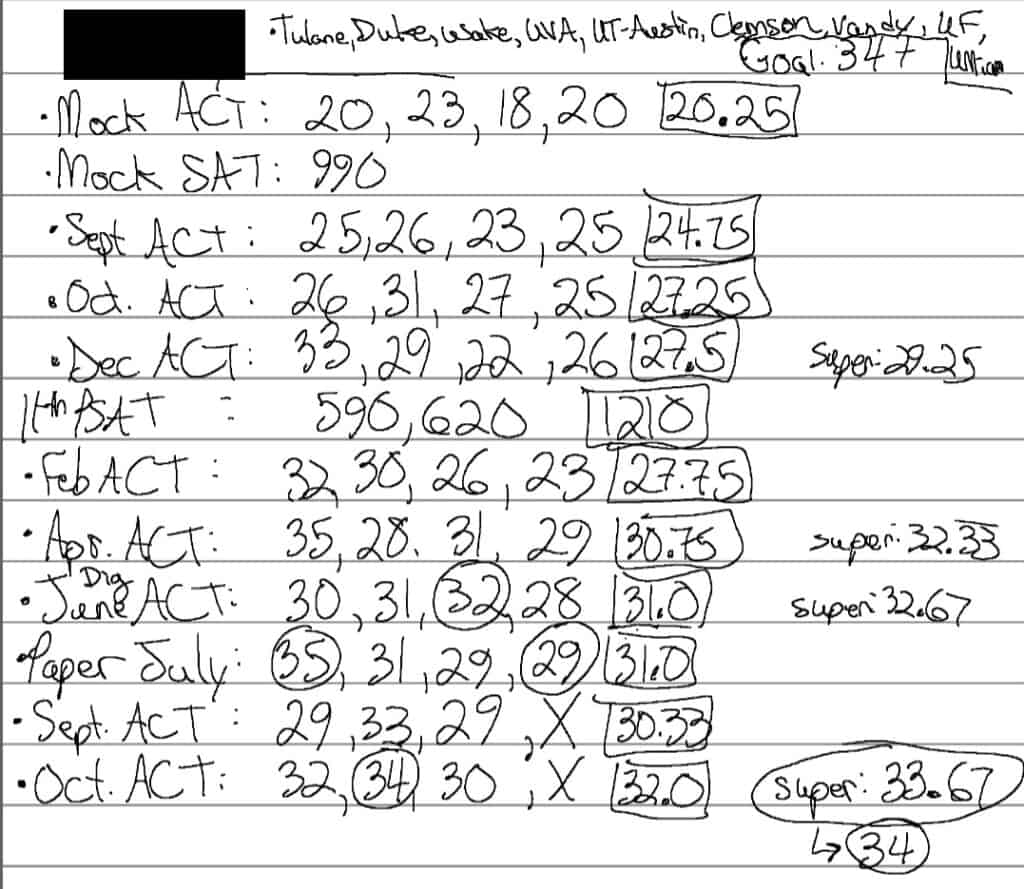
She took the ACT eight times. She didn’t always go up, but she always kept going. She started with a 20 on her first mock test (an official past exam) and officially sat for the test four months after she started tutoring with us.
Here were her composite scores:
- June 2024: 20 (an official past ACT taken in a test setting)
- September 2024: 25
- October 2024: 27
- December 2024: 28
- February 2025: 28
- April 2025: 31
- June 2025: 31
- September 2025: 30 (anyone else would have quit here, if not before)
- October 2025: 32 (and a 34 superscore)
The composite scores don’t tell the whole story: her scores in at least one section had improved on almost every test date (which kept improving her superscore).
In the end, her highest section scores were a 35 on English, 34 on Math, and 32 on Reading (she opted not to continue with the Science section once that became optional to take and report). She had reached her score goal of a 34 superscore on the ACT.
Maintain Motivation
Another defining feature of Ashley’s tutoring is that she took our standard but often ignored advice: don’t take breaks. The SAT and ACT are like everything else in life: use it or lose it. You don’t stay stagnant on the tests when you stop practicing them. You decline. The tests evaluate too many topics to maintain the requisite knowledge and skill on them all without continued review and practice. And yet, families will often take 2-3 weeks off to wait for scores before resuming prep. When there are roughly 8 weeks between exams, these breaks reduce total tutoring by at least 25% and cause students to regress and lose momentum. Success tends to motivate and beget more success. Stagnation or decline increases the chances that students will give up. Although Ashley’s composite scores did not go up on every test, her superscore increased on almost every test, which was key for fueling her continued motivation).
Unless a student is scoring above their score goal on practice tests leading up to a test date, then they should continue with uninterrupted prep and keep building on their earlier knowledge gains and score gains. If a student is below their score goal on practice tests, then should definitely not take a break to wait on scores (and we even have a money-back guarantee about continuing prep in these instances, so families can continue prep after a test and if we’re all pleasantly surprised by the score and they hit their score goal earlier than expected, then we will refund the cost of any tutoring sessions between the test and when they received that score back).
Worth It
We are still waiting on Ashley’s college application outcomes, but, as her parents have said, it was already worth it (Update: she was admitted to and decided to attend Tulane’s honors program — Ashley talks about her experience with Summit Prep® in a video below). Unlike most tutoring companies, Summit Prep has the breadth and depth of curriculum, provides the consistent motivation, and believes in its students enough to help them improve so dramatically. Ashley learned a massive amount (she had to in order to improve so much), and she’s a better student for it. But that is not the most impactful outcome. What she learned about herself has been profound.
People are often quick to say what they could achieve. But we don’t award medals for who has the greatest potential to win a championship. Ashley doesn’t have to allege that she could have scored a 34 if she had really tried. She did it. She knows that if she is hiking up a mountain in life and she has fallen down a few times and her progress is much slower than when she started, she will endure and reach the summit. The proof that you have undertaken hard things and prevailed makes you much more likely to try hard things and to prevail. It is the fuel to try, to fail, to keep going, and to ultimately succeed.