
Take a breath. Lean left, tuck in, and grab the slick hold with your right. Slide your left hand into a squeeze, step up, chest to the wall—jump!
My fingers slipped from the top edge, and the world tipped sideways. The rope whipped behind my heel, spun me like a weather vane, and for a split-second, I ran the numbers in my head: mass × acceleration × rotational radius… brace for impact. When the motion stopped, I was dangling, mostly unscathed — just a few scrapes, a bit of adrenaline, and a new appreciation of gravity and the tools + math that had protected me.

From Classroom Vectors to Vertical Reality
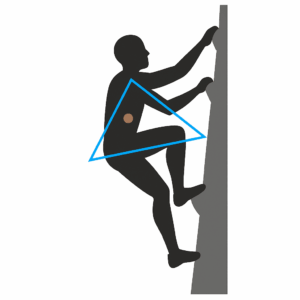
At Summit Prep®, we remind students that math isn’t about abstract computation; it allows students to see how the world actually works and to use that knowledge to better operate in it. Rock climbing proves it with every move. Low-friction foothold? Increase the normal force by pressing straight in. Off-balance stance? Keep your center of gravity inside the “triangle” formed by hands and feet. Side-pull above your hip? Make sure it’s inside the line of your outer foot or you’ll barn-door off the wall.
Those are vector diagrams come to life. The arrows you’ve sketched in precalculus translate into real forces you can feel through chalk-dusted fingertips and rubber climbing shoes. When students realize that, math class stops being a hoop to jump through and starts looking like a toolbox they can carry anywhere.
Turning Theory into Instinct
Because I studied physics, I approached climbing as a live-action lab. I devoured technique videos, plotted forces in my notebook, then tested them after work at the crag. Over time, the numbers blurred into intuition: a one-inch hip shift, a tiny change in pull angle, and suddenly I floated instead of flailing. That moment — the instant knowledge becomes instinct — is the same spark we aim for in every Summit Prep session. It’s why we don’t just teach formulas; we practice transferring them to unfamiliar problems until they click.

The Cycle That Drives Progress
That slip near the top was a calculated risk: solid gear, trustworthy rock, clear fall zone. The rope snagged my heel, spun me, and delivered a master class in rope management. On the next attempt, I watched my heel, cleared the rope, and cruised to the anchors. Analyze, adapt, flow 00 then repeat. Climbing, like learning, is a cycle of setting challenges, extracting lessons, and leveling up.
Why This Matters for Students
Students often ask, “When am I ever going to use vectors?” Maybe tomorrow — on a climbing wall, in a robotics lab, on a skateboard ramp, or designing the next sustainable building. Math gives you a fluent language for problem-solving in three dimensions, and once you speak that language, you see hidden handles everywhere. Education doesn’t just prepare you for tests; it equips you to grab opportunities, steady yourself when plans swing off axis, and push higher than you thought possible.
So the next time you’re staring at a page of arrows and Greek letters, imagine them painted on a cliff face. They’re showing you the safest line, the most efficient motion, the path to the top. Trust the math, trust the process, and keep climbing — both on the wall and in whatever challenges life sets in front of you.