
Last year, we looked at the inflation in AP exam scores (some of the exams were recalibrated to make it easier to get higher scores).
This year, our AP exam blog post is focused on the expansion of AP exams:
- An increase in the number of students taking AP exams
- An increase in the number of AP exams that each student is taking
- An increase in the types of AP exams offered
- And, consequently, an increase in the number of exams taken each year
More Students Taking AP Exams
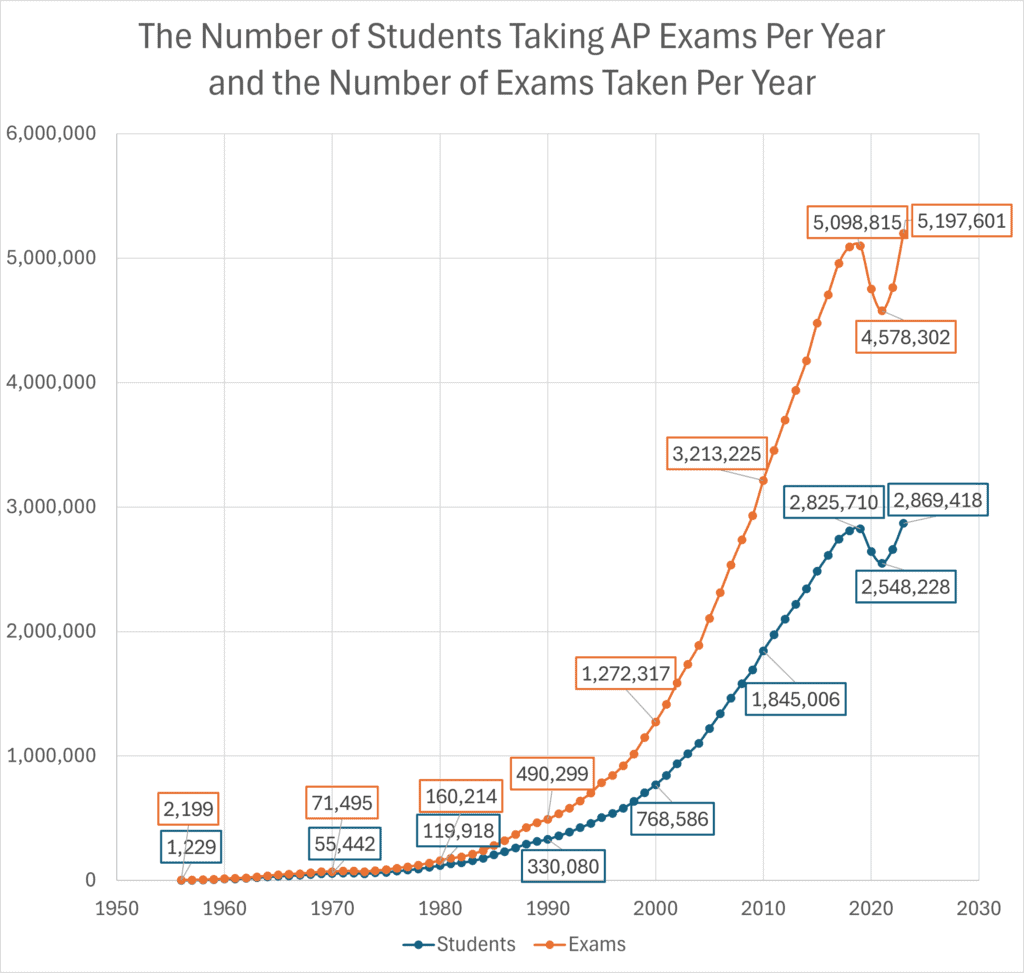
Almost 3,000,000 students took AP exams in 2023 — roughly threefold the number who took AP exams just 20 years ago.
More AP Exams Per Student
Each AP exam student is, on average, taking more AP exams as well.
In 1994, only 35% of students who took an AP exam took two or more AP exams that year; by 2024, nearly half (47%) did so.
Similarly, over that same time period, the percentage rose for those taking three or more AP exams, from 12% to 23% — nearly doubling.
But the largest growth has happened at the top, where there has been explosive growth in the number of students taking many AP exams.
| Exams taken | 1994 | 2004 | 2014 | 2024 | Growth since 1994 |
|---|---|---|---|---|---|
| 1 exam | 259,011 | 530,411 | 979,928 | 1,159,694 | 4.5x |
| 2 exams | 101,040 | 245,248 | 492,118 | 621,130 | 6.1x |
| 3 exams | 48,233 | 134,252 | 305,908 | 398,964 | 8.3x |
| 4 exams | 24,670 | 77,946 | 199,354 | 274,613 | 11.1x |
| 5 exams | 13,008 | 47,039 | 129,308 | 193,630 | 14.9x |
| 6 exams | 6,821 | 28,106 | 85,372 | 136,527 | 20.0x |
| 7 exams | 3,294 | 17,340 | 56,174 | 96,805 | 29.4x |
| 8 exams | 1,578 | 9,903 | 37,636 | 67,708 | 42.9x |
| 9 exams | 755 | 5,590 | 23,613 | 46,316 | 61.3x |
| 10 or more exams | 535 | 5,967 | 33,117 | 83,747 | 156.5x |
In the last three decades, while the number of students taking a single exam has grown 4.5x, the group of high-achieving students taking 10 or more exams has increased by a staggering 156.5x.
Outliers
And those taking the most AP exams increased even more.
Between 1990 and 1993, there were only 3 students who had taken more than 14 AP exams in high school. In 2024, there were 6,234 that did so — a 207,700% increase.
In 1993, amazingly, there was one student in the country who took more than 10 AP exams in one year — a feat that should be a World Record. Yet, in 2024, there were 71 students who took more than 10 AP exams in one year — far from a trend, but the trend of all students goes in the same direction: more AP exams.
New AP Exams
Part of the increase is due to the creation of additional AP exams for students to take.
In 1956, there were only 11 AP exams.
By 2004, there were 34.
In May 2026, there were 40.
Just recently, AP Precalculus was added, with its first exam in 2024. AP African American Studies officially launched in the 2024-25 school year, after two pilot years.
In 2027, there will be two new AP exams:
- AP Business with Personal Finance
- AP Cybersecurity
Expect the list to keep growing.
Why?
The “AP” in AP exams stands for “Advanced Placement.”
Previously, these exams were used only for placement: a student would demonstrate college-level proficiency in a course so they could test out of that same course in college. Accordingly, these exams never needed much precision — the scoring is only on a 1 to 5 scale.
| AP Score | Official Meaning | Recommendation for College Credit |
| 5 | Extremely Well Qualified | Highly recommended for college credit and/or placement. |
| 4 | Very Well Qualified | Recommended for college credit and/or placement. |
| 3 | Qualified | Considered qualified for college credit and/or placement. |
| 2 | Possibly Qualified | No specific recommendation for college credit. |
| 1 | No Recommendation | No recommendation for college credit. |
Now, however, AP exams are filling a gap for which they were never intended: authenticating proficiency.
Previously, grades were quite good indicators of a student’s proficiency in a given subject: in 1966, only about 22% of students who went on to 4-year universities had A-averages in high school. Due to massive grade inflation, grades no longer signal the same level of mastery: in 2024, 84% of students who went on to 4-year universities had A-averages in high school. An A-average went from relatively rare to the norm.
As a recent University of California, San Diego report showed, even students with unweighted 4.0 GPAs throughout their high school math classes are sometimes not proficient in high school, middle school, or even elementary school math. Even perfect grades were sometimes insufficient to indicate any mastery of a subject.
That is why colleges, especially the top colleges, are looking to AP exams as the real grades in classes — and they would love to have AP exam scores for every core high school class so they know if the student with an “A” has a 5 on the AP exam in that subject or a 1. Caltech and Stanford became the first colleges ever to require that a student submit their AP exam scores. While not required by most colleges, the top colleges expect that every AP class on a transcript will have a corresponding AP exam score reported on the application. Thus, it’s not enough to just demonstrate “rigor” to the top colleges by taking AP classes; they want to see that you mastered the content through your AP exam scores.
And if an exam goes badly? See what you can and can’t do about a low AP score.
If you’d like to take a mock AP exam, reach out to us anytime. We’re happy to help, and we tutor for most of the exams.