If every SAT test center within a reasonable drive is full, you have three real options: widen the ordinary search until a seat turns up somewhere you can actually get to, join the College Board’s waitlist and hope a seat opens closer to home, or move to a later test date. Which one is right depends on a question that comes before everything else: are you already registered for that date somewhere far away? If so, read the next section before you touch anything, because you can’t hold a confirmed seat and sit on the waitlist for the same test date.
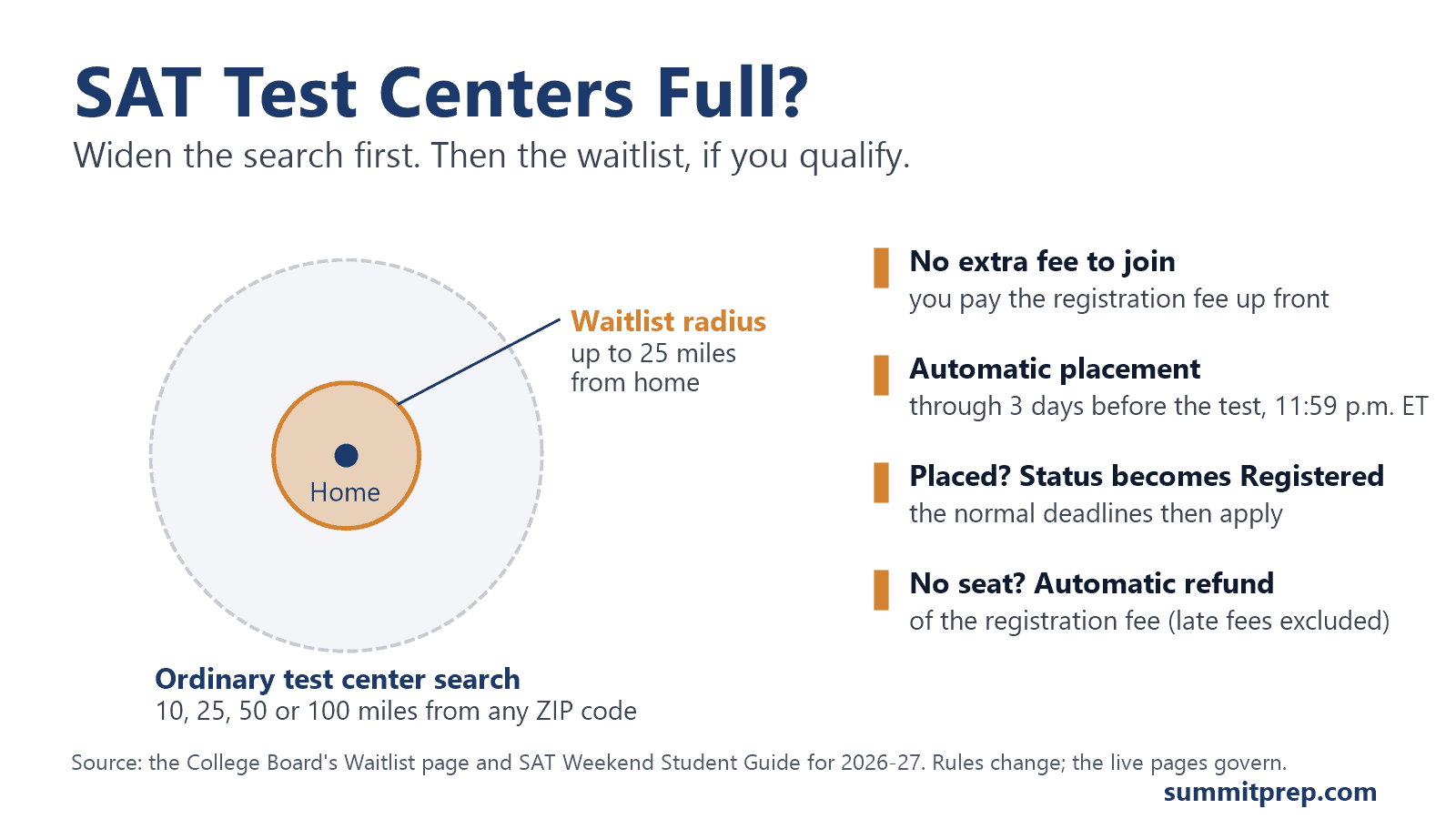
The waitlist itself is simple, and the College Board runs it automatically. You register and pay as usual, choose how far from home you’re willing to go (up to 25 miles), and if a seat opens inside that radius before the cutoff (11:59 p.m. ET, three days before the test), you’re placed in it and your status changes to Registered. It costs nothing extra to join, and if no seat opens, the registration fee comes back on its own. But, it doesn’t guarantee a seat, it can’t target your own high school, and it has a few rules that surprise families.
Already registered for that date at a far-away center?
This decision comes first because it’s the hardest one to undo. The College Board’s waitlist page is explicit: a student who already has a registration for a test date can’t join the waitlist for that same date. (A registration for a different date is fine.) So, a student with a confirmed seat 80 miles away can’t keep it as insurance while waiting for something closer. If you want something closer, there are only two moves.
The first is an ordinary center change. In your College Board account you can switch to any center that shows open seats, up to the change deadline for that test date (the same day as the late registration deadline), for a $34 fee through June 2027 (fee waivers don’t cover change fees). Check regularly, because a seat that opens at a closer center can be taken this way without ever touching the waitlist.
The second is to cancel the confirmed seat and join the waitlist. That trades a sure seat for a maybe. The cancellation fee is $34 up to the change deadline (the registration fee itself comes back), the old seat is not held for you, and nothing on the waitlist page promises that a seat will open within 25 miles of your house. Joining the waitlist also means registering again, and the College Board publishes no separate last day to join, so count on this move only while registration for that date is still open. If no seat opens, you test on a later date, if there is one that still works for your colleges.
Our advice: if the date matters (a college deadline, a score you need before applications go out) and the trip is workable (the travel checklist below helps you decide), keep the seat, because a long drive is a cost you can plan for and the waitlist isn’t. If the trip is not workable, the real question is whether a later date works, not whether the waitlist might. One more thing: once the change deadline is behind you, a center change is off the table too, so plan on a cancellation then ($44) costing you the date, not just the fee.
What to do when nearby SAT test centers are full
Before the waitlist, make sure the problem is really a shortage of seats. The College Board’s public test center search takes a ZIP code and a test date and lets you look 10, 25, 50 or 100 miles out. Four things to know:
- A missing school is not a full school. Many centers don’t offer the SAT on every date (the College Board says so right under the search box), so try the dates on either side before you conclude there’s nothing.
- The search shows places, not seats. You see actual availability during registration, and a seat is yours only when the registration is complete. A center that shows up in the public search can already be full by the time you reach that step of registration.
- The ZIP code can be anyone’s. Searching from a grandparent’s town to find a seat you can get to is fine. Your home address on the account is a different matter: the waitlist measures its radius from it, the College Board’s testing rules require accurate information, and a hotel is not where you live.
- The student registers. The College Board asks students to register for themselves rather than have a parent or counselor do it, so a parent can sit beside the student, but the student should do the clicking.
Then check back. The College Board’s own announcement when fall 2026 registration opened said it would watch registration in real time and add seats as needed, and it told students who don’t see a convenient option to check back later or join the waitlist. It gave no schedule, and neither can anyone else. Rumors about seats appearing at a certain hour on a certain day are rumors, so check at a rhythm you can keep up. And if your own high school is a test center, ask your counselor whether it reserves weekend seats for its own students, which the College Board allows participating schools to do.
If something else is wrong (an error message, a deadline that has passed, an accommodation that doesn’t match the center), contact College Board support with the exact message, because no amount of searching fixes an account problem.
Is a distant test center worth the trip?
A 25-mile radius is not a 25-minute drive, and a seat 60 miles away can be the right answer or a terrible one depending on the morning. For each seat you could actually take, write down:
- The arrival time. For standard digital testing, the exact time comes on the admission ticket a few days before the test, and it overrides the sample schedule on the College Board’s site. Until then, plan around the sample schedule (doors close at 8:00 a.m. unless the ticket says otherwise): work out the door-to-door time at that hour on a Saturday, with a buffer, and 30 minutes more if you’re borrowing a College Board device. Arrive late and you’re absent, and an absent student registers again and pays the standard fees.
- Sleep. A 5:00 a.m. departure costs the hours that matter most on test day, so a drive that long usually means a hotel the night before. Decide whether that is realistic, and who drives.
- Money. Gas, tolls, parking, the hotel, and the hotel’s cancellation terms. Book nothing until the registration actually shows that center, and keep the booking refundable even then, because a center can still close, and if yours does, the College Board may arrange a makeup, but nothing we read says it covers travel.
- Fit. Whether the seat works with what you need: a device that meets the requirements, or approved accommodations (both below).
If a seat passes these checks, register for it now. You can still switch to a closer center for the $34 change fee if one opens up by the change deadline, which is the only way to hold a seat for that date and keep looking for a closer one.
How the SAT waitlist works
Everything in this section comes from the College Board’s waitlist page and its SAT Weekend Student Guide for the 2026-27 testing year.
- Who can use it. Students who live in the United States or an eligible U.S. territory. It is not available in the U.S. Virgin Islands, the Northern Mariana Islands or the U.S. minor outlying islands, and the College Board has published no timeline for students outside the U.S. (Late registration itself is available worldwide. The waitlist is not.)
- Where it appears. During registration, on the test-center search screen, when no center inside your starting radius has seats, or after you redo the search.
- What it costs. You preregister and pay the normal registration fee (and any late fee) up front. There is no extra fee to join.
- The radius. Measured from your home address, and you choose it, up to a maximum of 25 miles.
- Placement. Automatic. If a seat opens at a center inside your radius, you’re assigned to it. There is no email you must answer and no window in which to accept. Your status changes from Waitlist to Registered, and from then on the rules of a completed registration apply.
- The cutoff. Placement can happen right up to three days before test day at 11:59 p.m. ET. If you’re still unplaced then, the registration fee is refunded automatically (the College Board says that refund can take five to seven business days).
So what are your odds? Nobody outside the College Board knows. It doesn’t publish how it chooses among waiting students, how many students are waiting or how often seats open, so anyone who quotes you odds is guessing.
SAT waitlist rules to know before you join
- Centers with open seats are excluded. The College Board puts any center that currently has availability inside your chosen radius on an exclusion list, so that if you join the waitlist anyway, those centers are excluded from registration. In plain terms, if a center inside your radius has a seat when you opt in and that center would work for you, register there instead, because opting for the waitlist excludes it. The page doesn’t explain whether that exclusion ever changes, so don’t join expecting to fall back on a center you passed over.
- More than 25 available centers means no waitlist. If that many centers inside your radius have seats, the College Board won’t let you join and tells you to shrink the radius or pick one of them. (The number is centers, not seats, and it has nothing to do with the 25-mile cap.)
- You can’t pick your school. Placement goes to any center inside the radius. If you’ll only test at one particular school, the waitlist can’t promise it, so register at that school on a date when it has seats, or, if it’s your own high school, ask your counselor about the reserved seats mentioned above.
- A placement comes with the deadlines of a regular registration. A seat assigned on the last possible day still needs the photo you uploaded at registration (and, for standard digital testing on your own device, exam setup and an admission ticket, below), and it doesn’t give back any deadline that already passed.
SAT waitlist deadlines: three that are not the same thing
These three dates are easy to collapse into one. Keep them apart:
- The registration deadlines. Every SAT Weekend date (the College Board’s name for the public weekend SAT, as opposed to SAT School Day) has a regular registration deadline and a later deadline for late registration, center changes and regular cancellation, all at 11:59 p.m. ET, on the College Board’s dates and deadlines page.
- The waitlist cutoff. Placement, and cancelling an unplaced waitlist registration, run through three days before test day at 11:59 p.m. ET.
- Cancellation after placement. A placed student can cancel through two days before test day, which for a Saturday test is the Thursday, the same last day to cancel that every registered student has.
For instance, here is how those land for the Saturday, November 7, 2026 test:
| Checkpoint | Nov 7, 2026 test | Basis |
|---|---|---|
| Regular registration deadline | Oct 23 | Dates page |
| Late registration, center change, $34 cancellation | Oct 27 | Dates page |
| Last waitlist placement, last cancellation while unplaced | Nov 4 | 3 days before |
| Last cancellation after placement | Nov 5 | 2 days before (Thursday) |
| Scores released to students | Nov 20 | Score release page |
And the one deadline the College Board does not publish: a separate last day to first join the waitlist. The three-day cutoff is when placements stop, not an extension of late registration. So, treat the posted registration window as your window to join, and if it has passed, ask the College Board what is still open before you count on that date.
What the SAT waitlist costs, and what comes back
| Fee | Amount | Waiver covers it? |
|---|---|---|
| Registration | $68 | Yes |
| Joining the waitlist | $0 extra | Not needed |
| Late registration | $38 | Yes |
| Test center change | $34 | No |
| Cancellation by the change deadline | $34 | Yes |
| Late cancellation | $44 | Yes |
There are three different money paths:
- Never placed. The registration fee is refunded automatically once the cutoff passes (the College Board says five to seven business days). Late fees are not refunded.
- You cancel while still unplaced. Allowed through the same cutoff. The waitlist page doesn’t say whether the ordinary cancellation fee applies to that cancellation, so assume it might and treat anything better as a bonus.
- Placed, then you cancel. The waitlist page says the registration is refunded and any late fee is not, and it also says a placed registration follows the normal rules, which charge a cancellation fee ($34, or $44 after the change deadline). So, budget for the fee. Ordinary refunds start processing three to five business days after cancellation, to the original form of payment.
How a fee waiver’s benefits are handled for a waitlist registration that never places isn’t spelled out on the College Board pages we read, so if that matters to you, ask the College Board before you join.
Once you’re placed: confirm the seat, then get ready
A placement shows up as a status change to Registered, with a center and a date in your College Board account. Check it, and check the email address and phone number on the account, because the College Board’s notices go there (it also tells students to watch My SAT and Bluebook for changes).
Then get ready for test day, which depends on how you’re testing:
- Standard digital testing on your own device. Install Bluebook (the College Board’s testing app), complete exam setup one to five days before the test (that is what produces the admission ticket), and follow the arrival time and address on the ticket, not the sample schedule.
- A College Board loaned device. Exam setup and the admission ticket happen at the center, and the College Board tells loan-device students to arrive 30 minutes before the standard check-in time.
- Approved paper testing (an accommodation). No admission ticket and no Bluebook. Follow the instructions from your school’s SSD coordinator (SSD is the College Board’s Services for Students with Disabilities office), or from SSD itself if you’re homeschooled or your school can’t give the test.
The night before and the morning of, check the College Board’s test center closings tool (it lists only fully closed centers and updates every three hours) and your messages. If your center closes, the College Board contacts you and may arrange a makeup. Its makeup rules say you test only at the center you’re registered or authorized for, so don’t drive to another school hoping for a seat. For how to perform on the morning itself, read our performance tips for test day.
Devices and accommodations: a late seat doesn’t fix these
Loaned devices. If you need to borrow a device from the College Board, you must register and request it at least 30 days before the test, and a center change within 30 days of the test can mean the device can’t be sent to the new center. Even an approved request is not a guarantee: the 2026-27 lending agreement says the College Board can’t promise a loaned device will be available on test day. The waitlist can place you as late as three days out, and nothing we’ve read explains how a loaned device follows a placement that late. So, if you need a device, don’t lean on the waitlist to solve two problems at once. Borrow one that meets the requirements from school, family or a friend, or choose a later date that still leaves 30 days to register and request one. The device lending page has the requirements.
Accommodations. The College Board’s instructions are to get accommodations approved before you register, and approval can take up to seven weeks, so start early. If the registration deadline arrives before approval, the College Board’s own FAQ says to register as a standard test taker and contact SSD once you’re approved to ask whether the accommodations can be added, and it suggests a later date if you aren’t approved five days out. Changes have to reach SSD no later than five days before the test, nothing can be added or waived on test day, and SSD warns that implementing a request made less than two weeks before a test, or after its published SSD deadline, is extremely unlikely (a request received after the deadline, once approved, applies to future dates).
Students with school-based accommodations (readers, scribes, some paper formats, more than double time, etc) test under a separate arrangement even when they’re at a weekend center, so talk to SSD or your coordinator before assuming an open seat, or a waitlist placement, will work. Whatever you do, don’t give up accommodations you need to get a seat sooner. The details are on the College Board’s registering with accommodations page, and our guide to extended time on the SAT and ACT® covers the request itself.
If no seat opens: the backup plan
If the cutoff passes with no placement, the refund comes on its own, and the plan becomes the next test date. So, don’t wait for the cutoff to line that date up, because its seats can fill too. A registration for a different date doesn’t block the waitlist, so you can register for the next date now and stay on this date’s waitlist, and if a seat comes through, cancelling the backup costs only the ordinary cancellation fee ($34 by that date’s change deadline, $44 after it through the Thursday before, and fee waivers cover it). The backup’s registration fee comes back.
Check that the next date works for the colleges. The College Board publishes the score release date for each test (most weekend scores come out two to four weeks after test day), and standard score sends typically take another five to ten business days from the order. Rush delivery, one to four business days, works only for scores that are already released, so it shortens the trip to the college, not the wait for scores. Colleges differ on what counts: some go by the test date, some by a self-reported score, some by official receipt, and some allow later updates. Read the college’s own admissions page rather than assuming, and plan the whole year with our SAT and ACT testing timeline.
Three things that sound like backup plans but, for most students, aren’t:
- SAT School Day is run by schools and districts. Ask your school whether it offers it and whether you can take it, but it isn’t open to the public as overflow.
- Sunday testing is for students whose religion doesn’t allow testing on Saturday, with a letter from a religious leader. It is not extra capacity, and one administration can’t be taken on both days.
- There is no walk-in SAT and, outside individually approved accommodations, no at-home SAT. The digital SAT is still taken at a school or test center with a proctor, and to be let in you need a registration for that center (plus an admission ticket, for standard digital testing).
SAT waitlist versus ACT standby
If the ACT is your test, the SAT waitlist tells you nothing, because the ACT runs a different system. ACT standby is a paid request made after the late registration deadline. On test day, standby students are admitted only if space, materials and staff allow, in order of arrival, after registered students. The SAT assigns the seat before test day. The ACT decides at the door. Use the ACT’s own standby page for the rules and its test dates page for each date’s standby deadline. For the other ways to find an ACT seat, see our guide to what to do when ACT test centers are fully booked.
| Option | What confirms it | Main limit |
|---|---|---|
| Regular SAT seat | Account shows the center | Open seats only |
| SAT waitlist | Status changes to Registered | No guarantee, 25-mile cap, ends 3 days out |
| ACT standby | Admission at the door | Only if space, materials and staff allow |
The bottom line
The surest way to a seat is still to register the day registration opens, months before the test. If you’re reading this because the centers near you are full: widen the search before you join anything, don’t cancel a confirmed seat for a maybe, keep the three deadlines separate in your head, and have the next date picked out before you need it. And while you wait, keep preparing, because the seat only gets you in the door and the preparation is what actually changes the score. Work hard, and you’ll be ready on whichever date you end up testing.
Questions about which date fits your plan, or what to do with the weeks before it? We’re happy to help. Reach out anytime.
Frequently asked questions
Does the SAT have a waitlist?
Yes, for students who live in the U.S. or an eligible U.S. territory. If no test center near you has seats when you register, the College Board offers a waitlist on the test-center search screen. You pay the registration fee up front, choose a radius from home of up to 25 miles, and if a seat opens inside it you’re placed automatically, through three days before test day. There’s no extra fee, and if no seat opens, the registration fee is refunded.
Can I join the SAT waitlist if I’m already registered for that date?
No. The College Board doesn’t allow a registration and a waitlist entry for the same test date, so you’d have to cancel the seat first (the cancellation fee applies) and join while registration for that date is still open, which trades a sure seat for a maybe. A registration for a different date is fine.
Can I change my SAT test center if a closer seat opens?
Yes, up to the change deadline for that date, which is the same day as the late registration deadline. You switch in your College Board account to any center that shows open seats, for a $34 change fee through June 2027 (fee waivers don’t cover it). After the change deadline, the only ordinary move left is cancelling.
Can I waitlist for my own high school?
No. The waitlist places you at any center inside your radius that gets a seat, and you can’t request a particular school. If it has to be that school, register there on a date when it has seats, and if it’s your own high school, ask your counselor whether it reserves weekend seats for its own students.
How far will the SAT waitlist look for a seat?
Up to 25 miles from your home address, and you choose the radius. That cap applies only to the waitlist. The ordinary test center search goes out to 100 miles, and you can register at any center that has seats, however far away it is.
When is the last day to join the SAT waitlist?
The College Board doesn’t publish a separate one. Placements stop three days before test day at 11:59 p.m. ET, but that is a cutoff for placements, not a late-registration extension, so join during the posted registration window and ask the College Board if that window has passed.
How will I know I got a seat?
Your status in your College Board account changes from Waitlist to Registered, with the center and date. There is no acceptance step, so keep your email and phone number on the account current and check the account.
Is the SAT waitlist free?
Joining is free, but the test isn’t. You pay the registration fee (and any late fee) when you join. If no seat opens, the registration fee is refunded automatically, but late fees are not, and if you’re placed and then cancel, the normal cancellation fee applies.
Can international students use the SAT waitlist?
Only if they live in the U.S. or an eligible U.S. territory, because eligibility goes by where the student lives. For students who live outside the U.S., the waitlist isn’t available as of the 2026-27 testing year, and the College Board has given no timeline for that. Late registration, on the other hand, is available worldwide. Wherever you test, we tutor the SAT online for students anywhere.
Can I just show up at a test center on test day?
No. There is no walk-in or standby SAT. You can test only at the center you’re registered or authorized for, with an admission ticket for standard digital testing, and the waitlist assigns seats before test day, not at the door.
What we checked
The rules, fees and dates above are the College Board’s for the 2026-27 SAT Weekend testing year: its waitlist page, SAT Weekend Student Guide, dates and deadlines, test fees, canceling a registration, refunds, changing your registration, device lending, registering with accommodations, SSD’s after approval page, test center closings, makeup tests, score release dates, sending scores and Sunday testing, plus the ACT’s standby testing page. We also read the College Board’s test center search, registration instructions, testing rules, what to bring and do and what to expect pages, its page on testing with school-based accommodations, the 2026-27 device lending agreement and its May 2026 announcement that fall 2026 registration was open. Policies change, so the live pages govern.