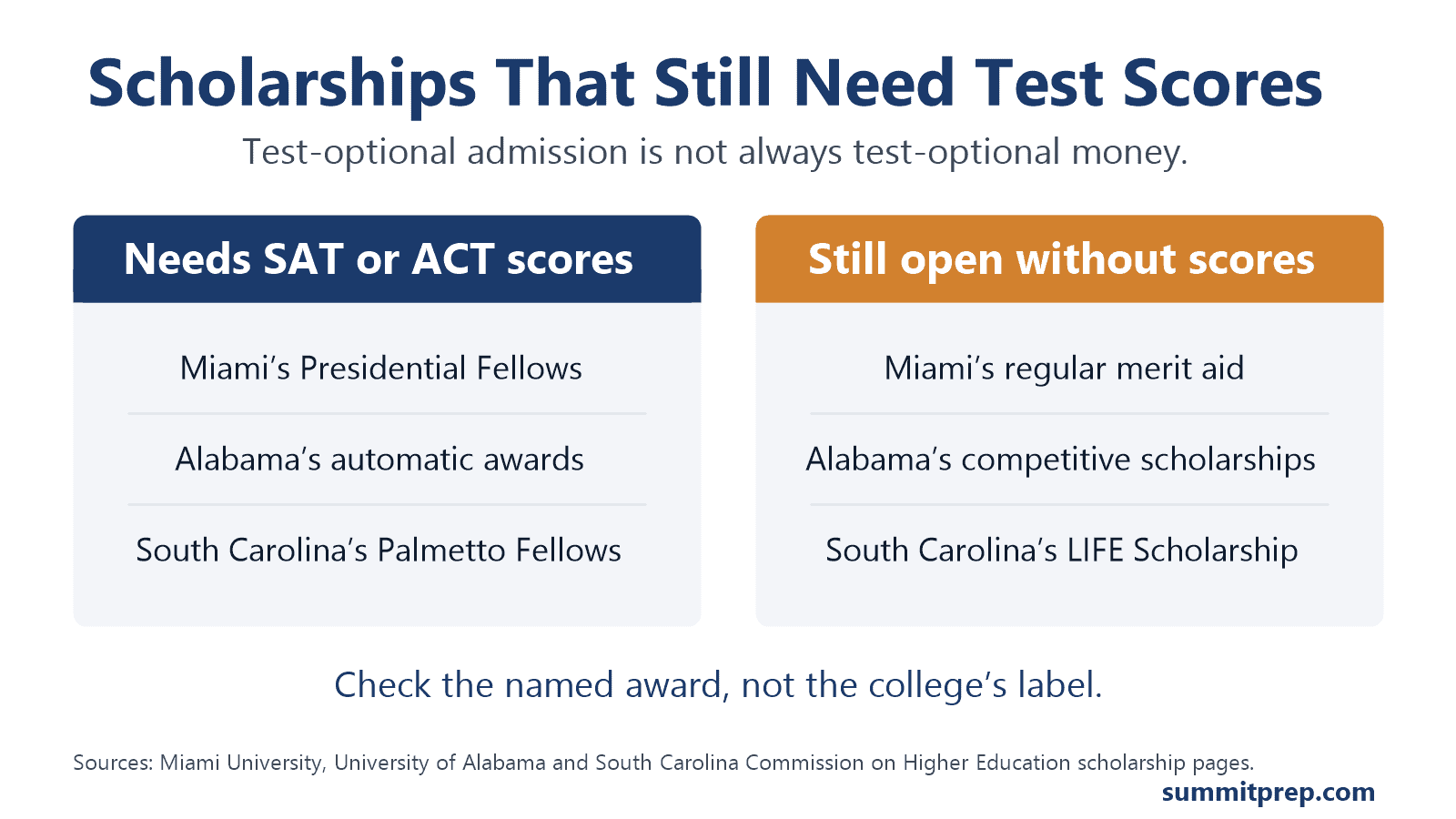
Yes, some test-optional colleges still require SAT or ACT scores for scholarships. At the colleges we checked, the requirement usually covers one named scholarship or a higher tier of an award, not all of a college’s merit aid, because test-optional describes how a college admits students, not necessarily how it hands out scholarship money.
At Miami University in Ohio, the Presidential Fellows scholarship requires SAT or ACT scores starting with students entering in fall 2027, while Miami’s regular merit scholarships stay test-optional. And at West Virginia University, a score doesn’t decide whether a student with strong grades qualifies for a Climb Higher scholarship, just how big it is.
So for every test-optional college on your list, the questions to answer are which award you would lose without scores, what you would still be considered for, and what has to arrive by when. We read each college’s own scholarship and admission pages (checked October 2026) for the rules that apply to students entering college in fall 2027, and the table below shows what we found, college by college.
Which Scholarships Require SAT or ACT Scores? College by College
Each row names the scholarship or tier at that college that needs an SAT or ACT score, and what’s still open without one. Tap See more on any row for thresholds, amounts, deadlines and the college’s own pages. When a row says no award in our check needs scores, that doesn’t mean scores never matter there (a college can still use a score it receives), so always check the specific award you want.
For automatic merit scholarships by GPA and test score in general, see our merit aid guide. This table answers only the test-optional question.
Search by college name or filter by label. On a computer, click College or Needs scores to sort (Needs scores groups the rows by label).
| Without scores | ||
|---|---|---|
| Baylor University | No requirement found None in the awards we checked | General merit and Getterman, with or without scores For students entering Baylor in fall 2027 (the 2026-27 application cycle) from graded high schools. Baylor considers every applicant for its admission merit scholarships whatever the testing plan; scores count only if the student chooses to send them, and no merit minimum is published. Merit is considered with the admission round (early action or early decision by November 1, 2026; regular decision by February 1, 2027), and offers are final at admission. A student can change the testing plan once before the decision; scores sent by May 1 for Baylor’s research do not raise aid. For regular decision, the last accepted tests are the December 5, 2026 SAT and December 12, 2026 ACT. The Getterman Scholars Program covers tuition (after any admission merit award), books, course fees and Honors housing and food for eight semesters, and it is open to test-optional applicants with a high GPA or class rank; the typical 1500 SAT, 34 ACT or 103 CLT is not a minimum. Getterman needs a complete admission application by November 1, 2026, the Honors and Scholarship Events applications (with a video) by November 12, 2026 at 11:59 p.m. Central, and attendance at the January 22 to 23, 2027 events. Baylor superscores the SAT and ACT. Homeschooled, narrative-grade and early-graduation applicants have their own test rules. Checked October 2026. Sources: Test-optional process Scholarship events |
| Brigham Young University | Named award Presidential and Heritage Scholarships | University Scholarships, considered without scores For first-year students entering BYU in Provo in fall 2027 under its test-optional admission rules (a student without enough accredited coursework can be required to send scores for admission). Presidential (the Dallin H. Oaks Scholarship, 150% of Latter-day Saint tuition for eight semesters, 50 new freshmen a year, with an essay) and Heritage (full Latter-day Saint tuition for eight semesters) both require an ACT or SAT score, with no published minimum. University Scholarships (half or full Latter-day Saint tuition) consider students without scores, and a score that’s sent counts only if it helps. The scholarship application and official scores are due January 2, 2027, and the admission application by December 15, 2026 (November 2, 2026 is the priority date). BYU uses scores from one test (no superscoring), and changing a submitted admission application means withdrawing and resubmitting it. Tuition differs for students who aren’t Latter-day Saints, so the dollar value varies. Checked October 2026. Sources: Freshman scholarships ACT and SAT scores Applying for scholarships Deadlines |
| Eastern Michigan University | Higher tier Higher Emerald tiers (ACT 25+ or SAT 1200+) | Emerald at 3.75+ GPA; Presidential at 3.85+ GPA For traditional first-year students entering in fall 2027 (Eastern Michigan lists separate scholarships for international students). Emerald is automatic once a student is admitted, and at a 3.75+ GPA the score sets the amount: an ACT 28+ or SAT 1300+ pays $8,000 in tuition plus $4,000 in housing a year; an ACT 25+ or SAT 1200+ pays $7,000 plus $3,000; no score pays $6,000 plus $3,000. Lower Emerald tiers need no score from a 2.75 GPA up, but the 2.50 to 2.74 band requires an ACT 22 or SAT 1100 ($2,000 plus $1,000). The housing part applies only to eligible on-campus double rooms. Emerald renews for three more years. The competitive Presidential Scholarship (full tuition, room and board for four years) takes a 3.85+ GPA with no score, or a 3.50 to 3.84 GPA plus an ACT 25 or SAT 1200. It needs a separate Presidential form, a qualifying campus visit or virtual honors session during 2026, and official transcripts and any scores by December 15, 2026; finalists hear by January 15, 2027 and interview on February 6, 2027. A student keeps only one main first-year scholarship. Checked October 2026. Sources: Scholarships Presidential Scholarship Terms and conditions First-year admissions |
| Hofstra University | Named award Trustee Scholars and Presidential Scholars | Provost Scholars and Dean’s Scholars (holistic) For domestic first-year applicants entering in fall 2027, under Hofstra’s standing testing policy (the policy page carries no entry year); Hofstra is test-optional for admission. Needs scores: Hofstra’s testing policy says a student must submit SAT or ACT scores to be considered for the Trustee Scholars and Presidential Scholars awards. Its testing page also lists students interested in the Trustee Scholarship among those who can’t apply test-optional for admission. It publishes no minimum score, and past winners’ average scores are not cutoffs. Without scores: test-optional applicants are considered for the Provost Scholars and Dean’s Scholars awards. All four are holistic, with no separate scholarship application, and none is guaranteed. The dollar amounts on Hofstra’s scholarship page were posted for an earlier entering class, so we print none; ask Hofstra for current amounts. Homeschooled, online-school and some program applicants have their own testing rules, and the policy doesn’t spell out how a later switch from test-optional would work, so ask before you decide. Checked October 2026. Sources: Testing policy Applying test-optional First-year scholarships |
| Iowa State University | Higher tier Loyal and Forever Scholar (Iowa residents) | True Scholar at a 4.00 GPA, $1,500 a year (in-state) For Iowa residents entering in fall 2027 at the Ames campus. Needs scores: Loyal Scholar takes a 3.80 GPA plus an ACT 32 or SAT 1450 and pays $3,000 a year; Forever Scholar takes a 3.60 GPA plus an ACT 28 or SAT 1300 and pays $2,000 a year. Without scores: True Scholar takes a 4.00 GPA and pays $1,500 a year. Each lasts four years and goes automatically to admitted students who qualify, but a student gets only one of the three. March 1, 2027 is the priority date; after it, awards depend on remaining funds. Iowa State builds its own superscore from official individual test results and does not accept the ACT’s superscore report. The cutoffs name only the ACT and SAT, so don’t assume a CLT score counts. Out-of-state students should check their home state’s award page; Georgia’s, for instance, lists a GPA-only award of $10,000 to $12,000 a year at a 3.80+ GPA. Checked October 2026. Sources: Iowa resident awards First-year admissions Georgia resident awards |
| Jacksonville State University | Higher tier Prestige and Excellence, $10,500 a year | Achievement, $8,000 a year at a 4.0+ GPA; other GPA awards For domestic first-time freshmen entering in fall 2027, in-state or out-of-state, enrolled full time. Jacksonville State is test-optional for admission, and its merit awards come from two tables, one by GPA alone and one by score and GPA. Score awards: Gamecock Prestige needs an ACT 31 or SAT 1390 with a GPA of 3.00 or higher, and Gamecock Excellence needs an ACT 29 to 30 or SAT 1330 to 1380 with a GPA of 3.50 to 4.00; both pay $10,500 a year ($42,000 over four years, as published). Without scores, the top GPA award is Gamecock Achievement, $8,000 a year ($32,000 over four years, as published) at a 4.0 or higher, with Success and Opportunity awards at lower GPAs. Put another way, a 4.0 student with an ACT 29 is listed at $2,500 a year more than the same student without a score (an annual figure, for as long as the student renews the award). Consideration is automatic at admission, with no separate application; the GPA is the highest cumulative GPA on the high school transcript at admission. Scores received by May 1, 2027 are reviewed for a fall upgrade, and a score can raise an award but never lower it. Jacksonville State accepts an ACT superscore only when ACT reports it (the university does not build one). Checked October 2026. Sources: Merit scholarships Freshman admissions Catalog: admission |
| Kansas State University | Higher tier University Scholar tier (Kansas residents); Presidential | Wildcat Traditions and other GPA awards (in-state) For Kansas residents entering in summer or fall 2027 (the resident awards cover the Manhattan, Salina and Olathe campuses). At a 3.95+ GPA (K-State uses the best cumulative GPA, weighted or unweighted), a student with no score, or an ACT of 20 or below or an SAT of 1030 or below, gets the Wildcat Traditions Scholarship, $3,000 a year. With ACT 27+ or SAT 1260+, the same student reaches the University Scholar Award, $5,000 a year. Lower GPA bands also have no-score awards. K-State describes these grid awards as ensured for students who meet the requirements and the priority date. Scores and seventh-semester transcripts for the grid awards must arrive by April 1, 2027. K-State superscores the ACT and SAT (the ACT Science section is optional). Separately, the competitive Presidential Scholarship (two awards for admitted fall 2027 seniors; no residency limit stated) requires ACT 32+ or SAT 1450+, a 3.85+ GPA and extraordinary leadership, plus its own application by December 15, 2026 at 5 p.m. Central and an interview (February 5, 2027). It pays $20,000 a year (published four-year total $80,000). Its page gives no later score date, so plan on scores by its December 15 deadline. Checked October 2026. Sources: Kansas resident awards Presidential Scholarship Admission requirements Scores and curriculum |
| Louisiana State University | No requirement found None stated in LSU’s test-optional FAQ | University scholarships and Stamps, at a 3.5+ weighted GPA For students entering in fall 2027 at the Baton Rouge campus. LSU is test-optional only for applicants with a cumulative weighted GPA of 3.5 or higher; below 3.5, scores are required for admission. LSU’s test-optional FAQ says test-optional applicants are still reviewed for university scholarships and for the competitive Stamps Scholarship. Watch out: the choice covers admission and scholarships together. If you apply test-optional, LSU ignores scores you sent earlier, and it publishes no route to send scores for scholarships only. Louisiana’s state TOPS award is separate and still needs a test score (see the Louisiana TOPS row). Checked October 2026. Sources: LSU test-optional FAQ |
| Louisiana TOPS (state award) | State award TOPS Opportunity: an ACT, SAT or CLT score | CLT can replace the SAT or ACT; a test is still needed For Louisiana residents (U.S. citizens or permanent residents) entering college in fall 2027. Louisiana’s TOPS Opportunity award has its own test rule, separate from any college’s test-optional policy. A standard high school graduate needs an ACT composite of 20 (the state sets it at the prior year’s Louisiana average, never below 20), an SAT 1030 or a CLT 66, plus the TOPS core curriculum and the TOPS core GPA. Home-study students and graduates of out-of-state high schools have different criteria. TOPS uses the highest qualifying ACT composite and does not superscore the ACT. To avoid a penalty, take the qualifying ACT by the April national test date (the SAT by the March national test date, the CLT no later than the April national ACT date of the graduation year); a student who qualifies with a later score receives a one-semester (or two-quarter) reduction. Apply through the FAFSA or the state’s TOPS online application, and make sure the scores are reported to LOSFA, which runs TOPS (LSU’s FAQ says LOSFA requires them and that TOPS is separate from LSU). The dollar amount depends on the college, so we print none. Checked October 2026. Sources: ACT, SAT and CLT rules TOPS LSU test-optional FAQ |
| Miami University (Ohio) | Named award Presidential Fellows scholarship | Regular merit scholarships, decided by weighted GPA For students entering in fall 2027 at the Oxford campus. Needs scores: Presidential Fellows requires SAT or ACT scores (self-reported), due with all required application materials by the firm December 1, 2026 deadline; semifinalists complete a final Fellows step after that date. Miami publishes no minimum score or GPA, and about 15 students are chosen after the semifinalist step and an invited February campus interview. It covers four years of tuition, fees, housing and food plus a one-time $5,000 enrichment stipend (not books or health insurance). Without scores: regular domestic merit stays test-optional and is based on weighted GPA. The top band, 4.30+ weighted, lists $9,000 a year for Ohio and reciprocal residents and $22,000 for other domestic students; consideration for most of these awards is automatic with a complete application by the December 1, 2026 priority date, and Miami says they are not guaranteed. Miami superscores for admission, scholarships and honors (it uses the highest scores a student submits). Watch out: Miami publishes no route into Fellows after December 1. Checked October 2026. Sources: Presidential Fellows Merit scholarships Test-optional FAQ |
| Mississippi State University | Named award In-state academic package; Maroon and White; Presidential | Out-of-state GPA awards, $12,000 to $19,000 a year For students entering in fall 2027 at the Starkville campus. Mississippi State is test-optional for admission, but its scholarship rules depend on residency. Mississippi residents: the Freshman Academic Scholarship Package needs an ACT 21 or higher (SAT 1060 or higher on the in-state page) and a 3.0 GPA, and pays $1,000 to $10,500 a year depending on where the GPA and score fall on the grid, so an in-state student without a score is not considered for it. Out-of-state students: the Freshman Non-Resident Academic Scholarship needs no score and is awarded on admission by GPA alone ($12,000 a year at 3.30 to 3.59, $16,000 at 3.60 to 4.09, $19,000 at 4.10 or higher). Maroon and White, for out-of-state students, needs an ACT 31 or SAT 1390 with a 3.30 GPA and the General Scholarship Application, with qualifying scores in by the December 1, 2026 priority date; it is competitive, and the current terms list no amount. The Presidential Endowed Scholarship Package (tuition, a meal plan and housing for up to four years, plus a $12,000 enrichment award usable after the first year) needs an ACT 30 or SAT 1360, a 3.75 GPA, membership in the Shackouls Honors College and its own application, with scores in by the December 1, 2026 priority date; it is competitive and replaces the academic package rather than adding to it. Without scores, a student can still apply for small named awards with no published score minimum (Study Abroad, $2,000 one time, and Eagle Scout, $2,000 for one year, each with its own conditions). GPA here means the higher of the official six-semester transcript GPA and Mississippi State’s core GPA. Mississippi State superscores the ACT (English, math and reading) and the SAT but does not mix the two tests; the last usable test for the academic package is February of senior year. Checked October 2026. Sources: Out-of-state scholarships In-state scholarships In-state chart (PDF) Non-resident academic award Maroon and White Presidential package Study abroad award Eagle Scout award Freshman admissions |
| Ohio University | No requirement found None; scores used only if they help | Full OHIO Excellence Award consideration For new first-year students entering the Athens campus in fall 2027 (international students are eligible for the merit parts). Ohio University is test-optional, and its OHIO Excellence Awards FAQ says students without scores get full consideration; if a student sends SAT or ACT scores, Ohio uses them only when they improve the student’s award eligibility. So scores can still help, even though no Excellence award publishes a score minimum. Ohio reads the higher of the student’s weighted or unweighted cumulative high school GPA, on a 4.0 scale. Consideration is automatic with a complete application by the November 15, 2026 Early Action deadline, but no award is guaranteed. Some Excellence awards are need-based or blend need and merit; for those, the FAFSA priority date is January 15, 2027. The OHIO Admission Promise ($2,000, renewable) needs a 3.0 GPA, a strong college-prep curriculum, a priority application and the FAFSA. Updated credentials sent later may be reviewed case by case, with no guarantee. To accept, students complete the housing contract and deposit by May 1, 2027. Checked October 2026. Sources: OHIO Excellence FAQ Test-optional policy |
| Oklahoma State University | Higher tier Higher grid tiers; President’s Distinguished (out-of-state) | GPA-only amounts, up to $9,000 a year out-of-state For students entering the Stillwater campus in fall 2027 (2027-28 award grids). Oklahoma residents: the Academic Excellence Award pays $1,000 to $3,000 a year on its score grid (ACT 24 to 36 or SAT 1160 to 1600 with a 3.0+ GPA; the top $3,000 cell needs ACT 32 or SAT 1420 and a 3.75 GPA). Without scores it pays $1,000 a year at a 3.50+ GPA or $750 a year at 3.25 to 3.49. Out-of-state students: the Out-of-State Achievement Scholarship pays $9,500 to $15,000 a year on its score grid (the top $15,000 cell needs ACT 32 or SAT 1420 and a 3.75 GPA). Without scores it pays $9,000 a year at a 3.75+ GPA, $7,000 at 3.50 to 3.74 and $6,000 at 3.25 to 3.49. These are partial tuition waivers for four years, and a student receives only the highest University Assured award they qualify for. OSU uses the higher of the weighted or unweighted GPA on the transcript, on a 4.0 scale. The score route needs official ACT or SAT scores, and an ACT superscore counts only when it comes from ACT. Out-of-state students can also compete for the President’s Distinguished Scholarship (3.75 GPA, ACT 27 or SAT 1260 and strong leadership; up to $2,500 a year for four years) or the President’s Leadership Council Scholarship ($1,500 for one year on the out-of-state page, no published score requirement), not both. OSU lists November 1 (early), February 1 (priority) and August 13 (final) scholarship dates, none with a year, and says sending scores after a test-optional admission won’t penalize a student. Checked October 2026. Sources: In-state scholarships Out-of-state scholarships Freshman scholarships Admission requirements |
| South Carolina Palmetto Fellows (state award) | State award Palmetto Fellows: SAT or ACT on every route | LIFE: two of GPA, score and rank (four-year colleges) For South Carolina residents (U.S. citizens or permanent residents who are legal South Carolina residents at high school graduation) entering an eligible South Carolina college full time in fall 2027. The state’s Palmetto Fellows Scholarship needs a test score on every route, even though the University of South Carolina and other colleges are test-optional for admission. Standard route: SAT 1200 or ACT 25, a 3.50 GPA on the South Carolina Uniform Grading Policy and a class rank in the top 6%. Without rank (for example, at a school that does not rank): SAT 1400 or ACT 31 with a 4.00 GPA. It pays up to $6,700 the first year and up to $7,500 in each of years two through four. The school counselor (or homeschool administrator) starts the application, then the student applies online. Early round: the SAT must be taken by March 6, 2027 and the ACT by April 10, 2027, and the state’s timeline says the application closes May 1, 2027, a Saturday, while its student packet moves weekend deadlines to the Friday before (April 30, 2027), so plan on April 30 and confirm the day with the counselor. Late round: SAT tests through June 5, 2027 and ACT tests through June 12, 2027 count, with the late application and official scores in by July 15, 2027. The state uses a student’s best section scores across test dates. LIFE is the no-score route at a four-year college (students who graduate midyear can’t use rank): any two of a 3.00 GPA, an SAT 1100 or ACT 22, and a top 30% class rank, worth up to $5,000 a year, with no statewide application (the college checks final records). A student receives only one of Palmetto Fellows, LIFE and HOPE. Checked October 2026. Sources: Student packet (PDF) Timeline (PDF) Quick reference (PDF) Regulation (PDF) State scholarships USC test-optional FAQ |
| Southern Utah University | Named award President’s (Utah residents; 3.9+ GPA and ACT 30+ or SAT 1380+) | Fellow’s, Founders’, Deans’ and Centurium, by GPA or score For Utah residents entering SUU’s Cedar City campus (not SUU Online) as first-year students in fall 2027. President’s is the exception at SUU: it needs both a 3.9+ unweighted GPA and an ACT of 30+ or an SAT of 1380+, by the December 1, 2026 deadline. It covers full tuition (listed at $3,311 a semester), not the full cost of attendance, and meeting the minimum doesn’t guarantee it, since qualifying students go through a further review for a limited number of awards. The other resident academic awards we checked take either a GPA or a score (a score route still needs at least a 2.3 GPA): Fellow’s ($2,250 a semester at a 3.90 to 4.00 GPA, ACT 33 to 36 or SAT 1450 to 1600), Founders’ ($1,650 a semester at 3.80 to 3.89, ACT 30 to 32 or SAT 1360 to 1440), Deans’ ($1,000 a semester at 3.60 to 3.79, ACT 27 to 29 or SAT 1260 to 1350) and Centurium ($500 a semester at 3.40 to 3.59, ACT 23 to 26 or SAT 1130 to 1250). Their deadline is March 1, 2027, and SUU’s chart is an estimate, not a guarantee. SUU doesn’t superscore. Checked October 2026. Sources: Scholarships SUU scholarship article Admissions policy |
| Stevens Institute of Technology | Other route Pinnacle Scholars: SAT, ACT and/or AP scores | AP scores can stand in for the SAT or ACT For first-year applicants entering in fall 2027. Stevens is test-optional for admission (its page says through fall 2029), but consideration for the Lawrence T. Babbio ’66 Pinnacle Scholars Program requires SAT, ACT and/or AP scores. AP scores should follow Stevens’ own AP-for-credit subjects and scores; the page doesn’t say how many AP exams, and it publishes no SAT or ACT minimum. Pinnacle is a competitive invitation at admission: students indicate interest through the Stevens portal after applying, write an extra essay and may be interviewed. The benefit is access to a stipend of up to $5,000 for a maximum of three undergraduate summers (Stevens calls it an annual stipend), for approved research or international experiences; it is not a tuition scholarship. Stevens superscores the SAT and ACT. Timing follows the admission plan you choose; we found no separate Pinnacle date. Checked October 2026. Sources: Submitting test scores Pinnacle Scholars |
| University of Alabama | Named award Automatic merit awards (score from one sitting) | Competitive Admissions; Alabama Prestige (AL high schools) For first-year students entering the Tuscaloosa campus in fall 2027. Alabama is test-optional for admission only at a 3.0 or higher cumulative high school GPA (below 3.0, a score is required). Its automatic merit awards all need an ACT composite or SAT total from one sitting (Alabama does not superscore for scholarships) plus a GPA through junior year, and only official score reports count, not self-reported scores; the admissions FAQ makes one exception, for National Merit Scholars. Out-of-state, at a 3.50+ GPA, the grid starts at $6,000 a year (ACT 25 to 26 or SAT 1200 to 1250) and reaches $28,000 a year for Presidential (ACT 32 to 36 or SAT 1420 to 1600). Out-of-state Presidential Elite needs a 4.0+ GPA and a perfect ACT 36 or SAT 1600 and covers tuition for up to eight semesters plus first-year housing and other benefits. In-state, Presidential covers tuition at a 3.50+ GPA with ACT 30 to 36 or SAT 1360 to 1600. Without scores, a student is still considered for the Competitive Admissions Scholarship (listed at $3,000 up to tuition in-state and $6,000 up to tuition out-of-state; check the offer for how many years it lasts) and, for students at Alabama high schools, the Alabama Prestige Scholarship (tuition plus first-year housing). Both are competitive, not guaranteed, and competitive consideration needs all materials by December 4, 2026. The priority date for a complete application, including official scores, is December 4, 2026. Watch out: after that date, automatic awards are considered only while funds remain. Alabama has announced that every first-year applicant entering in 2028 will need scores. Checked October 2026. Sources: Out-of-state awards In-state awards Testing requirements Admissions FAQ Scholarship timeline Scholarship policies Scholarship FAQ |
| University of Alabama at Birmingham | Named award Score-grid awards such as Presidential, Presidential Elite | Test-Optional Scholarships, up to the same top amounts For current high school seniors entering in summer or fall 2027 who are U.S. citizens, permanent residents, refugees, asylees or otherwise lawfully present. UAB is test-optional for admission only at a 3.5 or higher weighted GPA (below that, a score is required). With scores, merit comes from a published grid: the top in-state cell, Presidential ($12,000 a year), needs ACT 30 to 36 or SAT 1360 to 1600 with a 3.5+ GPA, and the top out-of-state cell, Presidential Elite ($28,500 a year), needs ACT 32 to 36 or SAT 1420 to 1600 with a 4.0+ GPA. UAB does not superscore for admission or merit. Without scores, Test-Optional Scholarships run $4,000 to $12,000 a year in-state and $7,500 to $28,500 a year out-of-state, chosen by UAB’s own formula and not guaranteed, so the same top amount does not mean the same student would get the same award. In-state students with ACT 33 to 36 or SAT 1450 to 1600 and a 3.5 GPA, and qualifying test-optional applicants, can be invited to compete for the endowed Regions, Ireland and McCallum Presidential scholarships (supplemental questions due February 1, 2027). Apply by January 15, 2027 in-state (the scholarship page also shows a later date without a year; confirm with UAB) or by May 1, 2027 out-of-state. Last test that counts: December of senior year for the in-state grid; the February ACT or March SAT of senior year for the out-of-state grid. Watch out: UAB says the testing choice cannot be changed after the application is submitted. UAB has announced that scores will be required for admission starting with fall 2028 entry. Checked October 2026. Sources: Test-optional policy In-state scholarships Out-of-state scholarships How to apply |
| University of Alabama in Huntsville | Higher tier Top tiers: Saturn V, Atlas D (ACT 31+ or SAT 1390+) | Juno 1, Titan III and Jupiter C, by GPA alone For first-time freshmen entering in fall 2027 (UAH’s 2027-28 grids); admitted students are considered automatically, with no separate application. UAH is test-optional for admission through fall 2027 and requires testing beginning spring 2028. Alabama residents: with no score, Juno 1 pays $2,000 a year at a 3.50 to 3.74 GPA, Titan III $4,000 at 3.75 to 3.99 and Jupiter C $5,000 at 4.0+. With ACT 31 to 36 or SAT 1390 to 1600, Saturn V covers tuition at a 4.0+ and Atlas D pays $7,000 a year at 3.50 to 3.74. Out-of-state students (this grid excludes Alabama and Tennessee residents; U.S.-residing international students are eligible): with no score, Juno 1 pays $5,000, Titan III $10,000 and Jupiter C $13,000 a year at the same GPA bands, and Saturn V pays $22,000 a year at a 4.0+ with ACT 31+ or SAT 1390+. The grids do not say whether the GPA is weighted. A score-based award is conditional until official reports arrive from the testing agency. UAH superscores the SAT and the ACT (English, math and reading; Science is left out). Updated transcripts or scores received by May 15, 2027 can raise the award, but a score UAH receives counts for admission too, not just scholarships. Awards run up to eight fall and spring semesters with at least 12 UAH credits each term, 24 a year and a 2.5 UAH GPA. Checked October 2026. Sources: In-state scholarships Out-of-state scholarships Test-optional policy Freshman admissions Academic scholarships |
| University of Arkansas | Named award Most merit awards; Honors College Fellowship | Not confirmed which awards stay open; ask For new freshmen entering the Fayetteville campus in fall 2027, in-state or out-of-state. Arkansas is test-optional for admission at a recalculated GPA of 3.2 or higher (placement testing can still be required after admission), but its admission page says ACT or SAT scores must arrive by February 1, 2027 for a student to be considered for most merit-based scholarships and fellowships. The Honors College Fellowship needs an ACT 32 from a single exam (no ACT superscore) or an SAT 1430, and also a 3.90 recalculated weighted GPA (on a 4.0 scale, with an extra point for AP, IB and clearly marked dual-credit courses). It pays up to $80,000 over four years (up to $20,000 a year) and replaces a university academic scholarship rather than adding to it. It is competitive: an application with an essay, activities and two recommendations, plus an interview for finalists. To be considered, apply for admission by November 1, 2026 (priority) or January 15 (final); the later August admission deadline does not keep fellowship eligibility. The fellowship application is due November 15 (priority) or February 1, 2027 (final, recommendations included). The last test that counts is December of senior year, with the official score sent to undergraduate admissions by February 1, 2027 (no separate Honors report). We did not confirm which awards stay open without scores, so ask before applying test-optional. Checked October 2026. Sources: Honors College funding Fellowship interviews Endowed fellowships Test scores Counselor page New freshman admission |
| University of Kentucky | Other route Score route to Hardymon, Bluegrass, Presidential, Singletary | Same awards at a higher unweighted GPA (3.75 to 4.00) For first-time freshmen entering in fall 2027 at the Lexington campus. Kentucky is test-optional for admission through the 2028-29 academic year, and its scholarship GPAs are unweighted on a 4.0 scale. Kentucky residents: the James F. Hardymon Scholarship ($6,500 a year) takes a 3.30 GPA plus ACT 28 or SAT 1300, or a 3.75 with no score, and the Presidential Scholarship (full in-state tuition and mandatory fees) takes a 3.50 plus ACT 31 or SAT 1390, or a 4.00 with no score. Nonresidents: the Bluegrass Scholarship ($16,000 a year) takes a 3.50 plus ACT 30 or SAT 1360, or a 3.80 with no score, and the Otis A. Singletary Scholarship (full out-of-state tuition and mandatory, course and program fees, plus a housing and dining stipend for the first two years in a UK residence hall) takes a 3.80 plus ACT 33 or SAT 1450, or a 4.00 with no score. Nonresidents also have a Presidential Scholarship (full out-of-state tuition and mandatory fees) on the same two routes as the in-state one. Smaller no-score amounts are listed at lower GPAs: $1,500 at a 3.00, $2,500 at a 3.25 and $3,500 at a 3.50 for Kentucky residents; $6,500 at a 3.00, $10,000 at a 3.50 and $13,000 at a 3.60 for nonresidents. Presidential and Singletary are highly competitive (complete the competitive section of the admission application), so meeting the minimum earns consideration, not the award. The other academic awards are automatic consideration, not a guarantee, and funds are limited and may run out before the deadline. The application and supporting materials are due December 1, 2026. A student receives one award. Kentucky does not combine scores from different test dates (no superscore), and scores can come from the testing agency or an official high school transcript. Checked October 2026. Sources: Freshman scholarships Test-optional policy Admission checklist |
| University of Louisville | Other route Top Trustees’ and National Scholars tiers; mentored awards | College-credit routes to some tiers and Vogt; Border Benefit For first-time freshmen entering in fall 2027. Louisville’s awards use a weighted high school GPA. Kentucky residents and students from seven Southern Indiana counties (Trustees’ Scholarships): the $7,000 tier (3.5 GPA plus ACT 31 to 35 or SAT 1390 to 1560) and the $8,000 tier (3.5 plus ACT 36 or SAT 1570 to 1600) list no no-score route. Lower tiers take transferable college credit instead of a score: $6,000 a year at a 3.5 with ACT 30, SAT 1360 to 1380 or 30+ credit hours; $4,500 a year at a 3.5 with ACT 28 to 29, SAT 1300 to 1350 or 21 to 29 credit hours; $3,500 a year at a 3.5 with ACT 26 to 27, SAT 1230 to 1290 or 12 to 20 credit hours; and $2,500 a year at a 3.5 with 5 to 11 credit hours (a no-score tier only). Louisville’s pages describe those credits as coming from passing AP, IB or Cambridge exams or dual credit classes that transfer. The competitive Henry Vogt Scholarship ($16,000 a year, about 150 awarded) takes a 3.5 plus ACT 31 or SAT 1390, and a student with a 4.0 and 21+ credits can apply without a qualifying score. The Grawemeyer scholarship ($22,000 a year for in-state students, meaning Kentucky and the seven Southern Indiana counties; out-of-state students can also apply for Grawemeyer at $30,000 a year) and the Martin Luther King scholarship (full in-state tuition plus up to $10,000 a year for educational expenses) list only a score route, a 3.5 plus ACT 24 or SAT 1160, and pick about ten students each. Vogt, Grawemeyer and Martin Luther King need a separate application and resume by December 1, 2026. Out-of-state students outside Louisville’s Border Benefit and Regional Scholar areas (National Scholars): $12,000 a year (3.5 plus ACT 27 to 28 or SAT 1260 to 1320) and $15,000 a year (3.5 plus ACT 29 to 36 or SAT 1330 to 1600) need scores, while $10,000 a year takes a 3.25 plus ACT 25 to 26 (or the SAT band on Louisville’s page) or a 3.25 plus 21+ credits. The Border Benefit Award (Illinois, Missouri, Ohio, Tennessee, Virginia, West Virginia and Indiana outside the seven counties) needs no score and brings out-of-state tuition down to the Kentucky rate, about $16,000 a year by Louisville’s estimate. Louisville says its admissions awards (no separate application) are guaranteed to students who meet the criteria and are admitted by April 1, 2027; a student gets the highest one, generally not two. Louisville uses the highest composite (no superscore), does not require ACT Science and counts a score only when it helps. Checked October 2026. Sources: In-state scholarships Out-of-state scholarships Test submission options Admissions updates |
| University of Missouri | Named award Stamps, Perfect Score; all merit for homeschool, GED | Ordinary merit by core GPA and course rigor For students entering the Columbia campus in fall 2027. Needs scores: Stamps Scholars requires ACT 32+ or SAT 1420+ and a 3.5 core GPA, admission to Mizzou and the Honors College, and required documents by December 1, 2026. It is competitive (an Honors and Premier Scholars essay, two references and interviews) and covers up to the estimated cost of attendance plus a one-time $16,000 enrichment fund. The Perfect Score Scholarship (Missouri residents) requires a 36 ACT; Mizzou’s two pages give different SAT minimums, so confirm the SAT figure with Mizzou. Homeschooled, GED, HiSET and unaccredited-school applicants need official ACT or SAT scores, received by December 15, 2026, to be considered for merit awards (homeschooled and unaccredited-school students also need scores for admission). Without scores: U.S. citizens and permanent residents from accredited, graded high schools are considered on core GPA (plus and minus grades ignored) and course rigor, with no published score cutoff, for awards including Mizzou Scholars ($11,000 a year) and Chancellor’s ($7,200 a year) for Missouri residents, and Mark Twain Level 1 ($21,500 a year) and Level 2 ($8,500 a year) toward nonresident tuition. Apply by the December 1, 2026 priority date; consideration is automatic, but no award is guaranteed. Mizzou superscores for the Perfect Score Scholarship; the Stamps terms don’t say. Checked October 2026. Sources: Freshman scholarships Test-optional policy Stamps Scholars Perfect Score |
| University of Nebraska-Lincoln | Named award Regents and President’s (Nebraska residents) | Chancellor’s (in-state); New Nebraskan (out-of-state) For first-year students at the Lincoln campus; the award pages carry no date but link terms for fall 2027 entry. Needs scores (Nebraska residents): the Regents Scholar Tuition Commitment takes at least an ACT 32 composite or the SAT equivalent (the page prints no SAT number), doesn’t use superscores, and covers full UNL tuition. The President’s Scholarship takes a 36 ACT composite that includes the Science section, plus a 36 STEM score on the enhanced ACT, or an SAT 1570 to 1600, and covers the full cost of attendance plus a $5,000 stipend each year. Both are minimums for consideration, not guarantees. Official scores from a February or earlier test must arrive by May 1. Without scores: the Chancellor’s Tuition Scholarship (in-state, up to $8,000 a year) can rest on GPA and class rank, and the New Nebraskan Tuition Scholarship (out-of-state, $15,000 or $20,000 a year) has a GPA-only route. Both are competitive. UNL lists November 1 as the priority date, with February 1 as the final date for resident awards and May 1 for New Nebraskan (no year printed). Checked October 2026. Sources: Regents Scholarship President’s Scholarship Chancellor’s (in-state) New Nebraskan Scholarship guidelines Regents terms President’s terms Chancellor’s terms New Nebraskan terms Preparing to apply |
| University of New Mexico | Named award Amigo (nonresidents, GPA plus ACT or SAT) | LUE Plus or WUE Plus at 3.0 GPA, Regents’ at 3.90 For students from outside New Mexico entering UNM in Albuquerque as first-year students in fall 2027. Amigo needs a GPA and a score together: a 3.5 unweighted GPA with ACT 23 or SAT 1130, or a 3.0 with ACT 26 or SAT 1240. UNM values it at about $23,149 a year in tuition benefit plus a $200 a year stipend. Without scores, the exchange awards take a 3.0 GPA or an ACT 20 or SAT 1030: LUE Plus for students from states outside the Western exchange region, WUE Plus for eligible Western states. Each lowers tuition to the New Mexico resident rate ($23,149 a year, as UNM lists it). Regents’ takes a 3.90 GPA with no score listed, is worth about $24,000 a year toward base tuition, fees and housing with a nonresident waiver, and is competitive. Amigo and the exchange awards are due February 1, 2027, but Regents’ needs the admission and scholarship applications by December 1, 2026. All are limited, and Amigo and the exchange awards are applied to out-of-state tuition. UNM’s CLT option for admission doesn’t by itself make the CLT count for Amigo. Checked October 2026. Sources: Scholarships Admission requirements |
| University of North Alabama | Higher tier Presidential (ACT 30+); Leadership, Valedictorian (ACT 20+) | No-ACT academic awards, $1,000 to $1,500 a year For U.S. citizens entering as first-time, full-time freshmen in summer or fall 2027, right after high school graduation. UNA admits first-year students without ACT or SAT scores. Its scholarship grid lists ACT scores only and does not state an SAT route. Without an ACT, the Academic award pays $1,000 a year at a 3.00 to 3.50 unweighted GPA and $1,500 a year at 3.51 to 4.00. At a 3.51 to 4.00 GPA, Presidential pays $10,000 a year with an ACT 30 to 32 and $12,000 a year with an ACT 33 to 36, plus $4,000 a year in housing for two years. The Leadership Scholarship needs a 3.00 GPA and an ACT 20 and is competitive, with its own application and a resume of one or two pages. The one-time $1,000 Valedictorian and Salutatorian award needs an ACT 20 and class rank verified by a school official. UNA superscores the ACT (highest English, Reading and Math) and accepts tests through April 2027, but only official scores count (an ACT report, a transcript or a counselor’s transmission; no screenshots). The priority date for admission, with the transcript GPA on file, is March 1, 2027; GPA updates after that are not accepted. Awards depend on funding, and UNA’s grid said its 2027 amounts were subject to final funding as of October 1, 2026; we found no revised amounts when we checked. Checked October 2026. Sources: Freshman scholarships Freshman admissions |
| University of Oklahoma | Named award Award of Excellence (ACT 31+ or SAT 1390+) | Test-Optional Scholarships, by holistic review For students entering the Norman campus in fall 2027. Needs scores: the Award of Excellence requires ACT 31+ or SAT 1390+ and a 3.5 scholarship GPA (OU’s own weighted GPA, with the same extra weight for AP, IB, honors and dual-credit courses). It pays $4,000 a year for Oklahoma residents (published four-year total $16,000) and $17,500 a year for out-of-state students (published four-year total $70,000). Without scores: OU’s Test-Optional Scholarships are decided holistically, with high school grades and course rigor weighted most and no published cutoff. They pay $1,000 to $2,000 a year for residents ($4,000 to $8,000 published four-year total) and $6,000 to $12,000 a year for out-of-state students ($24,000 to $48,000). Apply by December 15, 2026 for scholarship consideration; there is no separate scholarship application. A student receives only the highest merit award they qualify for. OU superscores the ACT and SAT and accepts self-reported scores, verified by enrollment; it encourages updated scores (from tests taken before April 30) and the seventh-semester transcript through April 30. Checked October 2026. Sources: Scholarships Test-optional policy |
| University of South Carolina | No requirement found None for general merit; ask about Presidential Scholars | University merit; Valedictorian Scholars by class rank For students entering in fall 2027 at the Columbia campus. The University of South Carolina’s test-optional policy covers general admission, the Honors College and the university’s own merit scholarships, with an exception its test-optional FAQ notes for applicants from schools that use written evaluations instead of grades. If you apply test-optional, scores you reported earlier are not used. Apply by December 1 for automatic consideration for general university merit; the Honors College application is due November 15 for Top Scholar awards (the university’s page prints no year). Valedictorian Scholars uses class rank alone: South Carolina residents ranked first in a South Carolina high school class of 20 or more at the end of junior or senior year receive $3,000 a year ($12,000 over four years, as published), and it cannot be combined with most other general university merit. Most test scores printed on the university’s scholarship pages are last year’s recipient averages, not minimums. One award page (Presidential Scholars, for students named Palmetto Fellows) does list a score minimum that the test-optional FAQ doesn’t address, so ask USC about that award. A few named awards list extra terms, so read the one you want. State awards such as Palmetto Fellows have their own test rules (see the South Carolina Palmetto Fellows row). Checked October 2026. Sources: USC test-optional FAQ Resident scholarships |
| University of Southern Mississippi | Named award Academic Excellence top tier, its housing award, Luckyday | No award without scores confirmed; ask USM For students entering in fall 2027 at the Hattiesburg campus, full time, in the fall right after high school. Southern Miss admits students without SAT or ACT scores who meet its high school course requirements with a 3.2 GPA (homeschooled and GED applicants have score rules of their own), but the scholarships we checked need scores. Academic Excellence pays full tuition (not the full cost of attendance) for up to four years to a student with an ACT 32 to 36 or SAT 1420 to 1600 and a 3.25 or higher cumulative GPA. Academic Excellence Housing adds the value of a double room for the first year only, for an ACT 32 or SAT 1420 with a 3.6 GPA, if the student lives on campus. Both are considered automatically at admission, but the student must be fully admitted, with official scores processed, by March 1 of senior year (self-reported scores are not enough); Southern Miss superscores both the ACT and the SAT for these awards. Luckyday, a competitive award for Mississippi residents, needs a 3.5 GPA and an ACT superscore of 20 (the program does not say whether an SAT can stand in), plus acceptance to the university, the FAFSA, references, essays and an online interview, with the application complete by January 15, 2027. We did not confirm a current award that pays without scores, so ask the scholarship office before applying test-optional. Checked October 2026. Sources: Freshman scholarships Academic Excellence Luckyday Scholars Admission requirements |
| University of Texas at Arlington | No requirement found No published requirement; top tiers consider scores | Maverick Academic, by GPA and course rigor For new first-year students entering UTA in fall 2027 (not the accelerated online, CAP or nondegree programs). Maverick Academic ($1,000 to $8,000 a year) says the SAT and ACT are optional (encouraged, not required): it looks at a qualifying unweighted GPA plus either scores or course rigor, and UTA doesn’t publish the GPA cutoff. Presidential Honors ($13,000 a year) and Presidential ($10,000 a year) consider scores in a competitive review, but neither page publishes a score minimum or says scores are required. All three are competitive and limited by availability, so none is guaranteed, and a student gets the highest merit award they’re eligible for, not several. There’s no separate scholarship application: all required admission documents are due by March 1, 2027. Checked October 2026. Sources: Scholarships Freshman admissions Presidential Honors Presidential Scholar Maverick Academic |
| Utah State University | Higher tier Premier Presidential and Deans (Utah residents) | Resident Scholar, $5,000 a year at 3.95+ GPA For Utah residents entering Utah State as first-year students in fall 2027. The two Premier Academic Awards come from a GPA and test score grid, so both need an SAT or ACT. Presidential covers tuition, student body fees and differential tuition. Deans pays $7,500 a year. At a 4.00 unweighted GPA, the grid shows Deans at ACT 30, 31 or 32 (SAT 1360, 1390 or 1420) and Presidential at ACT 33 or SAT 1450 and up (other combinations are on USU’s grid, so don’t estimate between them). Without scores, Resident Scholar pays $5,000 a year at a 3.95 to 4.00 unweighted GPA, lower GPA awards are listed too, and the Advanced Coursework Scholarship (3.0+ GPA plus rigorous courses such as AP, IB, Honors or concurrent enrollment) can add to a GPA-only award. All materials are due by the December 1, 2026 priority date, which guarantees consideration, not an award. USU uses the highest single ACT sitting. Presidential excludes the Price, Blanding and Moab campuses. Checked October 2026. Sources: Freshman scholarships Resident award chart Presidential terms Test-optional policy Test scores |
| Utah Tech University | Higher tier Presidential, Chancellor (Utah residents; score-based index) | Trustees, Dean’s and Utah Merit by GPA, up to $2,700 a year For Utah residents entering Utah Tech as first-year students in fall 2027. The two top academic awards use an index (10 times the unweighted GPA plus the ACT composite, so a 3.80 with a 30 makes 68). Presidential, which covers full in-state base tuition, needs an index of 68 or higher. Chancellor, $3,700 a year, needs 64 to 67.9. Utah Tech accepts the SAT for both but doesn’t publish how an SAT score converts to the index. Without scores, the GPA-only awards are Trustees ($2,700 a year at a 3.70 to 4.00 unweighted GPA), Dean’s ($1,750 a year at 3.40 to 3.69) and Utah Merit ($1,250 a year at 3.00 to 3.39). Awards are automatic for students fully admitted by March 1, 2027, and new transcripts or scores aren’t accepted after that date. The score must come from one test (no superscoring), the GPA isn’t rounded up, and GED and HiSET students aren’t eligible. Checked October 2026. Sources: Resident scholarships First-year admissions |
| Utah Valley University | Named award Merit scholarships, Presidential included (Utah residents) | UVU says merit awards need a score; ask about others For Utah residents who are high school seniors applying to UVU (Orem) for fall 2027. UVU’s admissions page says it is test-optional for admission, but that an ACT or SAT score is required for merit-based scholarships. Presidential needs both a 3.9+ unweighted GPA (not rounded) and an ACT of 31 or an SAT of 1400. It covers full tuition and general student fees, but course fees can remain, so it isn’t the full cost of attendance. Students are considered automatically, which isn’t a guarantee. The admission application, official transcript and scores are due February 1, 2027. UVU lists other resident academic merit tiers too, but their amounts and GPA bands weren’t clear on its page when we checked, so we leave them out. UVU also has honors, department, performance and need-based awards, and we didn’t confirm each one’s test rule, so check its terms. Checked October 2026. Sources: Freshman scholarships Admissions |
| Vanderbilt University | No requirement found None in the awards we checked | Cornelius Vanderbilt (full tuition), with or without scores For students entering in fall 2027. Vanderbilt is test-optional for admission for fall 2027 and fall 2028 entry, including for international and homeschooled applicants, and its scholarship pages say merit consideration is test-optional for fall 2027 too. The Cornelius Vanderbilt Scholarship covers full tuition plus a one-time stipend for a summer immersive experience (full tuition is not the full cost of attendance; need-based aid can be added) and is renewed each year at a 3.0 GPA. It has no published minimum score or GPA, and selection is competitive, based on the whole application. The scholarship application is due December 1, 2026 through MyAppVU; Vanderbilt strongly encourages it and gives preference to students who submit it. Students who apply with scores may self-report them, enrolling students who applied with scores must send official reports, and Vanderbilt superscores the SAT and ACT. Vanderbilt has announced that scores will be required for fall 2029 entry. Checked October 2026. Sources: Signature scholarships Scholarship FAQ Testing policies |
| West Virginia University | Higher tier Climb Higher Level 1 (3.8+ GPA plus a score) | Climb Higher Level 2 at 3.8+ GPA; lower GPA-only levels For students entering in fall 2027 at the Morgantown campus (WVU’s other campuses pay different amounts). Needs scores: Climb Higher Level 1 takes a 3.8+ GPA plus an ACT 30+ or SAT 1360+ and pays $6,000 a year in-state and $18,000 a year out-of-state. Without scores: Level 2 takes the same 3.8+ GPA and pays $4,500 a year in-state and $16,000 out-of-state, and Levels 3 and 4 are GPA-only too. Every level is automatic consideration once a student is admitted by the deadline, and WVU’s page lists eligibility criteria rather than promising an award. In most cases, students who get in-state tuition rates through equivalency programs such as Ohio Reciprocity aren’t eligible for WVU merit scholarships. Scores can come later: official scores (not Common App self-reports) must be on the student’s record by August 1, 2027, and WVU says updated scores may take 2 to 3 weeks to receive and process. WVU superscores the SAT and uses the higher ACT superscore, with or without Science. Renewal takes a 2.75 overall GPA and 30 earned credits a year (AP and dual-enrollment credit from high school doesn’t count). Checked October 2026. Sources: Climb Higher Scholarships Superscore FAQ Renewal rules |
| Wichita State University | Higher tier Top Freshmen Merit cells (ACT 30+ or SAT 1360+) | University Academic awards by GPA alone For domestic high school seniors entering Wichita State in fall 2027 straight from high school. At a 3.9+ unweighted GPA (based on at least six semesters), the Freshmen Merit Scholarship with ACT 30+ or SAT 1360+ lists $4,000 a year for Kansas residents and qualifying tuition-discount recipients and $6,000 a year for students paying the regular nonresident rate. Without scores, the University Academic Scholarship at the same GPA lists $2,000 and $3,000 a year. Lower GPA bands have smaller awards. A student gets only the highest award they qualify for, never both. Wichita State calls its charts estimates, not guarantees, and funding is limited, so apply by the December 1, 2026 priority date (later applicants are considered only while funds remain); there is no separate application. Scores can be self-reported at first. Improved official scores received by May 1, 2027 can raise the award, and no award pays until the final official transcript, plus official scores for score-based awards, is on file by July 1. Wichita State does not superscore. If residency or discount status changes, the award drops to the resident rate. Checked October 2026. Sources: Freshman scholarships Admissions FAQ |
No match in this selection of 34 colleges and two state awards. For a college not listed here, check its own scholarship page.
For students entering college in fall 2027. Checked October 2026 on each college’s and state’s own scholarship and admission pages. A selection of 34 colleges and two state scholarship programs, not every college.
The labels in the table:
- Named award: a specific scholarship (or a college’s whole score-based grid) needs an SAT or ACT score, and the row says what, if anything, stays open without one.
- Higher tier: a qualifying score moves a student to a bigger award or a higher level, and the college also publishes an amount for students without scores.
- Other route: the same award can be reached without an SAT or ACT score, through a higher GPA, AP scores or college credit.
- State award: a state scholarship with its own test rule, whatever the college’s own policy.
- No requirement found: no SAT or ACT requirement in the awards we checked, though a score you send may still count, and awards we didn’t check may differ.
What You Actually Give Up Without Scores: Six Examples
The table squeezes each college into two short cells, so here are six colleges that show what sits behind them. Each one is a different way that skipping the SAT or ACT can cost a student money (or cost nothing at all), under the rules for fall 2027 entry. Let’s start with Alabama, where every automatic award depends on a score.
University of Alabama: Automatic Scholarships Need an ACT or SAT Score
The University of Alabama is test-optional for admission, but only for applicants with a 3.0 or higher cumulative high school GPA (below that, a score is required). Its scholarship pages are much less flexible. Every automatic award on Alabama’s out-of-state and in-state scholarship grids pairs at least a 3.50 GPA through junior year with an ACT or SAT score, and that score has to come from one sitting (Alabama doesn’t superscore for scholarships) on an official score report, not a self-reported one.
For an out-of-state student, the grid starts at $6,000 a year with an ACT 25 to 26 or SAT 1200 to 1250 and reaches $28,000 a year for the Presidential Scholarship with an ACT 32 to 36 or SAT 1420 to 1600 (above that, Presidential Elite, at a 4.0 or higher GPA with a perfect ACT 36 or SAT 1600, covers tuition plus first-year housing). For an Alabama resident, Presidential covers tuition with an ACT 30 to 36 or SAT 1360 to 1600. Without a score, a student isn’t eligible for any of those automatic awards, no matter how high the GPA (Alabama’s admissions FAQ makes one exception, for National Merit Scholars). That’s a lot of money to hang on one test.
So what’s left? Two competitive scholarships that don’t need scores. The Competitive Admissions Scholarship is listed at $3,000 up to tuition for Alabama residents and $6,000 up to tuition for out-of-state students (check any offer for how many years it lasts), and the Alabama Prestige Scholarship, for students at Alabama high schools, covers tuition plus first-year housing. Both are competitive, so neither is guaranteed, and a student without scores still needs a complete application and all supporting documents in by December 4, 2026 to be considered for them.
That same December 4, 2026 date is Alabama’s priority date for a complete application, official scores included, and after it automatic awards are considered only while funds remain, so a score that arrives late can cost money even when it qualifies.
Put another way, an out-of-state student with a 3.6 GPA and a 32 ACT from one sitting meets the published requirement for $28,000 a year, while the same student without a score is competing for awards that aren’t automatic at all. At Alabama, withholding a score is really a choice to compete for scholarship money instead of qualifying for it.
Miami University: Presidential Fellows Needs Scores, Regular Merit Doesn’t
Starting with students entering in fall 2027, Miami University’s Presidential Fellows scholarship requires SAT or ACT scores. Students apply for Fellows by self-reporting their scores, and Miami superscores for scholarships (it uses the highest scores a student submits), but the scores and all required application materials have to be in by Miami’s firm December 1, 2026 deadline. Semifinalists then complete one final Fellows step after that date. Miami publishes no minimum score or GPA, and about 15 students are chosen after the semifinalist round and an invited campus interview in February. The award is enormous: four years of tuition, fees, housing and food, plus a one-time $5,000 enrichment stipend (though not books or health insurance).
Miami’s regular merit scholarships, however, stay test-optional for domestic students and are decided by weighted GPA (a GPA that gives extra weight to harder coursework, so it can go above 4.0). The top band on Miami’s scholarship table, a 4.30 or higher weighted GPA, lists $9,000 a year for Ohio and reciprocal residents and $22,000 a year for other domestic students. Consideration for most of these awards is automatic with a complete application by the December 1, 2026 priority date, but Miami says these awards aren’t guaranteed.
So at Miami, a missing score costs a student one specific and very competitive fellowship, not Miami’s regular merit aid. And because Miami publishes no route into Fellows after December 1, a later admission deadline doesn’t reopen it.
West Virginia University: Climb Higher Pays More With a Score
At West Virginia University’s Morgantown campus, the Climb Higher Scholarship is a clean example of a score raising the amount rather than deciding whether a student gets anything. At a 3.8 or higher GPA, Level 1 takes an ACT 30 or higher or an SAT 1360 or higher and pays $6,000 a year to West Virginia residents and $18,000 a year to nonresidents. Level 2 takes the same 3.8 GPA with no score at all and pays $4,500 a year in-state and $16,000 out-of-state. (Levels 3 and 4, at lower GPAs, don’t need scores either.)
So what is the score worth? At the same GPA, $1,500 a year to an in-state student and $2,000 a year to an out-of-state student, for as long as the student keeps the award. Keeping it takes a 2.75 overall GPA in college and 30 earned credits a year (AP and dual-enrollment credit from high school doesn’t count toward the 30). And every level is minimum eligibility, with automatic consideration once a student is admitted, not a guarantee.
WVU is also flexible about timing, which matters for a student who applies without scores and then tests again. Official scores (not scores self-reported on the Common App) that are on the student’s record by August 1, 2027 can raise the award, and WVU says updated scores may take 2 to 3 weeks to arrive and be processed. WVU superscores the SAT and uses the higher of a student’s ACT superscores with or without Science.
Same GPA, With and Without a Score
WVU isn’t unusual. Several colleges in our table publish the same kind of pair: one amount at a GPA without a score, and a higher amount at the same GPA with one.
| College and GPA | No score | With a score |
|---|---|---|
| WVU, in-state, 3.8+ | $4,500 | $6,000 (ACT 30 or SAT 1360) |
| WVU, out-of-state, 3.8+ | $16,000 | $18,000 (ACT 30 or SAT 1360) |
| Wichita State, Kansas rate, 3.9+ | $2,000 | $4,000 (ACT 30 or SAT 1360) |
| Wichita State, nonresident rate, 3.9+ | $3,000 | $6,000 (ACT 30 or SAT 1360) |
| Kansas State, Kansas residents, 3.95+ | $3,000 | $5,000 (ACT 27 or SAT 1260) |
| Jacksonville State, 4.0 | $8,000 | $10,500 (ACT 29 or SAT 1330) |
| Oklahoma State, out-of-state, 3.75+ | $9,000 | $15,000 (ACT 32 or SAT 1420) |
| UAH, out-of-state, 4.0+ | $13,000 | $22,000 (ACT 31 or SAT 1390) |
| UAH, Alabama residents, 4.0+ | $5,000 | Tuition (ACT 31 or SAT 1390) |
| Eastern Michigan, 3.75+ | $6,000 + $3,000 housing | $8,000 + $4,000 housing (ACT 28 or SAT 1300) |
Two cautions about that table. Read the two amounts in each row as alternatives, not a sum. At Wichita State, for instance, a student gets only the highest award they qualify for, never both, and none of these colleges says the paired awards combine. And a four-year total is only real if the student keeps the award all four years.
University of Kentucky: A 4.00 GPA Can Replace the Score
The University of Kentucky gives each of its four main academic scholarships two routes: a lower unweighted GPA (a GPA with no extra weight for honors or AP work) plus a qualifying ACT or SAT score, or a higher unweighted GPA with no score at all.
| Award | With a score | Without a score |
|---|---|---|
| Hardymon (in-state) | 3.30 + ACT 28 or SAT 1300 | 3.75 |
| Bluegrass (out-of-state) | 3.50 + ACT 30 or SAT 1360 | 3.80 |
| Presidential (in-state) | 3.50 + ACT 31 or SAT 1390 | 4.00 |
| Singletary (out-of-state) | 3.80 + ACT 33 or SAT 1450 | 4.00 |
For instance, let’s say a Kentucky resident has a 3.90 unweighted GPA and no score. That student can’t use the no-score route to the Presidential Scholarship, which takes a 4.00, but does meet the no-score route to the Hardymon Scholarship at a 3.75. With an ACT 31 or SAT 1390, the same student would also meet the score route to Presidential. A 3.90 is not a 4.00, and at Kentucky that last tenth of a point decides which route is open. But it works the other way too: a 4.00 student shouldn’t be told that a score is required, because at Kentucky it isn’t.
The application and supporting materials are due December 1, 2026, and Kentucky doesn’t combine scores from different test dates (no superscore). Presidential and Singletary also need the competitive section of the admission application, and the other academic awards are automatic consideration with limited funds that can run out before the deadline. So at Kentucky, the real decision is which number is stronger, the GPA or the score.
The University of Louisville takes another route around the score. Its Trustees’ Scholarships (for Kentucky residents and students from seven Southern Indiana counties) pay $6,000 a year at a 3.5 weighted GPA with either an ACT 30 (or an SAT 1360 to 1380) or 30 or more transferable college credit hours, and Louisville’s pages describe those credits as coming from passing AP, IB or Cambridge exams or dual credit coursework that transfers. Louisville’s competitive Henry Vogt Scholarship ($16,000 a year, about 150 awarded, with its own application and resume due December 1, 2026) also lets a student with a 4.0 GPA and 21 or more credits apply without a qualifying score. But the $7,000 and $8,000 Trustees’ tiers list only score routes.
Stevens Pinnacle Scholars: AP Scores Can Stand In for the SAT or ACT
Stevens Institute of Technology is test-optional for admission (its page says through fall 2029), but for students entering in fall 2027, consideration for its Pinnacle Scholars Program requires SAT, ACT and/or AP scores. That “and/or” means AP scores are a real alternative, and Stevens says they should follow its own AP-for-credit subjects and scores, though Stevens doesn’t say how many AP exams it wants and publishes no SAT or ACT minimum.
Pinnacle is a competitive invitation at admission (students indicate interest through the Stevens portal after applying, write an extra essay and may be interviewed), and the benefit is access to a stipend of up to $5,000 for a maximum of three undergraduate summers (Stevens calls it an annual stipend), for approved research or international experiences. It isn’t a tuition scholarship, so don’t count it as one when comparing offers.
For a student who skipped the SAT and ACT but has strong AP scores, that’s welcome news. Does it make AP scores a substitute for the SAT or ACT at other colleges? Not unless the award says so. But it’s one more reason AP exam scores can matter well beyond college credit (see our post on colleges that want AP exam scores).
University of Missouri: The Kind of High School Changes the Rule
At the University of Missouri, U.S. citizens and permanent residents from accredited, graded high schools are considered for merit scholarships on core GPA (Mizzou’s own GPA, which ignores plus and minus grades) and course rigor, with no published score cutoff. That covers awards such as Mizzou Scholars ($11,000 a year) and Chancellor’s ($7,200 a year) for Missouri residents. Consideration is automatic with an application by the December 1, 2026 priority date, though no award is guaranteed.
But homeschooled, GED, HiSET and unaccredited-school applicants need official ACT or SAT scores, received by December 15, 2026, to be considered for merit awards (homeschooled and unaccredited-school students also need scores for admission). Same college, same scholarship list, and a different rule depending on the kind of school a student attended. Don’t assume other colleges have the same rule, though, because this one is Mizzou’s own.
Mizzou also has two awards that need scores from everyone. The Stamps Scholars Award requires an ACT 32 or SAT 1420 or higher with a 3.5 core GPA, admission to Mizzou and its Honors College, and the required documents by December 1, 2026. It’s competitive (an essay, two references and interviews) and covers up to the estimated cost of attendance plus a one-time $16,000 enrichment fund. And the Perfect Score Scholarship, for Missouri residents, requires a 36 ACT. (Two of Mizzou’s own pages disagree on its SAT minimum, which is an awkward thing for a scholarship called Perfect Score, so confirm the SAT figure with Mizzou.)
State Scholarships That Still Require a Test Score
Does a college’s test-optional policy cover the state scholarship a student plans to use there? No. The policy covers that college’s own decisions, and two state programs in our check show how differently a state can set its own test rule.
South Carolina: Palmetto Fellows Needs a Score, LIFE Doesn’t
The University of South Carolina is test-optional for admission, for its Honors College and, its test-optional FAQ says, for the merit scholarships its admissions office awards (with an exception the FAQ notes for applicants from schools that use written evaluations instead of grades). But South Carolina’s Palmetto Fellows Scholarship needs an SAT or ACT score on every route, even though the colleges where students use it may be test-optional. It pays up to $6,700 the first year and up to $7,500 in each of years two through four.
| Route | Test score | GPA and rank |
|---|---|---|
| Palmetto Fellows, standard | SAT 1200 or ACT 25 | 3.50 GPA, top 6% |
| Palmetto Fellows, no rank | SAT 1400 or ACT 31 | 4.00 GPA |
| LIFE, four-year (two of three) | SAT 1100 or ACT 22 | 3.00 GPA, top 30% |
The Palmetto Fellows deadlines take some care. In the early round, the SAT must be taken by March 6, 2027 and the ACT by April 10, 2027. The state’s timeline says the early application closes May 1, 2027, but that day is a Saturday, and the state’s own student packet moves weekend deadlines to the Friday before (April 30, 2027). So plan on April 30, and confirm the exact day with the school counselor, who starts the application. In the late round, SAT tests through June 5, 2027 and ACT tests through June 12, 2027 count, and the late application and official scores must be in by July 15, 2027. The state uses a student’s best section scores across test dates.
LIFE is the no-score route. At a four-year college, a student with a 3.00 GPA and a top 30% class rank can qualify without any score (students who graduate midyear can’t use rank), for up to $5,000 a year, and there’s no statewide application (the college checks final records). The university also has one award that uses class rank alone: Valedictorian Scholars pays $3,000 a year ($12,000 over four years, as published) to South Carolina residents ranked first in a South Carolina high school class of 20 or more.
Louisiana: TOPS Needs a Test, and the CLT Counts
Louisiana State University is test-optional for applicants with a weighted GPA of 3.5 or higher, and its test-optional FAQ says those applicants are still reviewed for university scholarships and the competitive Stamps Scholarship. But Louisiana’s TOPS Opportunity award still needs a test score: an ACT composite of 20 (the state sets it at the prior year’s Louisiana average, never below 20), an SAT 1030 or a CLT 66, plus the TOPS core curriculum and TOPS core GPA. Those are the criteria for a standard high school graduate, and home-study students and graduates of out-of-state high schools have different ones. (If the CLT is new to you, here are the colleges that use CLT scores.)
TOPS uses the highest qualifying ACT composite and doesn’t superscore the ACT. And timing costs money here. Take the qualifying ACT by the April national test date (the SAT by the March national test date, and the CLT no later than the April national ACT date of the year the student graduates from high school), because a student who qualifies with a score from a later test receives a one-semester (or two-quarter) reduction in the award. Apply through the FAFSA or the state’s TOPS online application, and make sure the scores are reported to LOSFA, the state agency that runs TOPS. As LSU’s own test-optional FAQ notes, LOSFA requires the scores for TOPS, and TOPS is separate from LSU’s test-optional admission. The dollar amount depends on the college, so we don’t print one.
Can You Get Merit Aid Without SAT or ACT Scores?
Yes. Test-optional merit scholarships are real, and sometimes they’re the biggest award a college offers. Consider these five, all for students entering in fall 2027 (checked October 2026):
- Vanderbilt University: merit consideration is test-optional, including for the Cornelius Vanderbilt Scholarship, which covers full tuition plus a one-time stipend for a summer immersive experience. It’s competitive, with no published minimum score or GPA, and the scholarship application (strongly encouraged, with preference given to students who submit it) is due December 1, 2026.
- Eastern Michigan University: the competitive Presidential Scholarship (full tuition, room and board for four years) takes a 3.85 or higher GPA with no score, or a 3.50 to 3.84 GPA plus an ACT 25 or SAT 1200. It needs its own form, a qualifying campus visit or virtual honors session during 2026, and all materials by December 15, 2026.
- University of Alabama at Birmingham: UAB’s no-score Test-Optional Scholarships run $4,000 to $12,000 a year in-state and $7,500 to $28,500 a year out-of-state, the same top amounts as its score grids. (Test-optional admission at UAB requires a 3.5 or higher weighted GPA, and UAB sets each award with its own formula, so none is guaranteed.)
- Baylor University: the Getterman Scholars Program, which covers tuition (after any admission merit award) plus books, course fees and Honors housing and food for eight semesters, is open to test-optional applicants with a high GPA or class rank. Its recipients’ typical 1500 SAT, 34 ACT or 103 CLT is not a minimum.
- Ohio University: students without scores get full consideration for OHIO Excellence Awards, and Ohio uses scores only when they improve a student’s award eligibility.
In short, no scores doesn’t mean no merit aid, and at some colleges it doesn’t even mean no shot at the top award.
Granted, being eligible without a score isn’t the same as having the same odds or getting the same amount. UAB’s matching top amounts don’t mean an identical student would get an identical award, and colleges like WVU publish a higher amount at the same GPA when a qualifying score is sent. But the no-score routes are real, and a student with strong grades should know exactly what each one requires before deciding that a score is needed.
Can You Send Scores Later, or Only for Scholarships?
It depends on two separate rules, and you need both answers. The first is whether the college lets you change your testing choice after you apply. The second is the scholarship’s own score deadline, which can fall months before or after the admission deadline. Here’s how those rules differ at colleges in our table:
| College | Later scores? | When |
|---|---|---|
| West Virginia (Climb Higher) | Yes, official scores can raise the level | On record by Aug 1, 2027 |
| UAH | Yes, but they count for admission too | Received by May 15, 2027 |
| Wichita State | Yes, improved official scores | Received by May 1, 2027 |
| Jacksonville State | Yes, a score can raise the award, never lower it | Received by May 1, 2027 |
| Kansas State (grid awards) | Yes, scores and transcripts | Arrive by Apr 1, 2027 |
| North Alabama | Yes, official ACT scores | Tests through April 2027 |
| Oklahoma | Updates considered, not promised | Tests before Apr 30 |
| Utah Tech | Only until the date, none after | Mar 1, 2027 |
| Alabama (automatic awards) | No published upgrade route | Official scores by Dec 4, 2026 |
| Miami (Presidential Fellows) | No published route | Dec 1, 2026 (firm) |
| Baylor | Only by changing the testing plan, once | Before the admission decision |
| UAB | No, the testing choice is final | Once you apply |
| LSU | No published scholarship-only route | Once you apply |
So what should you do? If a college says in writing that it accepts later scores for scholarships, follow that rule and its date, and test early enough for the official report to arrive in time. If a college doesn’t say so, don’t count on sending scores later for scholarships alone. Plan as if the testing choice you make on the application is the one that counts, since UAB says that choice is final once you apply and LSU’s test-optional choice applies to its scholarship review as well as admission. And the rule can cut either way: at UAH, a score sent to raise a scholarship counts for admission too, while at the University of South Carolina, scores you reported earlier aren’t used at all once you choose test-optional. If the rule isn’t on the page, ask the scholarship office before you apply, not after.
Scholarship Deadlines That Come Before Admission Deadlines
Several of the biggest scholarships in our table close in November or December, and a score has to be taken, reported and on file by then. At the University of Arkansas, for instance, the Honors College Fellowship needs the admission application by January 15 at the latest (November 1, 2026 is the priority date), the last test Arkansas counts for it is the December test of senior year, and the general admission deadline in August doesn’t keep a student eligible for the fellowship. So when should the last test be? Plan it backward from the scholarship date, not from the admission deadline, and build in time for a retake with our SAT and ACT testing timeline.
| College and award | Deadline | What’s due |
|---|---|---|
| Baylor: Getterman Scholars | Nov 12, 2026 | Honors and Scholarship Events applications |
| Ohio University: OHIO Excellence | Nov 15, 2026 | Application (Early Action) |
| Miami: Presidential Fellows | Dec 1, 2026 | Scores and required materials (firm) |
| Missouri: Stamps Scholars | Dec 1, 2026 | Admission, Honors, documents |
| Kentucky: academic awards | Dec 1, 2026 | Application and materials |
| Vanderbilt: Cornelius Vanderbilt | Dec 1, 2026 | Scholarship application |
| Alabama: automatic and competitive awards | Dec 4, 2026 | Complete application; official scores for automatic awards |
| Kansas State: Presidential | Dec 15, 2026 | Application (5 p.m. Central) |
| Eastern Michigan: Presidential | Dec 15, 2026 | Application, transcripts, any scores |
| Oklahoma: merit scholarships | Dec 15, 2026 | Application (no separate form) |
| BYU: Presidential, Heritage | Jan 2, 2027 | Scholarship application, official scores |
| Arkansas: Honors College Fellowship | Feb 1, 2027 | Fellowship application, scores (final; Nov 15 priority) |
| Utah Valley: Presidential | Feb 1, 2027 | Application, transcript, scores |
Before You Apply Test-Optional: A Scholarship Checklist
Before deciding to apply without scores, run each college on your list through these steps. Each one is here because it changes the answer at one or more colleges in our table.
- Find the named award, not the college’s label. “Test-optional” describes admission. The scholarship page decides whether a score matters for money.
- Check who the award covers. Residency, campus and the kind of high school can all change the rule (Mizzou’s homeschool rule, WVU’s Morgantown-only amounts).
- Check which GPA it uses. Kentucky and Wichita State use unweighted GPA, Louisville and Miami weighted GPA, Arkansas its own recalculated weighted GPA, and Mizzou a core GPA that ignores plus and minus grades. A 3.9 isn’t the same number everywhere.
- Check how it reads scores. Some awards use a superscore (WVU’s Climb Higher, Miami’s scholarships and Mizzou’s Perfect Score), and others want one sitting (Alabama, and the ACT for Arkansas’s Honors College Fellowship). Our guides to which colleges superscore the SAT and which colleges superscore the ACT cover admission policies, and a scholarship can have a rule of its own.
- Check whether it needs official score reports. Alabama and WVU count only official scores for these awards, while Miami asks for self-reported scores for Fellows.
- Find the award’s own deadline, then work backward to the last test date whose official score will arrive in time.
- Find out whether there’s a separate application, essay or interview. Kentucky’s Presidential and Singletary need the competitive section of the admission application, and Miami Fellows, Mizzou Stamps and Kansas State’s Presidential all add essays or interviews.
- Ask whether you can add scores later, and by when. The table above shows how much that varies.
- Check renewal. WVU’s Climb Higher takes a 2.75 college GPA and 30 earned credits a year to keep.
If a college’s pages don’t answer these, call or email its scholarship office and ask:
- Which scholarships for my entering class require SAT or ACT scores?
- If I apply test-optional, can I send scores later for scholarship consideration, and by what date?
- Will a score I send for a scholarship also be used in my admission decision?
- Do you need official score reports for scholarships, or are self-reported scores enough?
- Do you superscore for scholarships?
- Which GPA do you use: weighted, unweighted or recalculated?
- Is there a separate scholarship application, essay, interview or deadline?
- Does this award replace other awards, or add to them?
Keep in mind that the scholarship side is only half of the decision. A score that clears a scholarship cutoff can still sit below a selective college’s typical range, and a score that earns no scholarship can still help an admission decision somewhere else, so read our guide on whether to submit your SAT or ACT scores for the admission side.
Scholarship Fine Print: Automatic, Full Tuition and Minimums
Several phrases on scholarship pages sound like promises and aren’t, and they matter most when a student is counting on a no-score route.
- “Automatic consideration” isn’t the same as an automatic award. It means the college reviews you for the award without a separate scholarship form. Miami says its merit scholarships aren’t guaranteed, Wichita State calls its award charts estimates, and WVU’s Climb Higher page lists eligibility criteria rather than promising an award. It would be nice if every scholarship page said so that plainly. (A few do promise the money: Louisville says its admissions scholarships are guaranteed to students who meet the criteria and are admitted by April 1, 2027, and Kansas State calls its grid awards ensured for students who meet the requirements by its priority date.)
- Full tuition isn’t a full ride. Southern Utah’s President’s Scholarship covers full tuition (listed at $3,311 a semester), not the full cost of attendance, and Utah Valley’s Presidential covers full tuition and general student fees, but course fees can remain. Even Miami’s Presidential Fellows, which covers tuition, fees, housing and food, doesn’t cover books or health insurance. So ask which costs an award covers.
- A minimum isn’t a selection. Miami chooses about 15 Fellows, Kansas State’s Presidential Scholarship (an ACT 32 or SAT 1450, a 3.85 GPA and extraordinary leadership) goes to two students, and Southern Utah puts students who meet its President’s Scholarship minimum through a further review for a limited number of awards. Meeting the numbers gets a student considered. That’s all.
- In our table, awards replace each other more often than they add up. At Oklahoma, Wichita State and UT Arlington, a student receives the highest merit award they qualify for, not several, and Iowa State gives each resident only one of its three academic awards. Don’t add two awards from the same college unless the college says they combine.
- A typical winner’s score isn’t a cutoff. Baylor’s Getterman Scholars typically score at least 1500 on the SAT, 34 on the ACT or 103 on the CLT, but those are typical scores, not minimums, and Baylor says test-optional students with high GPAs and class ranks are eligible. Most of the test scores printed on the University of South Carolina’s scholarship pages are last year’s recipient averages, not requirements.
Merit Aid Versus Need-Based Aid
Merit aid rewards grades, scores or other achievements, while need-based aid depends on a family’s finances and the aid forms (starting with the FAFSA). So withholding a score can affect a merit award, while a grant based only on need turns on the family’s finances, not on a test. Some colleges blend the two: some of Ohio University’s OHIO Excellence Awards are need-based or mix need and merit, and for those the FAFSA priority date is January 15, 2027. And once the offers arrive, here’s how to compare financial aid offers and get colleges to compete for you.
The Bottom Line
Test-optional is a rule about admission, and scholarships keep their own rules, which is why the named award, not the college’s label, is the thing to check. If a score would qualify a student for a named award at a college they would actually attend, then that score isn’t just about getting in. It’s also about paying for college, so it’s worth getting, and getting on time. If it wouldn’t, then the no-score routes are real, so check the award, the GPA it uses and the date, and apply without scores. Questions about a specific college’s scholarship rules? We love answering questions, so feel free to reach out to our college counseling team.
Frequently Asked Questions
Do test-optional colleges require SAT or ACT scores for scholarships?
Sometimes. At the colleges we checked, it’s usually one named scholarship or a higher tier, not all of a college’s merit aid. Miami University’s Presidential Fellows scholarship requires scores for students entering in fall 2027 while its regular merit stays test-optional, and at West Virginia University a qualifying score moves a student with a 3.8 GPA from Climb Higher Level 2 to Level 1. Private colleges do it too: Hofstra’s Trustee and Presidential Scholars awards and BYU’s Presidential and Heritage Scholarships need scores (and Hofstra says a student interested in its Trustee Scholarship can’t apply test-optional for admission at all). Check the named award in the table above.
Can you get merit scholarships without SAT or ACT scores?
Absolutely. Vanderbilt’s Cornelius Vanderbilt Scholarship (full tuition) is test-optional for fall 2027 entry, UAB’s Test-Optional Scholarships reach the same top amounts as its score grids, and Kentucky’s Presidential Scholarship has a no-score route at a 4.00 unweighted GPA. Being eligible without scores isn’t the same as having equal odds, though.
Can I apply test-optional and send scores later for scholarships?
Sometimes. For fall 2027 entry, WVU accepts official scores that are on the student’s record by August 1, 2027, and Wichita State takes improved official scores received by May 1, 2027. But UAB says the testing choice can’t be changed after you apply, and LSU’s test-optional choice applies to its scholarship review as well as admission. Check both the college’s rule on changing your choice and the award’s own score date.
Do you need SAT or ACT scores for a full-ride scholarship?
Not always, and “full ride” is often the wrong word anyway. Some of the biggest awards in our table need scores, such as Mizzou’s Stamps Scholars Award (up to the estimated cost of attendance) and the University of Nebraska-Lincoln’s President’s Scholarship for Nebraska residents (the full cost of attendance plus a $5,000 stipend each year), which needs a 36 ACT composite that includes the Science section plus a 36 STEM score, or an SAT 1570 to 1600. Others don’t: Eastern Michigan’s Presidential Scholarship (full tuition, room and board for four years) has a no-score route at a 3.85 GPA, and Vanderbilt’s Cornelius Vanderbilt Scholarship (full tuition) is test-optional. Always check which costs an award covers.
Does applying test-optional lower my scholarship?
It can, at colleges with score tiers. At Oklahoma State, an out-of-state student with a 3.75 GPA and no score is listed at $9,000 a year, while the top score cell at the same GPA (an ACT 32 or SAT 1420) is $15,000, and UAH lists $13,000 versus $22,000 for out-of-state students with a 4.0. It’s less likely to matter at a college that decides regular merit on grades and course rigor with no score cutoff (Mizzou, for students from accredited high schools), and at Ohio University, which uses scores only when they improve a student’s eligibility, a score can help but can’t hurt.
What SAT or ACT score do you need for a merit scholarship?
There’s no single number, because each award sets its own. In our table, the published score minimums run from an ACT 20 or SAT 1030 (Louisiana’s TOPS Opportunity award, which also takes a CLT 66) all the way to a perfect ACT 36 (Mizzou’s Perfect Score Scholarship). In between, Alabama’s out-of-state automatic grid starts at an ACT 25 or SAT 1200, WVU’s Climb Higher Level 1 takes an ACT 30 or SAT 1360, and Kentucky’s Presidential score route takes an ACT 31 or SAT 1390, and each of those also has a GPA minimum. Meeting a minimum earns eligibility or consideration, not a guaranteed award.
Should I send a score below a college’s typical range just for a scholarship?
Usually only if it clears a published minimum for an award you want, and only after checking what else the college does with it. A score can meet a scholarship cutoff and still sit below a selective college’s typical admission range, and at some colleges a score sent for a scholarship counts for admission too (UAH says so). A few colleges take most of the risk out of it: Ohio University uses scores only when they improve a student’s award eligibility, and BYU uses a score for its University Scholarships only if it helps.
Can AP or CLT scores replace the SAT or ACT for scholarships?
Only where the award says so. Stevens accepts SAT, ACT and/or AP scores for its Pinnacle Scholars Program, and Louisiana’s TOPS award accepts a CLT 66 in place of an ACT 20 or SAT 1030. But accepting the CLT for admission isn’t the same as accepting it for a scholarship: the University of New Mexico’s CLT option for admission doesn’t by itself make the CLT count for its Amigo Scholarship. And Iowa State’s resident award cutoffs name only the ACT and SAT, so don’t assume a CLT score counts there.
Do colleges superscore the SAT and ACT for scholarships?
Some do and some don’t, and the scholarship rule can differ from the admission rule. WVU and Miami superscore for these awards, and Mizzou does for its Perfect Score Scholarship. Alabama uses a score from one sitting, Arkansas’s Honors College Fellowship needs its ACT 32 from a single exam, UAB and Kentucky don’t superscore, and Iowa State builds its own superscore from official individual test results instead of accepting the ACT’s superscore report.
Does “automatically considered” mean I’ll get the scholarship?
No. It means the college reviews you for the award without a separate application. Miami says its automatic-consideration merit scholarships aren’t guaranteed, and Wichita State calls its award charts estimates, not guarantees.
Are state scholarships test-optional too?
Not necessarily, even when the colleges are. South Carolina’s Palmetto Fellows Scholarship needs an SAT or ACT score on every route, and Louisiana’s TOPS Opportunity award needs an ACT, SAT or CLT score. South Carolina’s LIFE Scholarship, on the other hand, can be earned at a four-year college with a 3.00 GPA and a top 30% class rank and no score at all (midyear graduates can’t use rank).
Is it worth retaking the SAT or ACT for a scholarship?
It can be, when a specific award is within reach. If one more sitting could move a student across a published threshold at a college they would attend (WVU’s ACT 30 or SAT 1360 at a 3.8 GPA, say, or Kentucky’s ACT 31 or SAT 1390 for Presidential), and the official score can arrive before that award’s deadline, then a retake is worth weighing seriously. If no award on the list has a threshold the student can realistically reach in time, then grades and applications are the better use of those months. Again, it comes down to the named award, and no retake comes with a guaranteed score or scholarship. If a retake makes sense, here’s how our one-on-one SAT tutoring and ACT tutoring work.
Do homeschooled students need SAT or ACT scores for scholarships?
At some colleges, yes. Mizzou requires official ACT or SAT scores, received by December 15, 2026, for merit consideration from homeschooled, GED, HiSET and unaccredited-school applicants, even though students from accredited, graded high schools are considered on grades and course rigor. Baylor and Hofstra also have testing rules of their own for homeschooled applicants. Check each college’s page, because the rule belongs to the college, not to any national standard.
How We Built This List
We read each college’s own scholarship and admission pages, and the state agencies’ pages for Palmetto Fellows and TOPS (official pages only), in October 2026, for students entering college in fall 2027. We screened a selected national group of 63 public and private colleges, and 34 of them are in the table, along with the two state programs. It’s a selection, not every college, so it can’t tell you what share of all colleges do any of this.
We left out colleges that require a test score for admission for fall 2027 entry (Auburn, Florida, Florida State, Georgia, Georgia Tech, Memphis, Ohio State’s Columbus campus and Tennessee among them; see our guide to which colleges require the SAT or ACT), because their standard first-year applicants can’t apply test-optional in the first place. We also left out colleges whose scholarship pages still showed only the previous year’s amounts or didn’t say which entering class they covered, or whose official pages disagreed with each other, and one college whose pages wouldn’t open when we checked. Where two of a college’s own pages disagree (such as Mizzou’s Perfect Score SAT figure), we print only what they agree on, and where a deadline is unclear (UAB’s in-state date, the Palmetto Fellows early round), we say so and give you the earlier date to plan on.
Several colleges in the table, including Alabama, UAB, UAH and Vanderbilt, have announced that scores will be required for a later entering class (part of the trend we’ve written about in test-optional becoming less optional), which is why every row is labeled with its entry term. We update the table each year.