
It’s common for us to get calls from parents whose children did not see an increase in their SAT or ACT scores after doing prep elsewhere. However, despite the lack of score increase, most are resistant to the idea of switching which test they are preparing for.
The common refrain: “My daughter has been preparing for the SAT for the last 9 months, and we don’t want to start over and have all of that time, hard work, and resources to be a waste.”
I sympathize with the feeling, and I agree that starting over would be inadvisable.
Yet switching from the SAT to the ACT (or vice versa) is not starting over.
The SAT and ACT measure roughly the same communication skills (grammar and rhetoric) and mathematics. There are some differences: the SAT tries to trick students more on those topics, and the ACT tests a greater variety of grammar and math topics. Yet there is more overlap than not.
More importantly, though, we should always make optimal choices. If continuing with the SAT will lead to the highest possible score in the least amount of time, we should continue with it. But if the ACT will do so instead, we should switch to the ACT – regardless of the time, effort, and resources spent on the SAT. We can’t change the past, so we have to make the optimal choice for the future. In short, we need to avoid succumbing to the sunk cost fallacy.
If your child hasn’t started preparing yet, first read how to choose between the SAT and ACT.
I started working with Teresa (not her real name) after her October SAT test in her junior year. A recruited athlete, she had started prep almost a year earlier and had started taking the real test in May of her sophomore year.
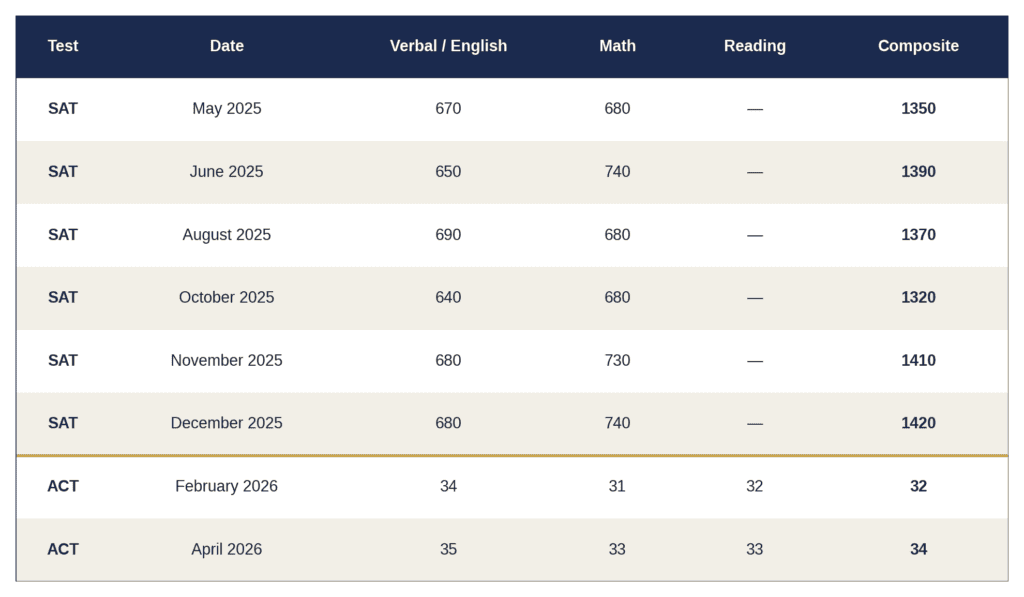
She did well on her November and December tests: she scored a 1410 and then 1420 – her highest single-day composite scores. But she needed a 1450 (equivalent to a 33 on the ACT) in order to meet the score required of her by the coach of the college that she was committing to. The December test was her 6th SAT test, and, while she did well, the SAT was just not the best fit for her. Her outlook on the SAT had turned negative, which itself became an obstacle to her performance on test day.
After the December results came back, despite having prepared for the SAT for over a year, she was open to switching to the ACT.
We did 6 hours of tutoring for the ACT in advance of the February test. She scored a 32 (technically a 32.33, which is just slightly higher than her highest SAT composite score of 1420). We did a few more sessions before the April ACT test, and she scored a 34.
With much less prep and one-third as many tests, she had surpassed her highest SAT score and had even surpassed her score goal: she needed a 1450 on the SAT or a 33 on the ACT. Her 34 on the ACT (equivalent to a 1500 on the SAT) beat both.
Teresa is amazing. She had the perseverance to keep taking the SAT six times, even after many disappointments, and then to keep going and take the ACT.
But the takeaway from her experience and others who have had similar experiences can be generalized: if plan A isn’t working, consider plan B. If students have stagnated on the SAT or ACT, they don’t need to switch tests (sometimes it is still better to push through on the current test), but they should at least consider switching tests. Take a mock test of whichever test the student has not been preparing for. See how it goes. If it’s a similar (or better) score, then a switch might just be what the student needs. Often, it’s not even just about the content: the student may need to feel like they are doing something different to regain their motivation and confidence.
Switching from the SAT to the ACT or vice versa is not going back – most of the content overlaps. But, even if it was, sometimes the fastest way forward is to go back and try another path.
Don’t despair.
Every student we have ever had who had both a sufficient runway and who persevered through setbacks has succeeded. In the worst-case scenarios, if they didn’t hit their score goal, they at least came close – close enough to significantly change their college prospects.
And along the way, they learned an invaluable lesson for life: it’s not necessarily how we perform in the face of success that determines our eventual success; equally, if not more important, is how we handle setbacks. Everyone feels motivated by success, but few can push through setbacks to succeed. If your child is struggling on the SAT or ACT, it can become a great life lesson for them to learn to persevere. That is, ultimately, more valuable than any SAT or ACT score or even the college they attend because they (the stories they tell themselves about themselves, their confidence, their character, their work ethic) are the instrument of their success.
People who persevere, even if it appears that they are going backward temporarily, are the ones who most succeed.
“Whether you think you can or you can’t, you’re right.”
– Henry Ford