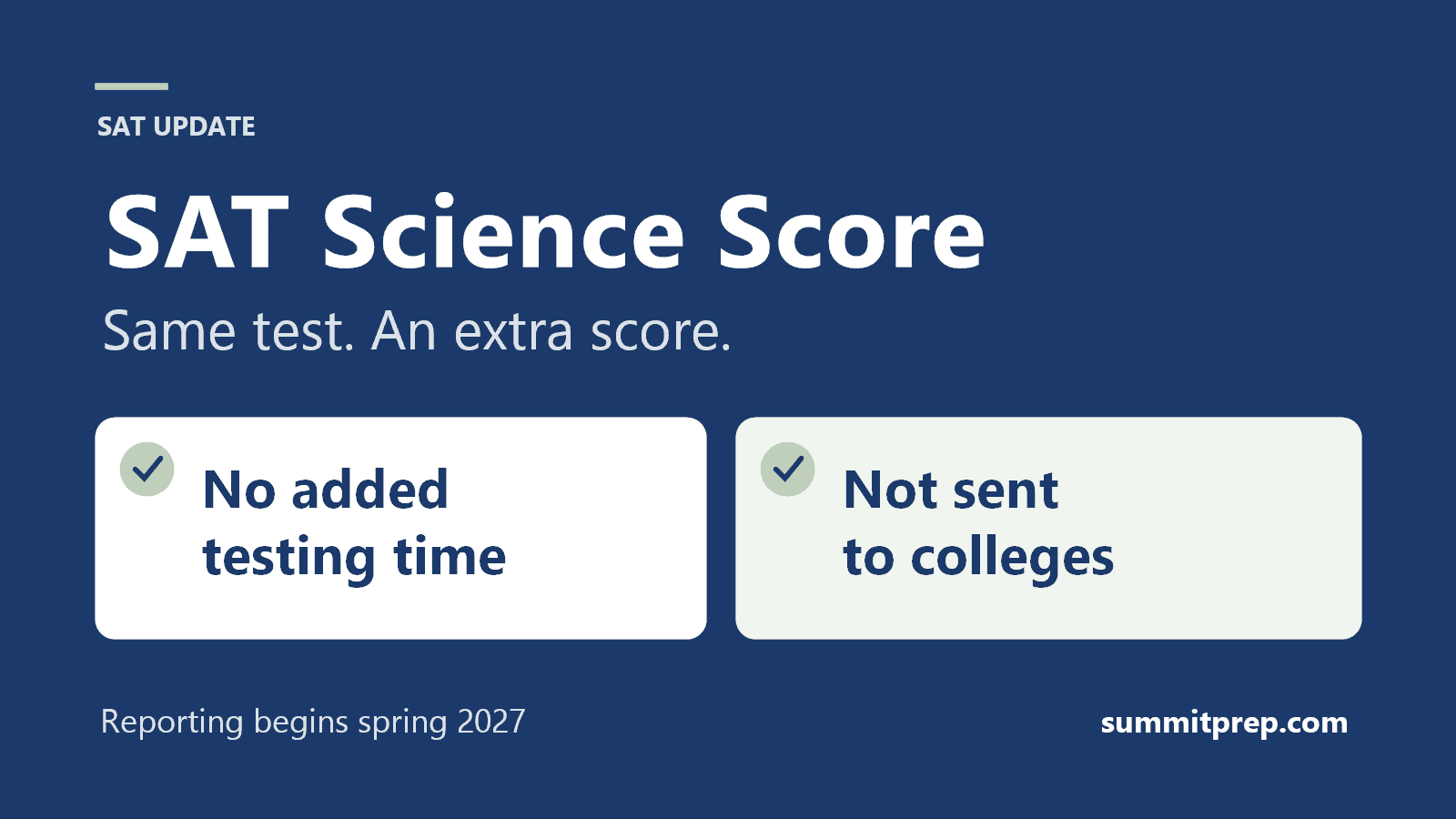
The College Board is adding a science score to the SAT starting in spring 2027. It will measure performance on questions students already answer in Reading and Writing and Math, so it won’t add another section or make the test longer.
But, for families planning around college admission, the most useful detail is in the College Board’s SAT Testing Rules: “It will not be sent to colleges and universities.”
So students don’t need to rush to finish the SAT before the score arrives, and they don’t need to retake an otherwise strong SAT solely to improve this extra number. The scores to focus on remain Reading and Writing, Math, and the total out of 1600.
What is the new SAT science score?
The official name is Science Practices and Foundations, and the College Board’s score-reporting specification gives it a range of 65 to 95, beginning with spring 2027 administrations.
It’s called a science cross-test score because it draws on questions across the SAT’s existing sections. The College Board describes it as a measure of scientific practices and the mathematical skills that support further study in science.
The main SAT score remains on a 400-to-1600 scale, made up of two section scores ranging from 200 to 800. The science score is reported separately; it doesn’t add points to, or subtract points from, that total.
And there is no new SAT Science section to sit through. The standard SAT still has two sections and 2 hours and 14 minutes of testing, plus a 10-minute break.
The College Board says reporting begins in spring 2027, but hasn’t detailed availability for every testing program. Follow the instructions for your administration.
Will colleges see or use the SAT science score?
Under the College Board’s published policy, it will send the new science result to a student’s school, district, and, in some cases, state. It won’t include that result in the scores it sends to colleges and universities.
That gives students a much clearer answer than “colleges probably won’t care.” The organization administering the test has explicitly excluded the score from its college reporting.
This also applies to the way the College Board sends scores for students interested in engineering, medicine, or another STEM field. A science-related name doesn’t create a new admissions requirement for those students.
Colleges can make their own requests for application information, of course. But there is no basis in this announcement for treating the new SAT science number as another admissions score that every STEM applicant needs to maximize.
The underlying questions still matter. If a scored Reading and Writing question asks you to interpret a scientific finding, getting it wrong can affect your Reading and Writing score. The extra science result doesn’t make those questions optional.
How is the SAT science score calculated?
The new score uses existing Reading and Writing and Math questions. In its Texas state-partnership materials, the College Board describes two types of skills behind it: scientific practices, such as analyzing data and evaluating evidence, and the quantitative skills used in science and STEM coursework.
In practical terms, students should already be working on skills such as:
- Understanding a study’s hypothesis, methods, results, and limits.
- Deciding whether evidence supports a scientific claim.
- Reading graphs and tables.
- Using equations, ratios, units, and mathematical models.
The College Board’s Kentucky science-score explainer gives examples of these kinds of skills, although Kentucky’s score is a different version from the one announced for spring 2027.
For a simple illustration, suppose a pump delivers 2.4 milliliters per minute and a question asks how much it delivers in 150 seconds. There are 2.5 minutes in 150 seconds, so it delivers 6 milliliters. The skill is converting units and applying a rate; you don’t need to memorize a chapter of chemistry to solve it.
This is our illustration, not an actual SAT question or a prediction of which questions will count toward the new score.
The College Board’s announcement and reporting specification do not give an exact question count, a Reading and Writing versus Math weighting, or a raw-score conversion for Science Practices and Foundations. So a calculator promising to turn a certain number of correct answers into this score would be getting ahead of the published information.
For students, the preparation decision is straightforward: keep improving the reading, reasoning, and math skills the SAT already tests.
Has the SAT had a science score before?
Yes, which explains why searches for an SAT science score can turn up different ranges.
| SAT science score | Range |
|---|---|
| 2016-era paper SAT: Analysis in Science | 10 to 40 |
| Kentucky digital SAT in 2026: Analysis in Science | 50 to 70 |
| Announced spring 2027 score: Science Practices and Foundations | 65 to 95 |
Kentucky already administered its version of the digital SAT science score in March 2026. That does not mean the coming 65-to-95 score has already launched everywhere, and the different scales shouldn’t be treated as interchangeable.
The older paper SAT’s Analysis in Science score also drew on questions across the test. A 2018-2019 testing guide described cross-test scores and subscores as “generally ignored by college admission offices.”
That supports the historical expectation that an extra science number won’t become a major admissions consideration, but it doesn’t prove every program ignored the old score. For the new score, we have stronger evidence than historical precedent: the College Board’s explicit policy on what it will send to colleges.
Why add a science score colleges won’t receive?
The SAT serves schools and states as well as college applicants, and those audiences can want different information from the same test.
The College Board’s announcement for schools and districts presents the science score as a signal of readiness for further learning and work in science. Information about students’ reasoning and quantitative skills can help educators decide where students need more support.
There is also a competitive benefit to offering that information. States and districts buy testing for large groups of students, and a test that can provide science-related results without adding testing time has an advantage to advertise.
Consider Illinois. When the state switched from the SAT to the ACT® for the 2024–25 school year, its education agency explained that students would no longer need a separate grade-11 Illinois Science Assessment. Using the ACT for science reduced overall testing time.
Science wasn’t the only factor in that award. Illinois evaluated technical specifications, diversity, and price, and ACT earned the highest overall score. But the ability to cover science in the same testing program had a concrete benefit for the state.
The College Board now promotes Science Practices and Foundations directly on its Texas partnership page, emphasizing that it provides science information without additional questions or testing time.
We suspect competition for state and district testing business helps explain the change. That is our interpretation of the incentives, rather than the College Board’s stated explanation. And offering a science score doesn’t automatically mean it can replace every state’s separate science assessment. Still, the competitive value is clear.
A science score can be useful to the organizations buying tests without giving college applicants another number they need to maximize.
SAT science score versus ACT Science
The ACT’s Science section is different. It is a separate timed section, optional on the national ACT, and some colleges have specific policies about taking and submitting it.
| Feature | SAT science score | ACT Science |
|---|---|---|
| Separate section | No | Yes |
| Added testing time | None | 40 minutes |
| Score range | 65 to 95 | 1 to 36 |
| Included in main total or enhanced Composite | No | No |
| Official college report | Excluded | Included if taken |
Leaving Science out of the enhanced ACT Composite doesn’t prevent colleges from using the separate section score. Pomona requires Science from applicants who choose to submit the ACT, and Georgetown highly recommends it, especially for students planning to major in the sciences.
So the advice for the two tests is different. Use our guide to which colleges use ACT Science scores when deciding whether to take that section. The SAT’s new reporting policy doesn’t change those ACT requirements or recommendations.
What should students do?
If you’re preparing for the SAT, keep working on Reading and Writing and Math. Focus your SAT preparation on the knowledge and skills keeping those scores down. Science passages, data, and mathematical models deserve attention because they’re already part of that work. A new score label doesn’t call for a separate biology, chemistry, or physics preparation program.
If you already have the SAT score you need, don’t retake solely for the science score. There is no admissions-driven reason to obtain or improve a separate result that the College Board won’t send to colleges.
If you’re still choosing a test, compare your performance on official practice tests. The added SAT science number isn’t a reason by itself to choose either exam. Our SAT-versus-ACT guide explains the differences that can actually affect that choice.
And if your school requires a testing administration, follow its instructions. Advice about college admission doesn’t determine a school’s separate testing or placement rules.
Put your time into the SAT scores colleges actually receive.
Frequently asked questions
What is a good SAT science score?
The new scale runs from 65 to 95, but the College Board’s announcement and reporting specification don’t provide an admissions target, a population average, or a percentile table for it. An 80 is the arithmetic midpoint of the scale; that doesn’t make it the average. A 90 is not automatically 90% correct or the 90th percentile.
Are SAT Science Subject Tests coming back?
No. The new score comes from questions on the regular SAT. The SAT Subject Tests were discontinued in 2021; they were separate subject exams.
Will the PSAT also get a science score?
The announcement discussed here concerns the SAT. It doesn’t establish the same change for the PSAT/NMSQT, PSAT 10, or PSAT 8/9. Don’t assume a change applies to every test in the SAT Suite.
Will older SAT scores receive a science score retroactively?
The announcement doesn’t promise that older results will be rescored to add Science Practices and Foundations. There is no need to retake an earlier SAT solely to obtain this extra result for college admission.
Information checked October 29, 2026. The College Board’s reporting policies and rollout details can change.