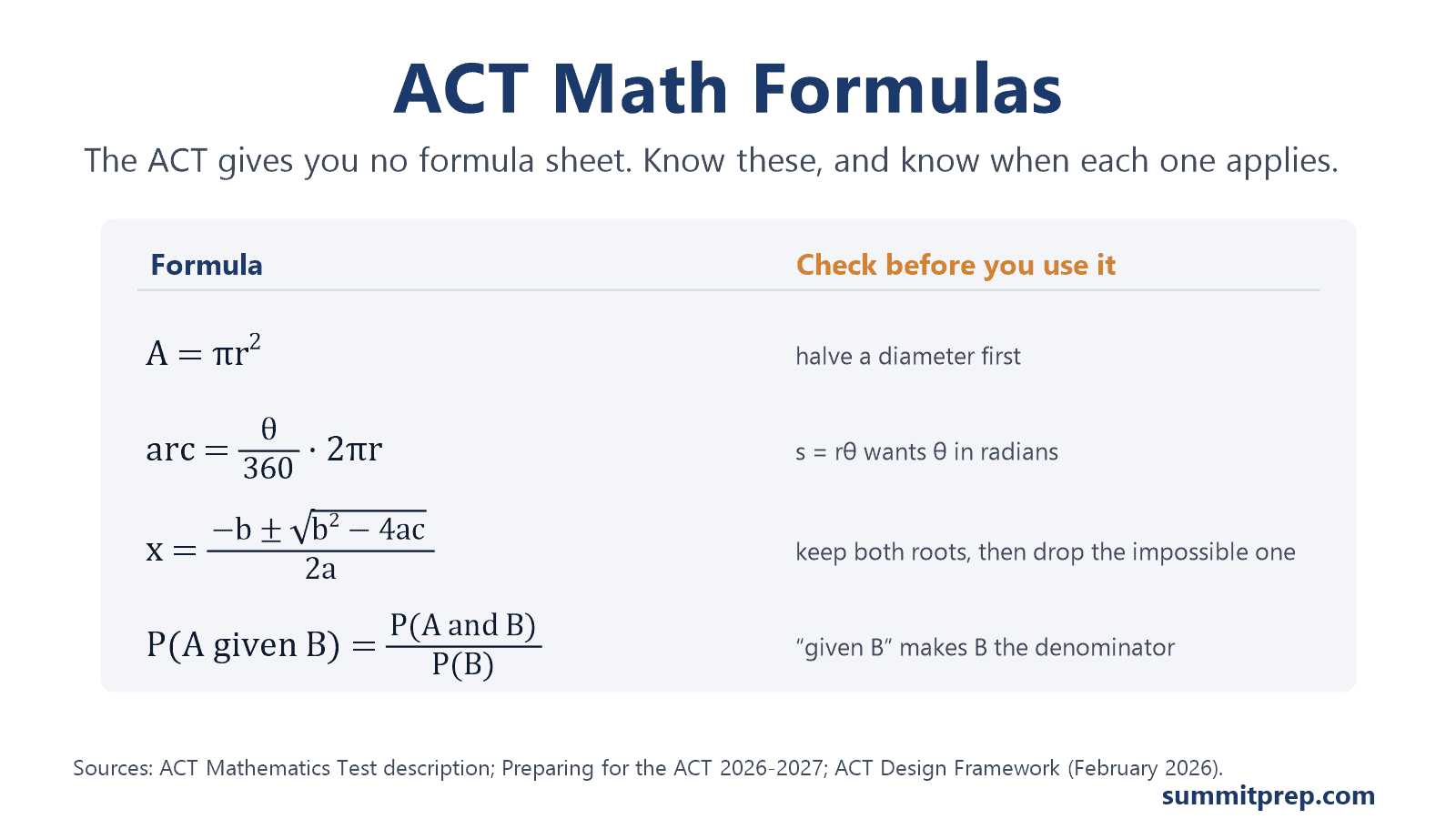
Search for an ACT Math formula sheet and you’ll quickly find a PDF hosted by the ACT itself. It isn’t for the ACT. That sheet belongs to the ACT International Subject Tests, a different exam, and the regular ACT hands you no formula sheet at all. You can’t bring one either (notes of any kind are banned from the test room), and you can’t park one in your calculator.
So, yes, you have to know the formulas. But the list is shorter than the giant lists floating around would suggest, and the ACT says so in its own description of the Math section: it assumes you know basic formulas and basic computation, and it does not require you to recall complex formulas or do extensive computation. When a question needs something unusual, such as the law of cosines, the question itself often hands you the formula and asks you to use it.
That last part matters more than any list, because in our experience the student who misses an ACT Math question usually knows the formula and just doesn’t see that it applies, or applies it to the wrong numbers. They divide by the new price instead of the old one, they put 80 degrees into a formula that wants radians, or they let the calculator hand them two answers and pick the negative width. So we give every formula below with the check that keeps it from being misused, and then we show you how to use a practice test full of mistakes to decide what to study first.
Want the list? Jump to the formulas.
Does the ACT Give You a Formula Sheet?
No. The ACT’s own design report for the enhanced ACT (February 2026) says the Math section provides no formula sheet, and the test-day rules prohibit notes in the room (along with textbooks and scratch paper). Calculators that can store documents must have those documents removed before the test, and calculators with computer algebra systems (a CAS, which can solve equations symbolically) aren’t allowed at all. The full rules are on the ACT’s test day and calculator policy pages.
The confusion comes from two other ACT products. The ACT International Subject Tests give students a reference sheet for their Math 1, Math 2 and Chemistry tests, and the ACT WorkKeys Applied Math assessment (a workplace test) prints a formula sheet in its directions. Both are real ACT tests. Neither is the ACT you take for college. It would be nice if the ACT labeled that Subject Test PDF more clearly (the words “International Subject Tests” appear only in the logo at the top), because it’s easy to print it out and study the wrong thing. Until then, ignore it.
What about the online ACT? Since the December 2025 test, the online ACT has had a version of the Desmos graphing calculator built into the Math section. It will graph, solve and compute for you, but it will not tell you which equation to type, whether the answer it shows is the one the question asked for, or whether a root is impossible because a width can’t be negative. We cover the calculator itself in our guide to Desmos on the ACT. This guide is about the math you have to bring with you, on paper or on screen.
The ACT Math Formulas to Know
Here are the relationships we’d want a student to know cold, grouped by topic. The left column is the formula. The right column is the check that matters, because almost every formula below has a condition that’s easy to miss (a nonzero denominator, a right angle, an angle in radians, equally likely outcomes, a draw without replacement). Learn them together.
Keep in mind that this is a teaching set, not a complete inventory of ACT Math. Vectors and matrices are in the ACT’s own standards, the spread of a data set is in its description of the section, and an unusual formula such as the law of cosines can show up with the formula printed in the question, so a strong student eventually meets all of them. And we’re not claiming which formula shows up most often. Nobody outside the ACT has that data, and anyone who tells you otherwise is guessing.
Numbers, percents and rates
| Formula | Check before you use it |
|---|---|
| is a decimal (25% is 0.25), and each change uses the amount right before it: a 25% discount then 8% tax is , then | |
| Divide by the old (starting) amount, never the new one (and the old amount can’t be 0) | |
| means | A 2 : 3 part-to-part ratio means 2 out of 5, not 2 out of 3; keep units the same on both sides |
| Add exponents only when multiplying the same base; for zero and negative exponents, and for fractional ones (an even root of a negative number isn’t real) | |
| The square root sign means the nonnegative root: , not , even though is also 49 |
Algebra
| Formula | Check before you use it |
|---|---|
| gives | ; multiplying or dividing an inequality by a negative number flips the inequality sign |
| (a vertical line’s slope is undefined; a horizontal line’s slope is 0); parallel lines share a slope; perpendicular slopes multiply to (except a horizontal and a vertical pair) | |
| Two equations in two unknowns: both must hold; solve by substitution or elimination | If one equation’s and terms are a multiple of the other’s, there are infinitely many solutions (when the constants match too) or none (when they don’t); the answer must fit the story (11 pens, not 11.5) |
| if then or | Setting factors equal to zero works only when the product is zero, not when it equals 20 |
| Write the equation as first (); if is negative there is no real solution; keep both roots, then throw out the one the problem forbids |
Functions
| Formula | Check before you use it |
|---|---|
| : put ‘s output into | is not ; whatever sits under a square root must be , and a denominator must be |
| shifts a graph right and up has vertex for the vertex is at | inside the parentheses means , a shift left; makes the vertex a maximum, a minimum |
| is the common ratio (what each term is multiplied by); growth multiplies (25% growth is each period, not adding 25% of the starting amount each time); counts the periods the rate is given in; the first term of a sequence is | |
| means | , and ; the answer can be negative () |
| Distribute as usual, then replace with |
Geometry
| Formula | Check before you use it |
|---|---|
| The angles of a triangle sum to angles on a straight line sum to vertical angles are equalcomplementary angles sum to | Go by the labels and the stated facts, not by how the drawing looks |
| Rectangle , triangle trapezoid composite shapes: add the pieces, subtract the cutouts | The height is perpendicular to the base you chose; a rectangular notch cut from a corner changes the area but not the perimeter (a notch in the middle of a side adds to it) |
| 45-45-90 sides 30-60-90 sides (opposite the , and angles in that order) | Right triangles only; is the side opposite the right angle, and the and the 2 belong to that longest side |
| Scale lengths by , areas by , volumes by | Uniform (similar) scaling only; match the exponent to the dimension |
| Halve a diameter before using ; keep exact until the last step | |
| and want in radians; the fraction-of-the-circle form works in degrees | |
| Prism or cylinder box , cylinder , cone sphere , | is the area of the base; is the perpendicular height, not the slant; an open-top container has one fewer surface than the closed formula counts |
| circle | The equation shows , so 25 means radius 5; means the center is at , not |
Trigonometry
| Formula | Check before you use it |
|---|---|
| For the acute angles of a right triangle; find the missing side first (legs of 8 and 15 give a hypotenuse of 17) | |
| Unit circle point | is measured counterclockwise from the positive -axis on a radius-1 circle centered at the origin; the sign comes from the quadrant ( is negative in Quadrant II); is undefined where ; keep degrees and radians straight |
Statistics and probability
| Formula | Check before you use it |
|---|---|
| median = the middle of the sorted list (the average of the two middle values when the count is even) | Weight each group’s mean by its size; averaging the two means is a different (and usually wrong) number; two group means can’t tell you the median |
| Favorable over total works only when the outcomes are equally likely (the eleven sums of two dice are not); subtract the overlap once | |
| independent events: | “Given B” makes B the denominator; drawing without replacement changes the second draw’s numbers |
| Stage counts multiply | Order matters: permutation; a group with no order: combination; if the branches differ, count each branch and add |
What the ACT Math Section Actually Tests
The enhanced ACT, the version given since April 2025 online and September 2025 on paper, has a Math section of 45 questions in 50 minutes, with four answer choices per question. Only 41 of those questions count toward your score. The other 4 (45 minus 41) are field-test questions (new questions the ACT is trying out), they are mixed in with the rest, and they aren’t marked, so you treat every question as if it counts. The counts are in the ACT’s own Preparing for the ACT booklet. Fifty minutes for 45 questions works out to about 67 seconds a question on average, which is an average, not a plan: the Math questions go roughly from easy to hard, as we’ve written before, so the early ones should take far less, and the ACT’s own advice in that booklet is to answer the easy questions first and come back to the hard ones. Our strategies for the enhanced ACT cover pacing in detail.
The ACT publishes the content balance of the section, and it’s worth knowing, because it tells you what a complete preparation covers. It does not tell you what to study first. That comes from your own mistakes, which is the next section.
| Category | Share | What it covers |
|---|---|---|
| Preparing for Higher Math (the five rows below) | about 80% | The math learned from late middle school onward |
| Number & Quantity | 10 to 12% | Real and complex numbers, exponents, roots, vectors, matrices |
| Algebra | 17 to 20% | Linear, quadratic, exponential and radical equations; systems |
| Functions | 17 to 20% | Notation, graphs, transformations, logarithms |
| Geometry | 17 to 20% | Shapes, solids, the coordinate plane, trigonometry |
| Statistics & Probability | 12 to 15% | Center and spread, probability, counting, data |
| Integrating Essential Skills | about 20% | Rates, percents, proportions, area and volume, averages, in multistep problems |
Two things people get wrong about that table. The 80% does not mean arithmetic no longer matters: percents, ratios and fractions sit inside many of the algebra and modeling questions, not only inside the 20%. And a category’s share is not a formula’s share. Geometry at 17 to 20% is seven or eight of the 41 scored questions, spread across triangles, circles, solids, coordinates and trig, so any one geometry formula gets only a small share of them, and some won’t appear on a given test at all. That is why a list sorted by “most tested” is a guess, and why your own error log beats any list.
What to Study First for ACT Math
Start with a practice test, not a formula sheet. The ACT posts four full-length official practice tests, online and as PDFs with answer keys, and that is where your study order comes from. Take one Math section under the real time limit (or your approved extended time), on the format you’ll actually test in, and score it with the key for that exact test. Then look past the score, because the score is the least useful thing on the page.
Three practical notes on those tests. Score with the key for your test and mode (the paper keys and the online keys list the same answers under different letters), and count only the 41 questions the key marks as scored. Don’t read anything into which practice questions are unscored; on the real test the field-test questions aren’t marked. And save one of the four tests for later, so you have unfamiliar questions to check yourself against after a few weeks of work. (Practice Test 1’s key sorts its questions into categories in a different mix from the other three, and we don’t know why, so if you want a baseline that matches the published balance, start with Test 2, 3 or 4.)
Name the mistake, not the topic
Go through every question you missed, every question you got right by guessing, and every question that took you three minutes. For each one, write down the kind of mistake, because “geometry” is not a diagnosis. Sort them into the six kinds below, because each one calls for a different fix.
| What happened | What it tells you | What to do next |
|---|---|---|
| You didn’t know the formula | A recall gap | Learn the formula with its condition, then use it on a new problem without looking |
| You knew it but set it up wrong (wrong base, wrong side, wrong divisor) | A setup gap | Practice choosing the method among look-alike problems before you drill the formula again |
| The setup was right and the arithmetic or algebra wasn’t | A basics gap | Fix the operation (fractions, signs, solving), then redo the original skill with new numbers |
| You ignored a condition (divided by zero, used a non-right triangle, forgot radians) | A condition gap | Say the condition out loud before you compute; practice one problem where it applies and one where it doesn’t |
| The calculator gave the right number and you read it wrong | A misread result | Write what the question asks for, and its unit, before you type anything |
| You can do it untimed but not timed | A fluency gap, not a knowledge gap | Timed mixed sets, and a faster route (see the examples below) |
So, let your error log set the order. If percents, fractions, signs or basic equation-solving show up in your error log more than once, those are the first thing to fix, even though “higher math” is 80% of the section, because every higher-math question is built on them and you’ll keep paying for the gap. If those are secure and the same applied topic keeps appearing (say, circle problems where you used the diameter as the radius), that topic is next. And if the familiar topics are fluent and your misses are the unfamiliar ones (logs, the unit circle, combinations), then you’ve earned the right to broaden out. Ties go to the mistake that repeats and to the topic that other topics depend on.
Learn the relationship, not the line
A formula on a flashcard is just a line of symbols, and what you actually need is the relationship: what each letter means, when it works, and why it solves this particular problem. To check whether you have it, close the notes, write the formula with its condition from memory, and then solve a problem you haven’t seen that doesn’t announce which formula to use. If you can do that, move on. If you can only do it with the card in front of you, you’re not done yet, no matter how many times you’ve read the card.
When a method is genuinely new to you, start by studying a worked solution, then try a close cousin of the problem with the answer available to check. When the method is familiar and you’re just rusty, go straight to attempting problems and checking. The ACT’s Mathematics standards list the topics, and a free textbook such as OpenStax’s Algebra and Trigonometry will reteach most of the algebra, functions and trig for nothing.
Come back to it, and mix it up
Consider two classroom experiments that match what we see in tutoring. In a Florida study of 787 seventh graders published in 2020, Rohrer and colleagues had classes practice the same problems either sorted by type or mixed together; a month after the review session, the mixed-practice students answered 61% of new problems correctly and the sorted-practice students 38%. In a 2021 study at a British school, Emeny and colleagues gave the same twelve problems either in one sitting or four a week for three weeks; the spread-out students did better on new problems a month later, and the one-sitting students overestimated how well they’d do. Those were middle school students (seventh graders in Florida, Year 7 in England) doing middle school math, not ACT prep, so treat the exact numbers as evidence for the habit rather than a promise about your score. The habit: revisit a repaired skill on a later day with a new problem, and practice it mixed in with other types so the problem itself has to tell you which method to use.
Here is the week we’d recommend: learn and repair on day one, a short corrected set on day two, a mixed set on day four, and a check on brand-new problems on day seven. That’s our pattern, not a law; move the days around your test date. But don’t skip the day-seven check, because a problem you’ve already seen can’t tell you whether you’ve learned anything.
Adjust for the time you have
If the test is in two weeks, don’t try to cover the tables above. Pick the two or three mistakes that repeat in your error log, repair those, and spend the rest of the time on timed official sections so the repair holds under pressure. If you have two or three months, work in the order above: prerequisites, then the applied topics you miss, then the extensions. And whatever the timeline, never leave a Math question blank; there is no penalty for guessing, and we’ve written about the best letter to guess on the ACT.
Repairing prerequisite gaps is slow, and it feels like going backward, which is why students skip it and memorize more formulas instead. Luckily, those gaps can absolutely be filled, and a student who can do fractions, percents and basic algebra without thinking saves time on nearly every question in the section, which is exactly the time the hardest questions need. But it’s not a quick process, so start early.
Worked Examples: When Thinking Beats the Calculator
The formulas above don’t tell you which route is fastest or what to do with what the calculator gives back, so the examples below show both. They are ours, written to make a point, not questions from an ACT.
A ratio question: reason in parts
A drink is 2 parts concentrate to 3 parts water (the volumes add), and a pump fills the mixed drink at 2 liters per minute. How much concentrate is in 20 liters, and how long does the pump take?
Don’t cross-multiply. Count the parts: , so each part is liters, and the concentrate is liters. The time is amount over rate, minutes. The classic miss is reading 2 : 3 as “2 out of 3” (concentrate to total) instead of “2 out of 5.”
A probability question: list the outcomes
Roll a fair die. What is the probability the result is even or greater than 4?
Even gives {2, 4, 6}; greater than 4 gives {5, 6}. Together that’s {2, 4, 5, 6}, four of six faces, so the probability is , and the probability of neither is . Six outcomes fit on one line of scratch paper, and listing them is faster than the formula, which also saves you from counting the 6 twice ( is wrong).
A quadratic: the calculator gives two answers, the question allows one
A rectangle has an area of 10 square meters, and its length is 2 meters more than its width. Find the width to the nearest hundredth.
Let the width be , so , or . The quadratic formula (or Desmos’s graph) gives
about 2.32 and . A width can’t be negative, so the answer is , about 2.32 meters. Two things a calculator will not do for you here: notice that the equation needs to be in “equals zero” form with , not 10, and throw out the root that fails the story. Keep both roots in your work, then apply the condition.
A sector: the units problem
A sector has radius 9 cm and a central angle of . Find its arc length and area.
Use the fraction of the circle: . Arc length is of the circumference, cm; sector area is of the circle’s area, cm². The formula also works, but only with in radians ( is ), and putting 80 straight into is a classic sector mistake. No calculator setting fixes a formula used in the wrong unit.
Averages: weight the groups
One group of 12 students averages 70 and another group of 8 averages 90. What is the combined average?
Not 80. Rebuild the totals: and , so
(The mean of the two means, 80, would only be right if the groups were the same size.) And if a question asks for the median of all 20 students, the answer is that you can’t tell from two averages, because the 12 scores averaging 70 could all be 70 or could be six 50s and six 90s, which changes the median.
A function with a hole: the condition survives the cancellation
Let . Find . Is equal to 6?
Factor:
for every except 3, so . But is undefined, not 6, because the original denominator is zero there, and simplifying doesn’t give that input back. Write the restriction down before you cancel anything.
A two-way table: “given” picks the denominator
Of 20 students, 6 club members ride the bus and 4 ride in cars; 3 nonmembers ride the bus and 7 ride in cars. One student is picked at random. What is the probability the student is a club member, given that the student rides the bus? And the probability the student rides the bus, given that the student is a club member?
“Given bus rider” means the denominator is the 9 bus riders, 6 of whom are members: . “Given club member” means the denominator is the 10 members, 6 of whom ride the bus: . The 20 is not the denominator of either one. Underline the word after “given” and you’ve done the hard part.
A composite shape: area and perimeter answer different questions
A 12 cm by 8 cm rectangle has a 3 cm by 2 cm notch cut from one corner, with the notch’s edges parallel to the rectangle’s. Find the remaining area and perimeter.
Area is subtraction: cm². Perimeter is not. The notch removes a 3 cm edge and a 2 cm edge from the outside and replaces them with a 3 cm edge and a 2 cm edge pointing inward, so the perimeter stays cm. Students who subtract the notch from the perimeter get a wrong answer that is sitting right there in the choices.
Make Your Own Formula Sheet (for Studying, Not for Test Day)
Our advice is to write your own sheet from the tables above, by hand, in your own words, and to rewrite it from memory once a week until you can do it without a mistake. Writing it is the studying. For each formula put three things on the line: the formula, what the letters mean, and the one condition that matters (radius not diameter, radians, old amount, equally likely, without replacement). Then add a five-question check to the top of the page and run it on every hard problem: What is the question asking for, with its unit? Which quantities do I have? Why this formula? What restriction applies? Does the answer make sense?
You can’t take the sheet into the test. That’s fine. By test day the sheet should be in your head, and the five questions should be a habit.
The Bottom Line
In short, the ACT gives you no formula sheet, the list you actually need is manageable, and the formulas are the easy part. Knowing when each one applies is the hard part, and the only way to find out which ones you misuse is to take an official practice test and name your mistakes. Fix the prerequisite gaps first, learn each relationship with its condition, come back to it on a later day mixed in with other problems, and check yourself on problems you haven’t seen. Keep at it for a few weeks, and you won’t need a formula sheet.
If you’d like help figuring out which of these your child actually needs, that is what our ACT tutors do every day. Feel free to reach out anytime.
Frequently Asked Questions
Does the ACT give you a formula sheet?
No. The regular ACT provides no formula sheet for the Math section; the ACT’s February 2026 design report for the enhanced ACT says so directly. The formula sheet PDF on the ACT’s website is for the ACT International Subject Tests, a different exam.
Can I bring my own formula sheet to the ACT?
No. The ACT’s test-day rules prohibit notes in the test room, and a calculator that can store documents must have them removed. A formula sheet is a study tool, and a good one, but it stays home.
How many questions are on the ACT Math section, and how long is it?
Forty-five questions in 50 minutes on the enhanced ACT, with four answer choices each. Forty-one of the questions are scored and 4 are unmarked field-test questions, so treat them all as real. Students with approved accommodations get their own timing.
Does the Desmos calculator on the online ACT mean I don’t need the formulas?
No. The ACT says every Math question can be solved without a calculator, and the built-in Desmos on the online test only does what you tell it to. It won’t choose the equation, notice that a root is impossible, or convert 80 degrees to radians for a formula that wants radians. Learn the ACT version of Desmos (our guide shows the moves that save time), and learn the math.
Which ACT Math formulas should I learn first?
The ones your practice test says you’re missing, starting with any prerequisite gaps in percents, fractions, signs and basic algebra. If you haven’t taken a practice test yet, start with the first two tables above (numbers and algebra), because everything else depends on them. The ACT’s category shares tell you what a complete preparation covers, not where to begin.
Is this every formula on the ACT?
No. It’s the set we want every student to know with its conditions. The ACT’s Math standards also include vectors and matrices, and its description of the section includes the spread of a data set, so a student aiming for a top score will meet them. Unfamiliar formulas are often given in the question itself, so the skill to practice is reading a supplied formula and matching its parts to the problem.
Why am I still missing questions after memorizing the formulas?
Because the formula is rarely the problem. Go back through your misses and sort them: wrong setup (wrong base, wrong denominator, wrong side), a skipped condition, an arithmetic slip, a calculator result read wrong, or a timing problem. Each has a different fix, and none of them is “memorize more formulas.”
Where should I get ACT Math practice problems?
From the ACT. Its free practice page has four full-length tests with answer keys, online and on paper. Use the key for your exact test and mode, keep a log of every miss by kind of mistake, and save one test for a fresh check after a few weeks. Our post on why practice tests matter explains how to get the most out of each one.
Sources and When We Checked Them
Checked in October 2026, for the enhanced ACT.
- ACT, Mathematics Test description: content categories and shares; basic formulas assumed, recall of complex formulas not required.
- ACT, Preparing for the ACT 2026-2027: 45 questions, 50 minutes, 41 scored (so 4 unscored field-test questions, which the booklet says are not labeled), four answer choices.
- ACT, Design Framework for the ACT Enhancements (February 2026): no formula sheet on the Math test; unusual formulas supplied in many questions that need them.
- ACT, test day rules and calculator policy.
- ACT, free official practice tests and Mathematics College and Career Readiness Standards.
- Rohrer, Dedrick, Hartwig and Cheung, A randomized controlled trial of interleaved mathematics practice (Journal of Educational Psychology, 2020); Emeny, Hartwig and Rohrer, Spaced mathematics practice improves test scores and reduces overconfidence (Applied Cognitive Psychology, 2021).
- The worked examples are our own; the formulas and their conditions follow the standard definitions in OpenStax’s open textbooks.