
First published in August 2021 and updated in October 2026 for the 2026-27 SAT and ACT.
With time and a half (50% more time), the digital SAT takes up to 3 hours 42 minutes, breaks included, and the ACT takes 3 hours 22 minutes 30 seconds (or 4 hours 22 minutes 30 seconds with the optional Science section). Most students qualify through an IEP, a 504 plan or their school’s own formal plan, and neither College Board nor ACT tells colleges that a student tested with accommodations.
| Section | Standard | Time and a half |
|---|---|---|
| Reading and Writing, Module 1 | 32 min | 48 min |
| Break | none | 5 min |
| Reading and Writing, Module 2 | 32 min | 48 min |
| Break between sections | 10 min | 10 min |
| Math, Module 1 | 35 min | 53 min |
| Break | none | 5 min |
| Math, Module 2 | 35 min | 53 min |
| Testing time | 2 hr 14 min | 3 hr 22 min |
| Total with breaks | 2 hr 24 min | 3 hr 42 min |
Extended times are maximums: since spring 2025, students with extended time may move on once a module’s standard time has passed. Time and a half means 50% more time on each module (1.5 times the standard time), so a 32-minute Reading and Writing module becomes 48 minutes. College Board calls it “up to time and one-half”; ACT calls it “one and one-half time.” The PSAT/NMSQT, PSAT 10 and PSAT 8/9 use the same timing. Sources: College Board’s SAT test coordinator manual and its extended-time FAQ.
With double time, the SAT modules are 64, 64, 70 and 70 minutes: up to 4 hours 48 minutes with breaks at a weekend test center, or 4 hours 58 minutes in school (SAT School Day and the PSAT), where double-time students get a 20-minute break between the two sections (College Board’s in-school manual).
| Section | Standard | Time and a half |
|---|---|---|
| English | 35 min | 52 min 30 sec |
| Math | 50 min | 75 min |
| Break | 15 min | 15 min |
| Reading | 40 min | 60 min |
| Science (optional) | 40 min | 60 min |
| Writing (optional) | 40 min | 60 min |
| Total with break, English to Reading | 2 hr 20 min | 3 hr 22 min 30 sec |
| Total with break, with Science (no Writing) | 3 hr | 4 hr 22 min 30 sec |
Double time on every section of the ACT is given only over multiple days, through ACT’s Special testing: English 70 minutes, Math 100, Reading 80, Science 80 and Writing 80. Because the sections are spread over several days, there is no single-day total. (ACT also offers double time on the Writing section alone, in one day.)
To get extra time, the school files the request after a parent signs consent: for the SAT, through College Board’s SSD Online, where a school-verified request is usually approved within a week, and for the ACT, through ACT’s TAA system, where requests are normally processed in 5 to 10 business days.
Have questions about extra time on the SAT and ACT? Here are answers to the frequently asked questions we receive.
How do I qualify for extended time on the SAT and ACT?
Most students who get extended time on the SAT and ACT have an IEP (Individualized Education Program), a 504 plan or another formal school plan that gives them extended time in school. What is the difference between an IEP and a 504 plan?
- An IEP typically has a much higher threshold. To qualify, students are evaluated by their school district, and the evaluation must show one of the thirteen disabilities defined in the Individuals with Disabilities Education Act and a need for special education because of it. The school district’s evaluation is free to families, and either a parent or the school can ask for it.
- In contrast, a 504 plan covers any physical or mental impairment that substantially limits a major life activity, so it covers broader needs and protects students under a different law, Section 504 of the Rehabilitation Act of 1973. (For a rough comparison, think of an IEP as a special education plan and a 504 as an accommodation plan: the former qualifies students for specialized instruction, while the latter mainly removes barriers so students can perform at their potential in a general education setting.) Public school districts must evaluate students for a 504 plan at no cost to parents, but many families choose a private evaluation, which they pay for. Because 504 plans are less selective and more subjective, schools vary widely in what they count as a disability and what accommodations they give.
Why does the SAT approve extra time more easily than the ACT does?
Since the 2021-22 testing year (ACT announced the change on July 21, 2021), ACT has accepted a copy of a current IEP or 504 plan as enough to show eligibility for the same allowable accommodations, so students with those plans now get extended time on the ACT about as easily as on the SAT. For students at private schools, which usually give their own plans rather than 504 plans, it’s typically much easier to get extended time on the SAT than on the ACT: College Board’s quick “school verification” also usually covers a school’s own formal plan that meets College Board’s criteria, while ACT asks for documentation from a qualified professional when a student has no current IEP or 504 plan. See ACT’s current accommodations policy and College Board’s explanation of school verification.
Why, at least historically, has the SAT granted extended time more easily? In our view, the SAT is designed so that the average student can finish within the allotted time. The test intentionally does not test students on how quickly they can read, analyze, calculate, and answer questions.
In essence, extended time does not help the average student on the SAT: students are either going to get the answer, or, even with infinite time, they will not get the answer because the reading analysis is so complex or they do not know the content to answer the grammar or math questions. Because extended time on the SAT will not significantly help the average student, the SAT grants extended time quite easily as long as a student gets extended time in school.
But, while extended time on the SAT only helps students who need extra time, extra time on the ACT would help almost every student, because the ACT is meant to be a time-pressured test. Fewer students run out of time on today’s shorter ACT than on the old one, but it is still time pressured, so giving more time to an average student who doesn’t need extended time would give that student an advantage. For that reason, the ACT used to be exceedingly careful about who it allowed to qualify for extended time so that students with extended time were not gaining an unfair advantage over the average student.
Private schools typically give students their own formal accommodation plans (not official 504 plans), and the requirements for those plans are not nearly as strict. Without a current IEP or 504 plan, ACT requires documentation from a qualified professional, and the request form a school fills in for ACT asks whether the student has been on the school’s plan for more or less than 12 months (ACT’s TAA user guide). In our experience, that makes it harder for a student with only a school’s own plan (usually a private school student) to get extended time on the ACT, especially if the school granted it recently. (See our timing advice below.)
For students with a current IEP or 504 plan, however, ACT says a copy of the plan “will be sufficient to demonstrate eligibility and need for the same allowable accommodations,” and its policy sets no minimum time that the plan must have been in place, so a track record of accommodations is not needed.
How do I know if my child needs extended time on the SAT and ACT?
Most students who need extended time on the SAT or ACT will already have accommodations in school, from an IEP, a 504 plan or a school’s own formal plan, before they begin taking the SAT or ACT. But if a student has an undiagnosed disability and needs extended time, a practice test often looks like this:
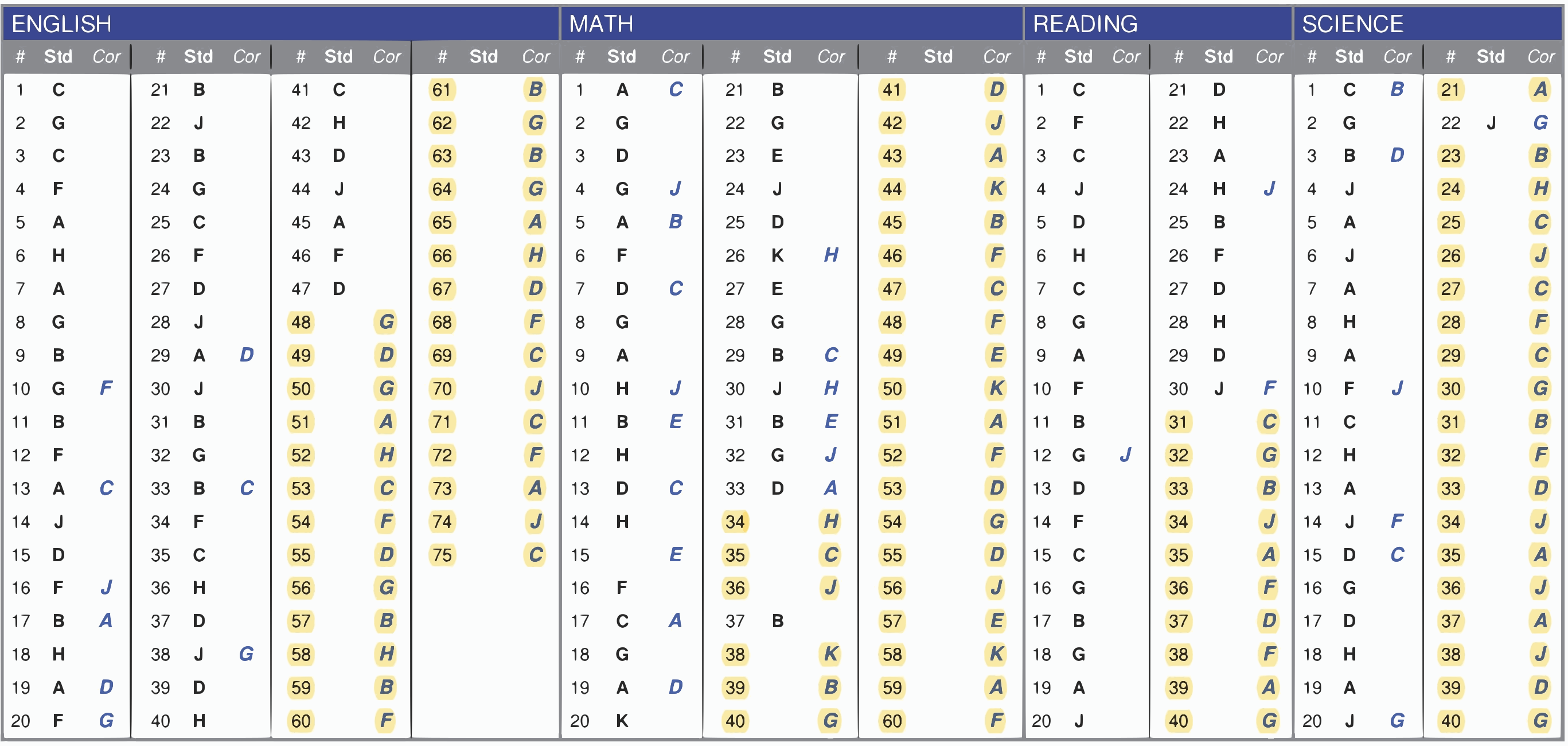
First, notice all the questions at the ends of all the sections (not just the Reading and Science sections) that the student left unanswered. In total, the student didn’t have time to get to 83 of the 215 questions on this pre-2025 version of the ACT, or 39% of the questions. (Today’s ACT has 131 questions, or 171 with the optional Science section, including some unscored field-test questions; see ACT’s comparison of the two versions.) Second, look at their accuracy on the questions that they did have time for. On the Reading section, for example, they only missed 3 of the 30 questions that they had time to answer.
That’s an incredibly high rate of getting questions correct. The combination of high accuracy and high number of unanswered questions shows us that this student is extremely smart but needs extended time in order to have any hope of demonstrating their hard work, skill, and knowledge to colleges on the ACT.
This student started with a 19 on this mock ACT test. After he got tested in his junior year for extra time, he was granted not only 50% extra time but actually 100% extra time (on the ACT, double time on every section is given over multiple days). His final official score: a 35. Going from a 19 to a 35 on the ACT was life-changing for him, not only because he was later accepted to a fantastic college but also because he understood himself much better and realized how smart and capable he is.
If a student’s testing shows high accuracy and a high number of questions unanswered, it might be time to consult a testing psychologist (or to ask the school district for an evaluation, which is free to families) to evaluate whether the student requires accommodations to be able to demonstrate his or her potential to colleges.
What kind of accommodations can a student qualify for on the SAT and ACT?
Extended time is by far the most common SAT accommodation among our students, but College Board offers many others in seven categories: extended time, breaks, reading and seeing accommodations, recording responses, use of a four-function calculator, assistive technology, and other accommodations. On the ACT, the main accommodations include:
- Time and a half (ACT calls it “one and one-half time”): 50% more time on each section, in one day at a national test center or over several days through Special testing (ACT’s timing sheet).
- Multiple-day testing: through ACT’s Special testing, which usually takes place at the student’s own school within a nine-day testing window that starts on the national test date and includes two weekends. In our experience, to get this accommodation, the student’s IEP or 504 plan needs a limit on the number of tests the student can take in one school day (something to the effect of “Bob cannot be required to take more than 3 tests in one day of school”).
- A highlighter, useful for the Reading and Science sections (built into the online ACT for every student; an accommodation on the paper test, per ACT’s accessibility guide).
- Double time (100% more time) on every section, given only over multiple days through Special testing. ACT also offers triple time over multiple days, and double time on the Writing section alone in a single day.
- Stop-the-clock breaks: standard time on each section, with the clock stopped for breaks, in a one-to-one room. No single break can be longer than about an hour, and breaks can total no more than 90 minutes.
- Private testing: students can be tested in an individual (one-to-one) room. For Special testing, the school arranges where the test is given; in our experience, that can be a familiar spot such as the college counselor’s office.
- Marking answers in the test booklet (paper test only): the student marks answers in the test booklet instead of on an answer sheet, and staff transcribe them.
- Small group testing, given only together with another accommodation, usually extended time.
Neither College Board nor ACT sets the amount of extra time by diagnosis, ADHD included. College Board says students should request extended time “only if their disability causes them to work more slowly than other students” (College Board’s extended-time page). The SAT is never untimed: College Board approves a set maximum, such as “Up to Time and One-Half” or “Up to Double Time.”
How do I get extended time on the SAT or ACT?
The first step is evaluating whether or not a student likely has an undiagnosed disability. Here are some questions to ask:
- Do they often run out of time on tests in school, even when they have prepared well for the material?
- Do teachers grant them informal accommodations, such as letting them come after school to finish tests?
- Do they have high accuracy on practice SAT or ACT tests but significantly run out of time on these tests?
If the answer to any of these is “yes,” then you might consider testing. If you do, choose a psychologist who (1) specializes in testing and (2) has extensive experience with the SAT and ACT accommodation process. The second point matters because there is, understandably, more skepticism toward students who seek accommodations in sophomore or junior year of high school, so you’ll want a professional who has helped many sophomores and juniors through the process. College Board itself advises that “a good overall strategy is to make a request during freshman year of high school.”
Once the testing is done and if the findings support the need for extended time, then families take that psychological evaluation to a student’s school. If the school approves a student for extended time in school, the school then submits the requests: for the SAT, the school’s accommodations (SSD) coordinator uses College Board’s SSD Online, and for the ACT, a school official uses ACT’s online Test Accessibility and Accommodations (TAA) system. (If a school does not approve a student for accommodations, then it’s highly unlikely that either the SAT or ACT will do so.) Families can apply to College Board directly on a paper form, but documentation is then always required; ACT accepts requests directly from families only in limited cases, such as a school that is unwilling to submit one.
How long do I need to have accommodations at school before I can apply for accommodations on the SAT or ACT?
There are no absolute cutoffs. College Board publishes no minimum time that a school plan must be in place before a first request. You may hear a rule of thumb to wait 4 months: older College Board guidance tied its quick “school verification” to a plan in place for at least four school months, and College Board’s current form for adding accommodations to an existing approval still asks about “the last four school months.” We recommend ignoring that rule of thumb.
In our experience, every one of our students with a documented case for extended time has been approved for it on the SAT, without waiting 4 months before applying.
For the ACT, it depends on whether a student has a current IEP or 504 plan or only a school’s own plan, which in practice usually comes down to whether the student attends a public or private high school:
- Students with an IEP or 504 plan (most public high school students who get extended time): You can request extended time on the ACT as soon as you get extended time in school, and you will almost definitely be approved for the extended time on the ACT. ACT says a copy of a current IEP or 504 plan “will be sufficient to demonstrate eligibility and need for the same allowable accommodations” (ACT’s accommodations policy).
- Students with a school’s own plan (most private high school students who get extended time): Though ACT’s 2021 changes to its accommodations policies made it a bit easier for private high school students to get extended time, it is still not as straightforward as it is for students with an IEP or 504 plan. In our experience, a track record of accommodations in school is the single biggest factor: private school students who apply to the ACT soon after getting extended time in school are almost all denied, while students who have had accommodations in school for at least a year, even at a private school, are approved nearly every time. So unless a student has an extremely strong case for extended time, we recommend waiting until the student has had accommodations in school for at least a year before applying to the ACT. Students who apply sooner will likely need to appeal, potentially more than once; about half of our students who appealed a denial of ACT accommodations were eventually approved. Note that ACT reviews an appeal (ACT calls it a “reconsideration”) only before that test date’s accommodations deadline, which is the regular registration deadline; after that, the appeal counts toward a later test date (ACT’s TAA user guide).
How long does it take to get approved for SAT and ACT accommodations?
If a family realizes that a student likely has a previously undiagnosed disability and decides to pursue testing, then the process and timeline are roughly as follows:
- Schedule an appointment with a testing psychologist: the best testing psychologists could have a 1 to 3 month wait for testing appointments.
- Do the psychological testing: usually the battery of tests is given over the course of two days; some testing psychologists work on weekends so a student will not need to take off from school, but others only work on weekdays so a student might need to take off two days from school.
- Receive the psychological evaluation: this is typically a 30 to 50 page report that takes around a month after the testing has been completed to compile and write.
- Contact the school: once you have the psychological report and if it supports the need for accommodations, then take this report to the school. Schools vary in their approval timelines: some will literally approve a student that same day, while others will have committee meetings that could take about two weeks.
- SAT: after a student is approved for extended time in school, the school’s SSD coordinator submits the request through SSD Online once a parent signs College Board’s consent form. The approval process for the SAT is usually very quick: College Board says a request the school can verify “may take as little as five days” and is usually approved within a week, while a request that needs a documentation review can take up to seven weeks. Students must be approved before they register for the SAT.
- ACT: register for a test date first and answer Yes to the accommodations question. ACT says registering is “not required, but it is strongly recommended,” because an unregistered request “may not be processed correctly or in time” (ACT’s accommodations page). You don’t have to take the ACT on the date you register for. A parent signs ACT’s consent form, which the school keeps on file, and a school official submits the request. ACT says requests are normally processed in 5 to 10 business days, and the accommodations deadline is the regular registration deadline for that test date. Note the order: for the SAT, get approved before you register; for the ACT, register first. And if the centers near you are already full, ACT standby testing has its own rules for students with approved accommodations, which our guide to ACT seat availability and standby testing explains.
- If ACT denies a request, the school can ask ACT to reconsider by editing the request in ACT’s system and adding documentation (usually additional letters from teachers, report cards from years past, maybe more testing, etc.). ACT reviews reconsiderations only if the accommodations deadline for that test date has not passed. In contrast, for the SAT, out of the hundreds of our students who have applied for extended time on it, we have never had a student not be approved for it, so we have never had to go through an appeal process for extended time on the SAT.
In sum, the whole process to secure extended time for the SAT and ACT could be as quick as 2 months or as long as 6+ months, particularly if one or more appeals are needed before a student is granted extended time on the ACT.
What happens if the SAT or ACT deny a request for extended time?
If you are denied, then you can appeal that decision. College Board calls it a “re-review,” which must be requested in writing and can take up to about seven weeks (College Board’s after-approval page); ACT calls it a “reconsideration,” which your school files. College Board’s decision letter explains why a request was denied; for the ACT, the decision notice goes to your school, so ask the school for a copy. Use the decision as a guide: make sure the school submitted everything correctly on your behalf, fill any holes it names, and provide even more evidence than was asked for, such as letters from past teachers.
For example, the ACT could deny accommodations to a student because a family or school did not provide evidence that the disability is a true disability (that it limits a person’s functioning in a core aspect of life). When ACT needs diagnostic documentation, its published criteria spell out what it looks for. For ADHD, for example, ACT asks for “Evidence of childhood onset before age 12” and says “Failure to finish timed tests cannot be used in isolation to demonstrate impairment.”
For a student without a current IEP or 504 plan, ACT also looks for a history of using the accommodations being requested; a student without that documented history files an Exceptions Statement Form. And ACT accepts “a current and official accommodations plan (other than an IEP or Section 504 Plan)” as supporting documentation, so a school’s own plan counts as evidence too (ACT’s accommodations policy). In our experience, two things help most. The first is that track record: ACT wants to see that a student has used accommodations in school for a while, ideally at least a year. The second, for a disability that medication typically helps (ADHD, for example), is to include the student’s prescription information in the request or appeal, which in our experience has increased students’ chances of approval. Our guess is that ACT’s reviewers expect a student with a life-limiting disability to try to treat it as fully as possible.
Is it worth the hassle to get extended time on the SAT and ACT?
If your child needs extended time, then it is overwhelmingly worth the hassle to get it. Here’s why:
- Confidence boost: Most of our students who go from regular time in school and on standardized tests to extended time realize quite quickly how much smarter they are than they thought they were. For example, the student above who went from a 19 to a 35 on the ACT (after getting accommodations and tutoring) had an enormous confidence boost from knowing he was actually brilliant but simply needed more time. Because students who need extended time and receive it can then actually succeed up to their potential, they feel much better about themselves and are motivated both by their success and by the sense that they will be more successful in life as well.
- Extended time in high school: Even if students have been performing reasonably well, very often we find that students had no idea how rushed they were on tests in school and how much better they can do with extended time. The additional time, as long as they need it, unlocks their potential.
- Extended time on the SAT and ACT: Because these test scores are so important for getting into college, doing better on these exams can dramatically help students in the college admissions process. Students can also then get extended time on their AP Exams, because College Board approvals carry over to the PSAT and AP Exams, with some limited exceptions (on AP, extended time does not automatically come with extra breaks). This can further help them with college admissions and with course credit in college.
- Extended time in college: After students get accepted to and enroll at a college, they can tell the school that they require accommodations. Thus, their history of accommodations in high school will, in all likelihood, allow them to get accommodations in college.
- Extended time on the GRE, GMAT, LSAT, etc.: If a student goes on to graduate school, their history of accommodations will also help support their case for extended time on graduate school exams. For example, LSAC grants the same or equivalent LSAT accommodations, up to double time, to test takers approved on the SAT or ACT who send a letter from that test maker, as long as the LSAT does not have to be given over more than one day.
Thus, getting the necessary extended time on the SAT and ACT is important, but the accommodations also set the foundation for unlocking a student’s potential more broadly and help them succeed beyond just the SAT and ACT.
If I get extra time on the SAT and ACT, which one is the better test for me?
The ACT is meant to be a time-pressured test: fewer students run out of time on today’s ACT than on the old one, but it is still time pressured. And the ACT can’t fine-tune accommodations to the exact amount of extended time that will provide an equal testing opportunity for each individual student with accommodations by giving them just enough time to be able to finish or almost finish the sections but not so much time that students gain an advantage.
As a result, the minimum amount of extended time on the ACT is 50% more time (very few students get more than this percentage of extended time). But most students who receive extended time do not quite need the full 50%: maybe they only need 30% extended time to be as rushed as students with the standard allotted time.
Because extended time on the ACT usually overcompensates and provides students with an advantage on the test (by removing much of the time pressure that is part of the test), we find that virtually all students with extended time score comparatively higher on the ACT than on the SAT.
The only exception is when the 50% extended time on the ACT is not enough; if the student really needs, let’s say, 75% extended time and only gets the 50%, then they will still be rushed even more than students under the standard time, they will not be able to hit their potential on the ACT, and they are likely better off taking the SAT.
But the latter circumstance is very, very rare: for the vast majority of students with extended time, they will perform better on the ACT. And, as was discussed earlier, timing is not a significant factor on the SAT (except if a student really needs extended time and does not have it), so there is no advantage gained on the SAT from having more time than one needs.
For the broader decision, here’s how to choose between the SAT and ACT.
Will colleges know I got extended time on the SAT or ACT?
No. College Board says that when colleges receive SAT scores, “they won’t know if a student took the SAT with accommodations,” and ACT “does not indicate the use of accommodations on score reports sent to colleges.” (One caveat: on some state-run in-school SATs, students can use state-allowed accommodations, and colleges don’t accept scores from those tests.) Only after you enroll will you tell a college that you have accommodations so that you can receive those accommodations in college as well.
The Format of the Digital SAT with Extended Time
On the SAT, students with extended time also get additional breaks: an extra 5-minute break between the two modules of each section that has extended time, which the Bluebook app sets automatically (on the SAT and PSAT, not on AP Exams, per College Board’s extended-time page). The SAT table at the top of this article shows every module and break: with time and a half, the SAT takes up to 3 hours 42 minutes including breaks (3 hours 22 minutes of testing), and with double time, up to 4 hours 48 minutes at a weekend test center. Some College Board pages give an older figure of 3 hours 21 minutes of testing; College Board’s current timing charts and its extended-time FAQ give 3 hours 22 minutes, because each Math module is 53 minutes.
Can a student with extended time on the SAT move on to the next section early?
Since spring 2025, the SAT has allowed students with extended time to move on to the next module once its standard time has passed, without waiting for all of their extended time to run out (College Board’s announcement). For instance, on each Reading and Writing module, students with standard time have 32 minutes. No student, with or without extended time, can end a module before those 32 minutes are up. But, after 32 minutes, that module will end for students with standard time, and students with extended time have the option to end the module at any time between 32 minutes and the full 48 minutes. Once they move on, they cannot go back to that module. Thus, a student with extended time could finish the SAT in less time than the 3 hours 42 minutes (which includes breaks) if they choose to end one or more modules early. The same rule applies to the PSAT and to digital AP Exams.
All students, including students with extended time, must still take the full length of every break. Breaks cannot be ended early, and each break ends automatically when its time is up.
Our advice: students with extended time should feel no rush to end a module earlier than the full extended time allotted to them. But if they are finished with a module (they have checked their answers, etc.), they no longer have to sit for the rest of the extended time before moving on.
The Format of the New, Enhanced ACT with Extended Time
By September of 2025, both formats of the national ACT (both the digital and the paper format) had switched to the new, enhanced ACT. It is now the only ACT: national online testing switched in April 2025 and school-day testing in spring 2026 (see ACT’s enhanced ACT FAQ and its ACT User Handbook). The ACT table at the top of this article shows each section with standard time and with time and a half.
Unlike the SAT, the ACT does not let students in a group room move on by themselves. Everyone in a room has the same timing and works on the same section at the same time. A student may stop working early, but the room moves on to the next section only when standard time has passed and everyone in the room has finished, or when the extended time runs out (ACT’s accessibility guide). A student tested alone through Special testing who has checked their work can move on once standard time has passed (ACT’s Special testing booklet).
Feel free to follow up with us with any additional questions, such as whether students should submit their SAT or ACT scores, when students should take the exams, how many times, etc., or about our SAT tutoring and ACT tutoring, in person in New Jersey or online wherever you live. It is, as always, our privilege to serve you and to help your children succeed in life.
More Resources:
- College Board: Requesting accommodations
- ACT website: Requesting accommodations from the ACT