
In July, the ACT announced that its test would change in 2025. We now have more details on what the new test will look like and how students can optimize their testing strategy.
Testing Strategy
The new ACT exam will be launched in April of 2025 — but only on the digital format. The new ACT doesn’t take effect for the paper format until September of 2025. There is some opportunity for students to take advantage of the combination of an optional Science section and the staggered release of the new test.
For instance, if a student’s Science section brings their overall composite score down (which is just the average of their four section scores), then they may want to consider taking the new ACT starting in April. For instance, let’s say a student has a 34, 32, 35, and 32 on the English, Math, Reading, and Science sections, respectively, then that student has a 33 composite (technically a 33.25, which the ACT rounds down to a 33). If the student retakes the ACT in April and gets the exact same scores, then the student’s composite will be a 34 (technically a 33.67, which the ACT rounds up to a 34). The student’s composite score will have moved up by one point with the same section scores, and this is true whether or not the student takes the Science section in April or not because the new ACT only calculates the composite score from the English, Math, and Reading sections. The Science section score will be a separate, stand-alone score (just like the Writing section score currently is; only a few schools, such as Dartmouth and Michigan State, look at or recommend the Writing section score, so most students don’t need to take that optional section). Perhaps (as we’ll discuss later) the Science too will become a section that is not only optional but unnecessary for students to take.
If, however, a student’s Science section score brings their average up, then they almost definitely won’t want to take the new ACT (in its digital format starting in April or in its paper format starting in September). Granted, there will still be more time per question, slightly different content, etc, so this is not an absolute recommendation, but, generally, students with Science section scores that bring their composite up will want to avoid the new ACT.
But, all else being equal, it’s best to avoid new tests because they inherently have uncertainty surrounding them and are moving targets as the makers of the test adapt the new test in response to student performance.
More Time Per Question, But…
For most students, the hardest aspect of the ACT compared to the SAT® is that students have to work much more quickly on the ACT. On the new ACT, students will have more time per question on every section of the new, enhanced test.
| Section: | Current Questions Per Section | Current Time Per Section | Future Questions Per Section | Future Time Per Section | Percent Increase in Time Per Question |
| English | 75 questions | 45 minutes | 50 questions (40 scored questions; 10 experimental questions) | 35 minutes | +17% |
| Math | 60 questions | 60 minutes | 45 questions (41 scored questions; 4 experimental questions) | 50 minutes | +11% |
| Reading | 40 questions | 35 minutes | 36 questions (27 scored questions; 9 experimental questions) | 40 minutes | +27% |
| Science (Optional Section) | 40 questions | 35 minutes | 40 questions (34 scored questions; 6 experimental questions) | 40 minutes | +14% |
| Total | 215 questions | 2 hours & 55 minutes | 171 questions (142 scored questions; 29 experimental questions) | 2 hours & 45 minutes | +19% |
Update (October 2026): The enhanced ACT has been the standard ACT on national test dates since September 2025 (online since April 2025) and in state and district school-day testing since spring 2026, so the choice between the two versions discussed above no longer applies. The “Future” columns describe today’s ACT; the “Current” columns describe the earlier version.
The new test is designed to be easier to complete within the given time constraint. According to the ACT’s own research, the new test is easier to complete within the time, but a significant portion of students (26% on the Reading section and 30% on the Science section) still report running out of time. So, while it might be easier to complete the test within the time constraint on the new test, that doesn’t necessarily mean that it’s easy to do so.
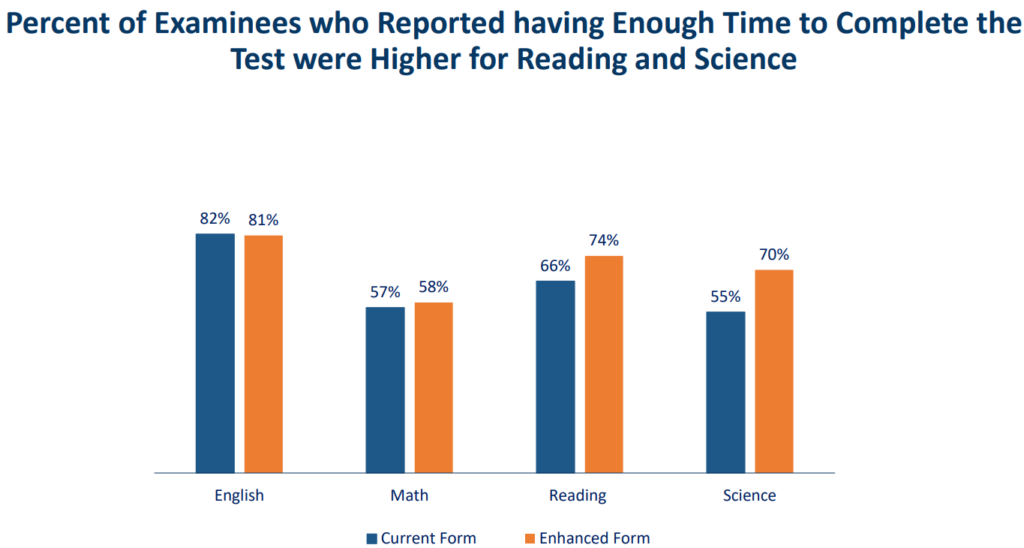
And, while only 58% of students reported that they had enough time to complete the Math section, that number is a bit misleading: the Math questions go from easy to hard, so it makes almost no difference for most students if they have enough time to “finish” the Math, because most students don’t get the Math questions at the end correct anyway. But, the Reading and Science sections do not get harder at the end, so having enough time to finish the Reading and Science sections is more impactful because students are simply missing out on getting questions correct if they can’t finish those sections. Thus, more time per question is beneficial but not necessarily a cure-all for students who were running out of time on the current ACT.
Optional (Useless?) Science Section
When the ACT announced that the Science section would be optional, I figured that most of the top schools would still require the Science section — why not get more information about the academic preparedness of applicants to improve decision-making?
But, according to the ACT’s own research that has recently been released, the Science section is essentially useless and pointless for most students.
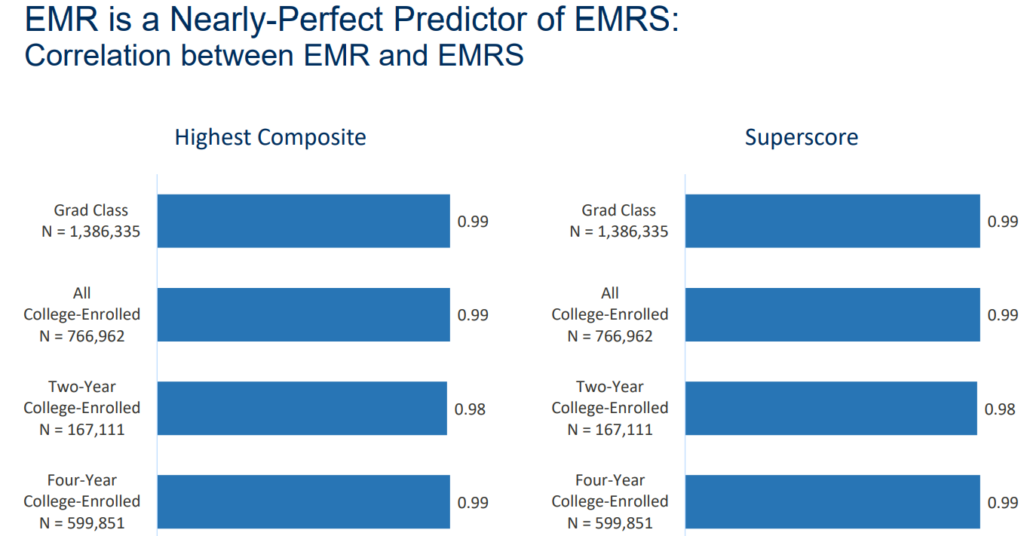
An ACT composite score from English, Math, and Reading has a .99 correlation to an ACT composite score from English, Math, Reading, and Science.
Essentially, a .99 correlation means that the two are 99% the same. Why put kids through taking an optional 40-minute Science section to get a score that is 99% the same? For most students, I see no reason to do that.
The ACT doesn’t publish research on how well the Science section in particular predicts success in a Science major in college, so perhaps there is still a good case for a student going into a STEM field to be required to take and submit an ACT Science section score. But, for most students, I hope that colleges don’t require the Science section because, according to the ACT itself, it appears essentially useless to do so. (Update: Of the colleges we track, only Pomona College requires the Science section of every applicant who submits the ACT, and a few, such as Duke and Georgetown, recommend it.) If students don’t need to take the Science section, then the test (English, Math, and Reading sections) will only be 2 hours and 5 minutes long (9 minutes shorter than the SAT, which is 2 hours and 14 minutes long).
More Score Variability
The new ACT has almost exactly half as many questions as the current ACT: it is changing from 215 questions to only 108 questions (I’m excluding the experimental questions, since those questions don’t contribute to a student’s score, and the Science section questions, since those also don’t contribute to the composite score). Fewer questions cause scores to fluctuate more from test to test simply because of random chance (and each question will have twice the impact on a student’s score, so a good day of guessing or a bad day of guessing will have twice the impact). While we suspected this would be the case, the ACT’s own research has confirmed it.
On the ACT test dates that offer My Answer Key, students can see exactly which questions they missed. Our free My Answer Key converter removes the experimental-question placeholders from the report so its numbers match the released booklet.
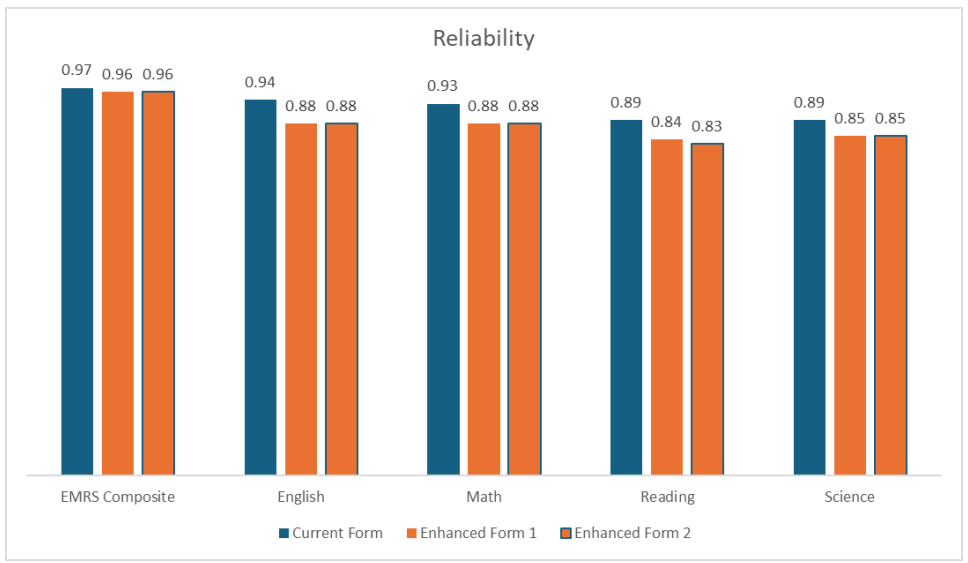
The above still demonstrate high measures of reliability, but not as high as they were on the current ACT. By losing reliability, the ACT is losing one of its advantages relative to the SAT: when the SAT changed in 2024, it too became less reliable, so students’ scores fluctuate significantly more.
Granted, both the SAT and ACT remain very good measures, just not as precise as they were. This is extremely important for students to understand because they should prepare for greater variability in their scores and, if they score lower than expected, not get discouraged on one or two tests — they need to expect to see their scores jump up and down more, so they need to retake the test until they have a good day, on a test that fits them well, with a test that has a good curve.
Here is an example of what we could expect score increases to look like with high reliability:

The student’s scores almost perfectly match the student’s acquired knowledge and skill.
But, what about when there is lower reliability?
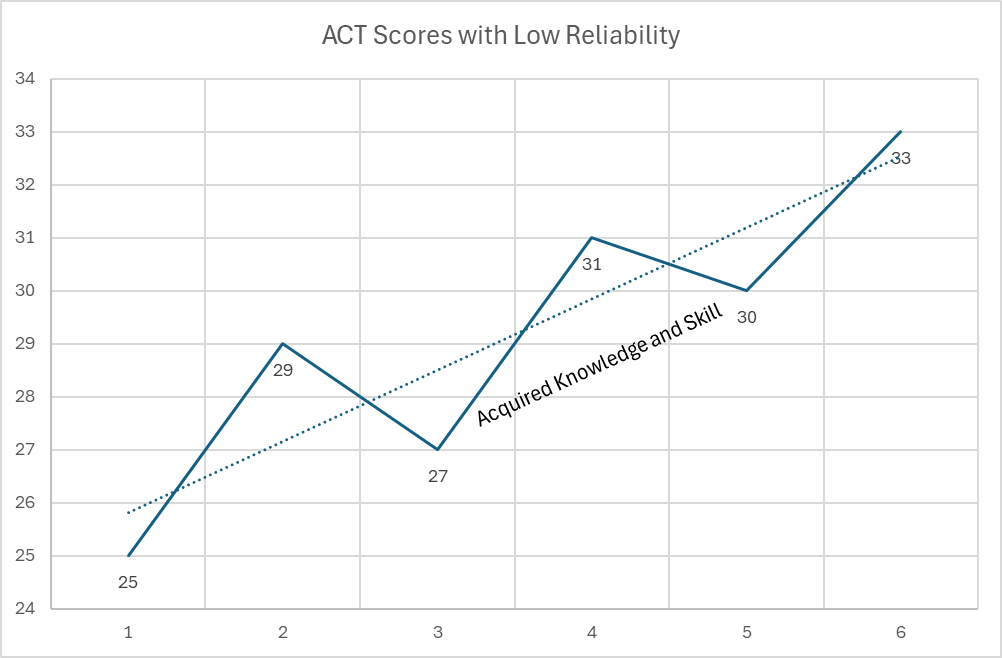
The student still reached the same goal, but it was a bumpy ride. On two out of five retakes, the student went down even though the student’s acquired knowledge and skill increased. That’s not fun, and students will need to be coached to understand that their scores will less perfectly match their knowledge and skill so they should expect to go up and down and not to get discouraged.
But, by how much should students expect their score to realistically fluctuate? By a lot.
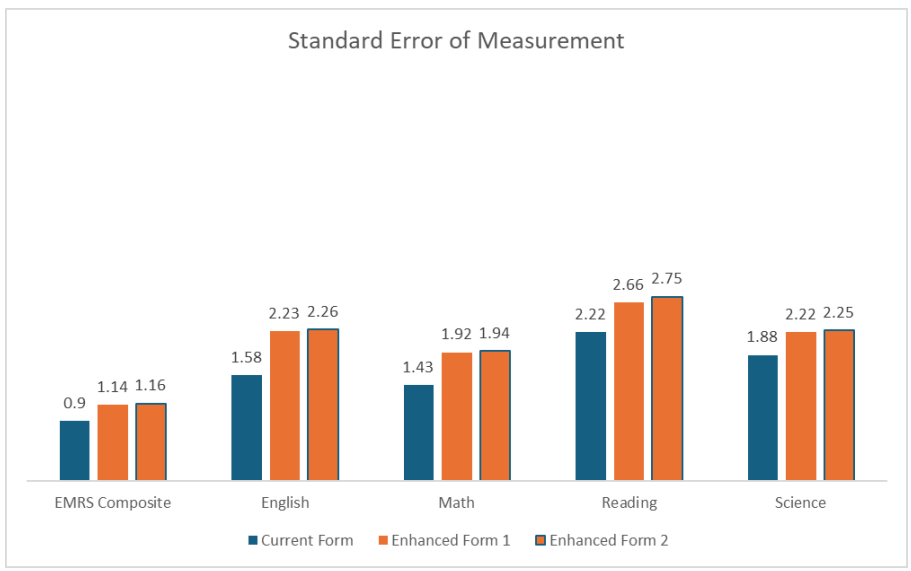
On the current ACT, the composite score has a .9 standard error of measurement. This means that 68% of the time a student will score plus or minus .9 composite points from their true knowledge and skill level. For instance, if a student’s true ability level is at a 30, they should expect that 68% of the time they will score between a 31 and a 29 (+/- .9 points from a 30) and that 95% of the time they will score between a 32 and 28 (+/- 1.8 points from a 30) — and actually still 5% of the time score above a 32 or below a 28. That’s already a lot of variability, but, without making the test longer, it’s the best they can do — and no test is perfect.
Unfortunately, the new ACT (like the current SAT) is becoming even more variable. The English section’s variability will increase by 42%, the Math section by 35%, the Reading section by 22% (but it’s already the most variable section), and the Science section by 19% — but hopefully no students or almost no students will be required by colleges to take that section.
The Reading section, in particular, is going to be quite variable. With a roughly 2.7 standard error of measurement, students can expect to see their scores be +/- 2.7 points of their true ability level 68% of the time and +/- 5.4 points of their true ability level 95% of the time. So, if a student’s true Reading ability score is a 25, then 95% of the time they will score between a 20 and a 30 on the Reading section. That’s pretty wild.
Again, as we have seen with the SAT since it changed in 2024, expect more fluctuation on the new ACT. This volatility could help a student to finish earlier than expected if they get lucky with a good test, or it could cause them to have to retake the test more times if they get unlucky with tests.
Next Steps
In sum, more time per question and a shorter exam (assuming students don’t need to take the optional Science section) are welcome changes. More variability in scores, however, is not welcome.
Since December 2025 the online ACT has also had the Desmos graphing calculator built into the Math section; our guide covers what the ACT version does and how to use it.
Overall, I like the changes and the updated test. The ACT has put out five official mock tests for the “new” ACT (two in printable pdf form can be found here and here; three separate ones can be found in the ACT’s official prep book). Important note: these “official” mock tests are not actually official tests from the updated test — they are recycled questions from past ACTs before the update. That doesn’t matter for the content — because the content is the same — but it does have implications for the scaling and scoring. These tests do not give authentic scores because they were never actually given as real past tests. We have found that these “official” mock tests overestimate students scores, on average, by about two points. They are still great for practicing the timing and format of the updated ACT, but a student should be cautious of using these scores as an apples to apples comparison — they are likely to underperform their scores on these “official” mock tests, on average, by 2 points.
For now, even with increased variability in scores on both the new SAT and new ACT, students can do what they have been able to do for decades: learn the foundational knowledge and skills most broadly needed for college (rhetoric, fundamental mathematics, reading, and data analysis), and they will see their scores on both the SAT and ACT improve regardless of the changes to the tests.
For the Math section specifically, our guide to ACT Math formulas and what to study first lists the relationships to know and how to find your own gaps on an official practice test.