
There has been too much misinformation about this topic, so here’s a guide for what most students should do. At the colleges that require the SAT or ACT the choice is made for you, so this guide is for test-optional colleges.
Our rule of thumb: send your SAT or ACT score if it is strong for the college, and “strong” means inside or above the college’s middle 50% range, or a little below it when the score still stands out for your high school. A score well below the range usually stays home. Then check the exceptions, because a scholarship, an every-score rule or a “no harm” policy can change the answer.
Here is how to do that in about five minutes per college.
First, check whether the college gives you a choice
“Test-optional” covers six different policies, and the label on the college’s own page decides which method applies to you. Our table of colleges that require the SAT or ACT covers the Forbes top 500, and our glossary explains what test-optional and test-blind mean.
| If the college says | What to do |
|---|---|
| Required | Send a qualifying score by the college’s route and deadline. |
| Announced return to required testing | Check the entry term; if it starts after your class, the choice is still yours. |
| Optional, encouraged, recommended or preferred | Use the method in this guide, and follow the college’s own advice before ours. |
| Expected | Plan to send a score. The college expects one. |
| Required for some, test-flexible | Check whether the condition covers your program or applicant group, and which tests satisfy it. |
| Test-blind | Don’t send a score for admission; the college won’t look at it. Scholarship rules can differ. |
Carnegie Mellon’s Griffin School of Computer Science requires an SAT or ACT score, five other colleges and programs accept AP, IB, A-level and other results in its place, and only its College of Fine Arts is test-optional, so “CMU is test-optional” is true for one college and wrong for the rest. Notre Dame says it “will remain test optional for those applying for fall 2027” and requires scores from fall 2028 entry, so an applicant for fall 2027 entry still makes the optional decision there. Purdue says it “is test expected, meaning we expect applicants to submit SAT, ACT or CLT scores,” and about 98% of the students it admitted for 2026 sent one, so at an “expected” college the question is not whether to send a score but which one. And Yale is no longer optional at all: it announced a test requirement in February 2024 (the ACT, AP, IB or SAT), and on May 27, 2026 it announced that, beginning with the next admissions cycle, first-year and transfer applicants must submit an SAT or ACT score. Its research from its test-optional years, below, is history, not current advice.
Find the college’s score range in about a minute
Don’t Google “Duke average SAT.” The results blend admitted with enrolled students, old classes with new ones, and superscores with single sittings. Go to the source instead: search the college’s name plus “Common Data Set,” open the latest edition, and go to section C9, which lists the 25th, 50th and 75th percentile SAT and ACT scores of the first-year students who enrolled that fall and submitted each test. The middle 50% runs from the 25th percentile to the 75th: a score at the 25th percentile was at or above about one in four of those students’ scores, and a score at the 75th was at or above about three in four. Read it with three cautions in mind:
- C9 describes enrolled students who submitted scores, so at a test-optional college it describes the students who chose to show their scores, which can push the range up. The SAT and ACT shares are reported separately, and a student who sent both counts in both, so you can’t add them: at Duke, 48% of enrolled first-year students submitted an SAT score and 27% an ACT score.
- Read the actual SAT total row, not the two section rows added together. The student at the 25th percentile in Math is usually not the student at the 25th percentile in Reading and Writing, which is why at Northwestern the two section 25th percentiles add to 1510 while the real 25th percentile for the total is 1520.
- The range may already be superscored. The Common Data Set tells colleges to report according to how they use scores, so compare your superscore with a superscoring college’s range and your best single sitting with the range of a college that doesn’t superscore.
If the Common Data Set is hard to find, the college’s class profile works as long as you read whether it describes admitted or enrolled students (Duke points applicants to its admitted-student profile, a different group from its C9 cohort), and the federal College Navigator and College Scorecard carry the ranges colleges report, often from an earlier year.
Which score to compare
Compare the score the college will actually use. If the college superscores, compare your superscore (our tables show which colleges superscore the SAT and which colleges superscore the ACT, with the self-report route for each). If you took both tests, compare the stronger one on the college’s scale; our guide to choosing the SAT or ACT covers what a 1400 SAT equals on the ACT, and our post on whether to submit both SAT and ACT scores covers that question. An enhanced ACT Composite (the three-section version) can be compared with a range built mostly from the older Composite, because ACT’s 2025 guidance says the two “can be used interchangeably with the legacy Composite scores for the same purposes”; what it can’t do is satisfy a program that still wants a Science score, so check the colleges that use ACT Science scores if you skipped it. And a college that wants every score you’ve earned, or that already holds an earlier report, changes the decision; our post on which scores colleges can see walks through those rules.
Decide whether to submit
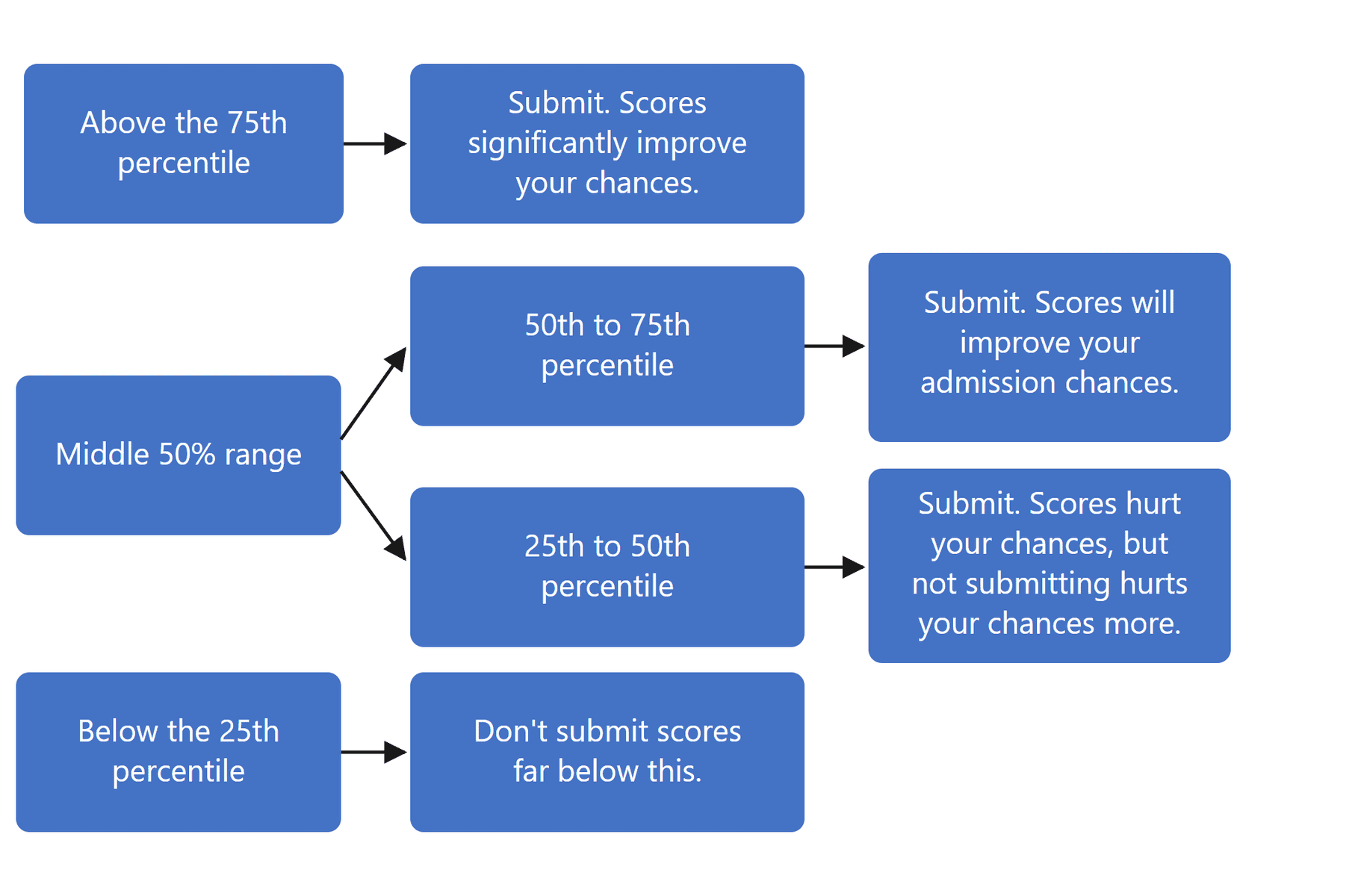
With the right range and the right score in hand, the decision mostly makes itself. Here is the chart, and the table below it adds the judgment zone and the exceptions:
| Where your score falls | Our recommendation |
|---|---|
| Inside or above the college’s middle 50% | Send it. Below the median is not below the range; half the enrolled submitters were below the median too. |
| A little below the college’s 25th percentile | Usually send it when the score is strong for your high school or the college encourages scores; otherwise it’s a judgment call, and we recommend sending it rather than leaving the college guessing. |
| Well below the college’s 25th percentile | Usually leave it off at a genuinely test-optional college, unless an exception below applies. |
Four exceptions override the table:
- A “no harm” policy. The University of Chicago says that “Any SAT or ACT score submitted will only be used in review if it will positively affect an applicant’s chance of admission.” At a college with that rule, a weak score costs nothing, so send it.
- A college that tells you what it wants. Tulane says that it will “encourage students with a 1300 or higher on the SAT and a 28 on the ACT to submit test scores,” assuming a strong academic record. When a college gives a number, use the college’s number, not ours.
- A scholarship that requires a score. The admission decision and the merit decision are separate, and a score that is weak for admission can still be required for money. Check which scholarships require SAT or ACT scores and which colleges accept superscores for merit scholarships before you decide.
- An every-score or Science rule. Once you send any score to an every-score college, you send them all; a program that wants ACT Science wants that section too.
Let’s do two real examples, one for each test, from the 2025-26 Common Data Set.
| College | SAT 25th / 50th / 75th | ACT 25th / 50th / 75th |
|---|---|---|
| Duke | 1510 / 1550 / 1570 | 34 / 35 / 35 |
| Northwestern | 1520 / 1540 / 1560 | 34 / 35 / 35 |
SAT, Duke. A 1550 sits at Duke’s median, so send it. A 1500 is just below the 1510 at the 25th percentile, which is exactly the judgment zone: at a high school that sends 1550s to Duke every year, a 1500 says little, but at a high school where a 1500 is the best score anyone has earned in a decade, it says a lot. Duke’s own advice is that an unsure applicant can apply without scores and opt in later (a yes can’t be switched back to a no). A 1400 is well below the range and unlikely to help on its own, and none of this is an admission forecast: a 1550 doesn’t get you into Duke, and a 1400 doesn’t keep you out if the rest of the application fits an institutional priority.
ACT, Northwestern. The 25th, 50th and 75th percentiles are 34, 35 and 35, which is what happens when a cohort bunches at the top of a 36-point scale: the “middle 50%” is two numbers wide. A 34 or 35 is inside the range, so send it. A 33 is one point below the 25th percentile, and the same school-context question applies. A 30 is well below. Northwestern says applying without a score “will not impact our review process or your chances of admission” and that it welcomes scores that “duly reflect your academic potential,” and it lets an applicant who applied without scores add them later, which is why there is no harm in deciding college by college.
A reporting deadline is not permission to take a new test: check each college’s own dates in our table of last SAT and ACT test dates by college.
Does not submitting test scores hurt you?
Not by rule at most test-optional colleges, but leaving off a good score gives up the help it would have been. Duke says students who apply without scores “will not be at a disadvantage in our consideration of their applications”; Northwestern says the same. We take them at their word: no one is marked down for a missing score. But “no penalty for a missing score” and “a good score helps” are both true at the same time, and the second one is what matters to you.
Students don’t choose to withhold their test scores because their scores are too high, so the college knows that the student who did not submit a test score had a test score that was below its median SAT/ACT score. Not submitting a test score is essentially submitting an ambiguously low test score.
But, because the score wasn’t submitted, the college has no idea how far below the median the student’s score actually is.
In this instance, top colleges are likely to choose the certainty of a still very good score below their median over the uncertainty of an unsubmitted score that might be very far below their median.
That is our reading of the incentives, not a quote from any admissions office, and some students who withhold never tested at all. Consider, then, what three colleges found when they studied their own test-optional years:
- Yale, February 2024. When it announced the end of test-optional admissions, Yale’s dean of undergraduate admissions, Jeremiah Quinlan, said that test scores were “the single greatest predictor of a student’s performance in Yale courses in every model we have constructed,” that applicants without scores had been less likely to be admitted, especially applicants from lower-income backgrounds and high schools with fewer college-preparatory courses, and that some had hurt their chances by withholding scores below Yale’s median that would have helped. Yale also said it had enrolled more than 1,000 students who applied without scores and that they had done relatively well, though with a statistically significant difference in average Yale GPA between students who applied with and without scores.
- Dartmouth, January 2024. Dartmouth’s January 2024 working-group report compared 2021-22 applicants from less-advantaged backgrounds (first-generation, a lower-income neighborhood or a high-challenge high school) who scored 1450 to 1490. Those who submitted the score were admitted at a rate of 7%; those who had withheld a known score in the same band, at 2%. That is nearly four times the admit rate for the same score, submitted. The known-score group was only 19% of nonsubmitters, the comparison is observational, and the pattern did not hold for more-advantaged applicants, so it is evidence, not a law.
- Cornell, April 2024. Cornell’s task force reported that, holding high school GPA and other characteristics constant, submitting scores went with a higher chance of admission at its then-test-optional colleges and little or none at its score-free colleges, while noting that submitters may be stronger in other ways. Its own conclusion was that sending scores to a test-optional college “seems prudent.”
All three went back to requiring scores, which tells you how they weighed their own evidence. In short, at a selective college that reads scores, an achieved score that is good for your context is evidence in your favor, and withholding it doesn’t make your testing neutral. It makes it unknown.
The relevant question, then, is not “Can I apply without test scores?” The relevant question is: “Should I apply without test scores?” In every aspect of life, there is a wide gulf between what we can and probably should do. Unless a highly selective college is test-blind (meaning it wouldn’t look at your score even if you sent it) or promises, as UChicago does, to use a score only when it helps, it is selectively test-optional: optional for some applicants, not for all of them. Colleges claiming to be test-optional should voluntarily shed light on their admissions processes, and if a college says not submitting test scores will not hurt a student, then we want it to tell us in detail how it evaluates applicants with and without test scores. Most don’t, which is why a college’s own research, when it publishes some, is worth more than its slogan.
Check your high school’s context
The same score means different things from different schools, and admissions officers read it that way. A college sees your score next to your high school’s profile (the document your counselor sends with your transcript, which the College Board recommends include the curriculum, the grading and ranking practices, and the school’s SAT and ACT score ranges) and, at colleges that use it, next to the College Board’s High School Performance Information, which shows an applicant’s score beside the school’s SAT 25th, 50th and 75th percentiles for the past three senior classes. (The College Board announced on September 2, 2025 that its older Landscape tool will be discontinued.) Neither reveals a score you didn’t send. Both tell the college what your school usually produces.
Here is the mirror image of our rule of thumb. Note: If a student comes from a high school known by top colleges to be of high caliber, then the colleges may feel confident enough in a student’s high school GPA to grant them admission without test scores, and in those instances the college would rather not have an SAT/ACT score below its middle 50% (because why bring down their average if they feel confident already in the student’s success at their institution?). That is our strategic read, not a stated policy. The flip side is the student from a school the college doesn’t know well, where a solid score supplies the context the transcript can’t. Ask your counselor for the current school profile and for how your score compares with recent graduates from your school; if your school has a scattergram tool, our guide to building a college list explains how to read it.
Institutional priorities work the same way. All colleges recruit students who meet their “institutional priorities,” which vary by college but can include recruited athletes, first-generation or Pell-eligible students, students from a region the college rarely sees, and, where a college still considers them, legacies and the children of faculty. If you meet an institutional priority, then you’re not competing against all the other applicants. You are competing against all the other applicants that meet the same institutional priority that you do.
Consider the decision process of a top college when it is considering two Pell-eligible students with equally great grades, both from high schools the college doesn’t know well (so it doesn’t have data on how students from those schools do at the college), and one applicant does not submit a test score while the other submits a 1500 to a college whose 25th percentile is 1510. The college knows the first student’s score was probably below its median. It has no idea how far below. The second student’s 1500 is a known quantity, and a strong one for that school. Which file would you rather be?
Am I likely to be admitted if I submit a score below the 25th percentile?
No. For example, you are unlikely to get into Duke with a 1500, and you’re not likely to get into Duke with a 1550 either, because Duke admits a small fraction of everyone who applies. The question this guide answers is narrower: given that you are applying, does your score help or hurt?
Won’t submitting a score below a college’s 25th percentile bring down their average?
Yes, a little, if you enroll. But colleges care much more about actual student outcomes than their average SAT/ACT score. Outcomes (graduation rates, retention rates, etc.) are dramatically more impactful on college rankings. If a college has to choose between the student it believes will succeed and protecting its range, it will choose the student, and that’s the right thing to do.
Do SAT and ACT scores actually help predict college outcomes?
Yes. But don’t take our word for it. Hear it straight from the colleges. Yale’s dean said it above. MIT’s Stu Schmill wrote in March 2022, when MIT reinstated its requirement, that considering test scores significantly improved MIT’s ability to predict student success, “especially in mathematics,” because every MIT student must pass calculus and calculus-based physics. Our post on how SAT and ACT scores predict college grades collects the research, and our companion post on colleges asking applicants to send optional scores tracks what the colleges have said since.
Should I always submit my SAT or ACT score?
No. If you have a 1200 and you’re applying to a college whose range starts at 1500, don’t submit, not even if you meet an institutional priority, because that score tells the college nothing it wants to know, and you still might get in without it if you’re a high enough institutional priority, have stellar grades in very rigorous courses (and probably 5’s on numerous AP exams), a stellar essay, etc. The exceptions are the ones listed under the table: a “no harm” college, a college that asked for the score, a scholarship that requires one. And an every-score college is the reverse case: there, once you send any score, you send them all.
If I don’t fit an institutional priority, can I still get in without test scores?
Maybe. It really depends on the caliber of the school. If you’re applying to a selective or highly selective college, you are not submitting scores, and you don’t fit an institutional priority, then, yeah, you’re very, very likely to be denied. Maybe a stellar essay will save you, but it’s unlikely. That is our judgment about the most selective test-optional colleges, and the Yale, Dartmouth and Cornell findings above are why we hold it.
But, most schools are not selective or highly selective. By the Institute for Higher Education Policy’s May 2026 analysis of federal data, 85% of four-year colleges that don’t admit everyone still admit at least half of their applicants, and 57% admit at least three in four. Most schools accept a majority of applicants, and so most students with grades at or above those colleges’ average have a good chance at admission without test scores. Granted, those schools are still more likely to give more aid and scholarships to applicants with high test scores. And some test-optional colleges go further and make a score mandatory for a named scholarship, so check which scholarships require SAT or ACT scores before deciding not to submit yours. The University of Alabama shows how the two decisions separate: for fall 2027 it requires a score from applicants with a GPA below 3.0, but its automatic scholarships for out-of-state students require an official score from a single test date, no superscores. But, most students will at least be able to gain admission to a decent school without submitting test scores.
Anything else I should know?
You are not alone in your confusion and consternation at this opaque process. But, it is a double-edged sword. When the pandemic made most selective colleges test-optional in the spring of 2020, students were clamoring for it. Then we saw the other edge: colleges used test-optional to their own advantage to more easily admit students who fit their institutional priorities. If you fit their priorities, that’s great: a win for you and a win for the college. If not, then that’s not so great, because test-optional admissions actually create more competition among top students for top scores as colleges’ average SAT and ACT scores creep up when students with lower scores who can still gain admission don’t submit their scores. That is our interpretation of the incentives, and the return of required testing at many selective colleges from 2024 to 2026 is the colleges’ own verdict on how it went.
Score submission FAQ
Is it worth taking the SAT or ACT if my whole list is test-optional? Yes. Taking a test and sending the score are two different decisions, and only the first has to be made in advance. A score you never earn can’t help at a college that reads scores and can’t qualify you for a scholarship that needs one.
Should I send scores to colleges before I apply? Usually not. Each SAT registration includes four free score reports, which you can choose or change through nine days after the test, and the ACT includes four if you list the colleges when you register, but the free sends go out whether or not you like the score, so self-report first (our post on score reporting in the Common App shows the per-college choice) and send official reports when a college asks.
I was deferred. Can I add a new score? At some colleges, yes, within a window: Duke lets a deferred Early Decision applicant who applied without scores opt in by February 13. No window lets you take a new test after the college’s last accepted date, so check the college’s last test dates and score deadlines before you count on a retake.
I’m applying Early Decision. Does that change the rule? No, but it raises the stakes, because you get one decision from that college. Our Early Decision guide says to submit a score with an ED application if it sits at or above the college’s middle 50%, because not submitting is essentially submitting an ambiguously low score; read it for how scores fit an Early Decision application.
My Math score is strong but my total is low. Does that matter for an engineering major? It can help, because colleges see the section scores as well as the total, and a strong Math section is evidence for a quantitative major that the total hides. Few colleges publish a section cutoff by major, so compare the section with the college’s section range and decide the way you would for the total.
Do AP or IB scores replace an SAT or ACT score? At a test-optional college they can supplement the file (and at a few test-flexible programs they can satisfy the requirement), but they don’t replace a required SAT or ACT. Our posts on AP exam scores in admissions and on whether to report AP scores cover that decision.

The bottom line
If the score is inside or above the college’s range, send it. If it is well below, usually don’t, and use the time to make it stronger. In between, your high school’s context and the exceptions decide. The SAT and ACT evaluate students on fundamental grammar, rhetoric (such as how to best construct paragraphs and essays), mathematics, reading comprehension, and data analysis (such as reading graphs and tables). These are skills that will help students excel in high school, in college, and in life. And these are skills that all students can improve upon. If you put in the hard work (it will be hard work), you can and will succeed and increase your proficiency in valuable skills, increase your scholarship chances, and increase your chances of admission to your desired college. Questions about your particular score and list? We love answering questions, so feel free to reach out to us anytime. We tutor the SAT and ACT one on one, in New Jersey and online for students anywhere, including outside the U.S.