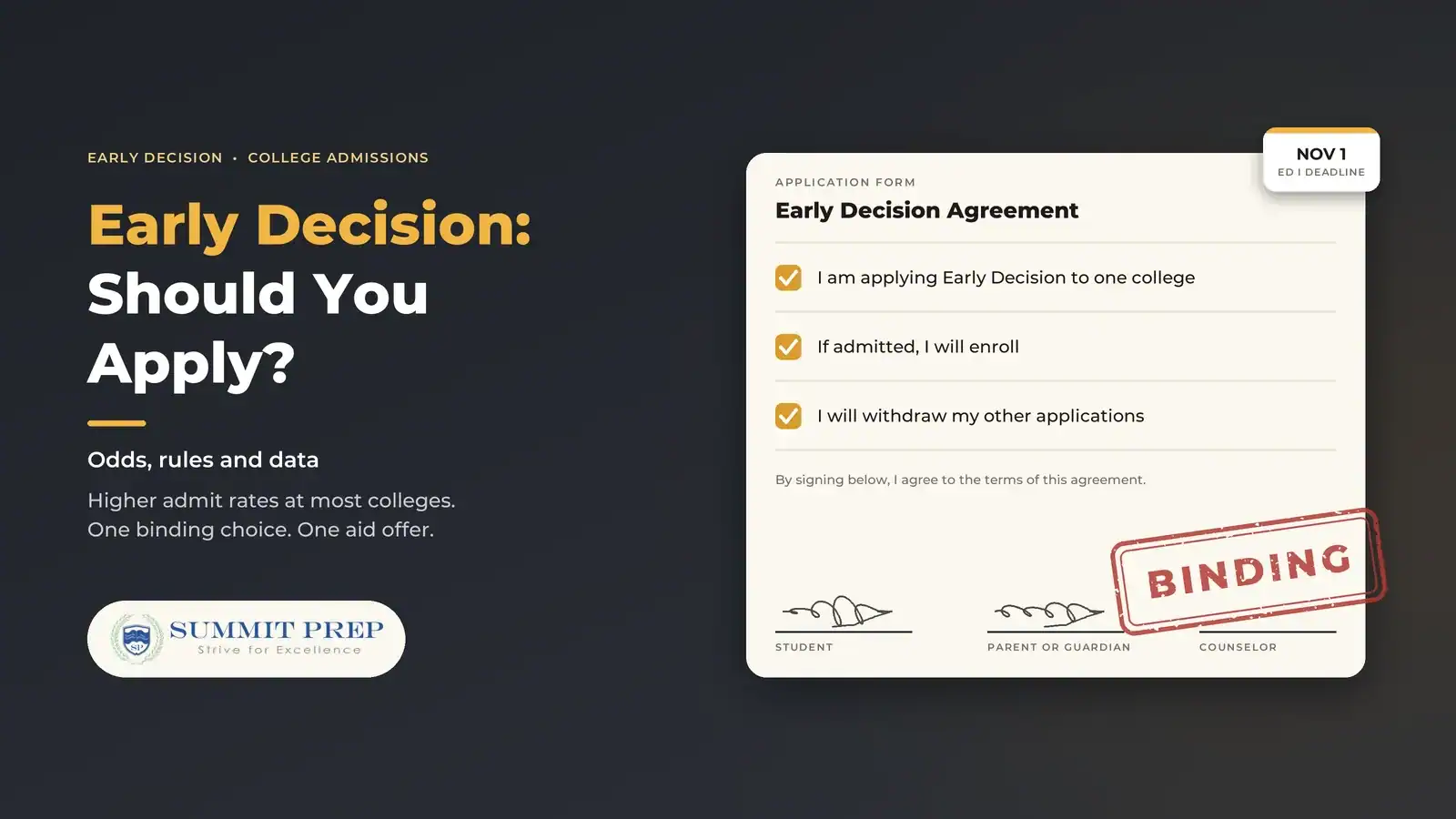
Early Decision (ED) is a binding application: you apply to one college by its early deadline, and if that college admits you, you enroll there and withdraw your other applications. In return, at many selective colleges the ED pool gets in at two to six times the rate of everyone else. Should you sign? If the college is truly your first choice, your family can pay what its net price calculator shows, and your grades and scores sit within its admitted range, then yes, apply Early Decision. If any one of those three is missing, then apply Early Action instead and keep your options open.
For the fall 2027 entering class, most ED I deadlines fall on November 1, 2026 (a Sunday, so several colleges list November 2), with decisions in mid-December and a second binding round, Early Decision II (ED II), due January 1 to 15, 2027. That matters more than the deadline suggests, because at 34 of the 58 colleges we analyzed, ED admits filled half or more of the fall 2025 class before anyone read a Regular Decision application. That’s a lot of seats gone by mid-December. The three conditions above also come with one practical check, covered below: your best test score has to exist by the deadline.
Key takeaways
- Early Decision is binding. Sign it only for a college you would choose over every other, at a price you have already checked.
- At the 58 selective colleges we analyzed for fall 2025, the ED pool got in at a median of twice the regular rate.
- The raw multiplier overstates the boost for an unhooked student. ED helps a student already in range and does little for one who isn’t.
- ED costs you the chance to compare aid offers, and the only exit is financial, decided by the college. File the aid forms.
- Whatever you decide about ED, apply Early Action somewhere. Most ED I deadlines for the fall 2027 class are November 1 or 2, 2026.
Does Early Decision increase your chances? What the data show
Yes, and at most selective colleges by a lot. The table below shows how much, college by college, and the rest of this section shows why the raw gap overstates the boost for a student with no hook.
Early Decision acceptance rates by college
Two rates sit side by side in the table. The “ED admit rate” is the admit rate of the ED pool alone, the students who signed the binding agreement, not the college’s overall acceptance rate, and the “regular admit rate” is the rate for everyone who wasn’t an ED applicant (which lumps Early Action in with Regular Decision), the definition James Murphy’s 2025 report for Class Action used for the 193 colleges that enrolled anyone through ED in fall 2024.
Early Decision (ED) admit rates versus Regular Decision admit rates at 69 selective colleges, from each college’s own Common Data Set (the fall 2025 entering class wherever the college has published its 2025-26 data; the data year is shown in each row). The ED edge is the ED admit rate divided by the regular-round rate, and class filled ED is ED admits as a share of the enrolled first-year class. Search by college or state, filter by the size of the edge, or click a column header to sort.
| 1 | Northeastern University | 4% | 43% | 11.2x | 54% | Fall 2024 |
| 2 | Dartmouth College | 4% | 22% | 5.7x | 64% | Fall 2025 |
| 3 | Barnard College | 6% | 33% | 5.2x | 68% | Fall 2025 |
| 4 | Tulane University | 12% | 58% | 5.1x | 65% | Fall 2025 |
| 5 | Brown University | 4% | 18% | 4.5x | – | Fall 2025, announced |
| 6 | College of the Holy Cross | 17% | 67% | 4.0x | 62% | Fall 2023 |
| 7 | Middlebury College | 10% | 39% | 4.0x | 73% | Fall 2025 |
| 8 | Tufts University | 8% | 32% | 3.8x | 61% | Fall 2025 |
| 9 | University of Pennsylvania | 4% | 13% | 3.6x | 52% | Fall 2025 |
| 10 | Williams College | 7% | 27% | 3.6x | 45% | Fall 2025 |
| 11 | Columbia University | 4% | 14% | 3.5x | 46% | Fall 2025 |
| 12 | Northwestern University | 6% | 20% | 3.5x | 57% | Fall 2025 |
| 13 | Vanderbilt University | 4% | 14% | 3.4x | 53% | Fall 2025 |
| 14 | Amherst College | 7% | 22% | 3.3x | 45% | Fall 2025 |
| 15 | Wesleyan University | 14% | 43% | 3.1x | 63% | Fall 2025 |
| 16 | Claremont McKenna College | 7% | 22% | 3.0x | 64% | Fall 2025 |
| 17 | Davidson College | 10% | 29% | 2.9x | 67% | Fall 2025 |
| 18 | Washington University in St. Louis | 9% | 27% | 2.9x | 68% | Fall 2025 |
| 19 | Boston University | 11% | 31% | 2.8x | 63% | Fall 2025 |
| 20 | Cornell University | 7% | 19% | 2.8x | 49% | Fall 2025 |
| 21 | Haverford College | 10% | 29% | 2.8x | 57% | Fall 2024 |
| 22 | Swarthmore College | 6% | 18% | 2.8x | 54% | Fall 2025 |
| 23 | Bowdoin College | 5% | 15% | 2.7x | 57% | Fall 2025 |
| 24 | Grinnell College | 13% | 34% | 2.7x | 65% | Fall 2024 |
| 25 | University of Miami | 16% | 44% | 2.7x | 40% | Fall 2025 |
| 26 | Bates College | 13% | 34% | 2.6x | 65% | Fall 2025 |
| 27 | Emory University | 9% | 22% | 2.6x | 73% | Fall 2025 |
| 28 | Duke University | 4% | 11% | 2.5x | 42% | Fall 2025, announced |
| 29 | Boston College | 14% | 33% | 2.4x | 60% | Fall 2024 |
| 30 | Hamilton College | 12% | 28% | 2.4x | 66% | Fall 2025 |
| 31 | Washington and Lee University | 12% | 28% | 2.4x | 58% | Fall 2025 |
| 32 | Villanova University | 26% | 60% | 2.3x | 56% | Fall 2025 |
| 33 | Wellesley College | 13% | 29% | 2.3x | 52% | Fall 2025 |
| 34 | Pomona College | 6% | 14% | 2.2x | 54% | Fall 2025 |
| 35 | Johns Hopkins University | 5% | 11% | 2.1x | 61% | Fall 2025 |
| 36 | Carnegie Mellon University | 10% | 21% | 2.0x | 31% | Fall 2025 |
| 37 | Vassar College | 19% | 38% | 2.0x | 58% | Fall 2025 |
| 38 | Skidmore College | 22% | 42% | 1.9x | 52% | Fall 2025 |
| 39 | University of Virginia | 15% | 28% | 1.9x | 35% | Fall 2025 |
| 40 | Bucknell University | 30% | 55% | 1.8x | 63% | Fall 2025 |
| 41 | Lehigh University | 27% | 47% | 1.8x | 63% | Fall 2025 |
| 42 | Carleton College | 20% | 35% | 1.7x | 51% | Fall 2025 |
| 43 | Pitzer College | 25% | 43% | 1.7x | 61% | Fall 2025 |
| 44 | Southern Methodist University | 47% | 80% | 1.7x | 25% | Fall 2025 |
| 45 | Harvey Mudd College | 12% | 18% | 1.6x | 46% | Fall 2025 |
| 46 | Santa Clara University | 47% | 76% | 1.6x | 28% | Fall 2025 |
| 47 | Smith College | 21% | 34% | 1.6x | 53% | Fall 2025 |
| 48 | Colgate University | 13% | 19% | 1.5x | 58% | Fall 2024 |
| 49 | Macalester College | 27% | 42% | 1.5x | 38% | Fall 2025 |
| 50 | Rice University | 7% | 11% | 1.5x | 51% | Fall 2025 |
| 51 | Texas Christian University | 47% | 68% | 1.5x | 34% | Fall 2025 |
| 52 | Elon University | 63% | 86% | 1.4x | 23% | Fall 2025 |
| 53 | Mount Holyoke College | 37% | 51% | 1.4x | 39% | Fall 2025 |
| 54 | Trinity College | 28% | 41% | 1.4x | 55% | Fall 2025 |
| 55 | William & Mary | 36% | 50% | 1.4x | 45% | Fall 2025 |
| 56 | Bryn Mawr College | 29% | 37% | 1.3x | 44% | Fall 2024 |
| 57 | Scripps College | 39% | 51% | 1.3x | 47% | Fall 2025 |
| 58 | American University | 65% | 81% | 1.2x | 20% | Fall 2025 |
| 59 | Dickinson College | 41% | 51% | 1.2x | 43% | Fall 2024 |
| 60 | Kenyon College | 30% | 35% | 1.2x | 56% | Fall 2025 |
| 61 | Lafayette College | 30% | 38% | 1.2x | 51% | Fall 2025 |
| 62 | Syracuse University | 48% | 56% | 1.2x | 37% | Fall 2025 |
| 63 | Oberlin College | 34% | 39% | 1.1x | 35% | Fall 2024 |
| 64 | Connecticut College | 39% | 41% | 1.0x | 48% | Fall 2025 |
| 65 | Franklin & Marshall College | 28% | 28% | 1.0x | 57% | Fall 2024 |
| 66 | Occidental College | 45% | 43% | 1.0x | 41% | Fall 2025 |
| 67 | University of Rochester | 42% | 42% | 1.0x | 38% | Fall 2025 |
| 68 | Brandeis University | 46% | 36% | 0.8x | 33% | Fall 2025 |
| 69 | Case Western Reserve University | 36% | 25% | 0.7x | 16% | Fall 2025 |
No colleges match that search. Try a different name or state.
Source: Summit Prep® analysis of each college’s own Common Data Set, sections C1 and C21 (fall 2025 entering class, applied in the 2024-25 cycle, unless the row says otherwise), checked October 2026.
More about the data: definitions, caveats, and how to check any college yourself
Regular Decision admit rate = (all admits minus ED admits) divided by (all applicants minus ED applicants). ED admit rate = ED admits divided by ED applicants; most colleges pool ED I and ED II. Class filled ED = Early Decision admits divided by the enrolled first-year class (an approximation, since a few ED admits do not enroll).
A higher ED admit rate does not mean an ordinary applicant’s chances rise by that multiple: ED pools include recruited athletes, legacies and students who applied because they were already strong candidates.
How the table was built: 69 colleges, 57 from their 2025-26 Common Data Sets, 10 on an older filing (marked, Northeastern among them), and 2 from the colleges’ own announcements and our own arithmetic: Brown (about 18%, from its admission release) and Duke (whose announcement counts 736 ED admits and leaves out 113 QuestBridge matches; with them, Duke’s rate would be about 13% and its multiplier about 3 times). Rows marked “announced” use the college’s own published early decision counts because its Common Data Set leaves them blank.
NYU, the University of Chicago and Wake Forest publish no ED counts in any Common Data Set we could find, so any ED rate you see for them elsewhere is an estimate. You can check any college yourself: search its name plus “Common Data Set,” open the newest PDF, and read section C21 next to section C1. That’s where nearly every number in the table comes from.
Now consider what three of those colleges tell applicants on their own Early Decision pages. Brown: “Please do not assume that your admission chances are improved by applying under the Early Decision plan.” Tufts: ED applicants are “held to same standard as Regular Decision applicants.” Columbia: “We hope you’ll resist external pressures to apply early for any other reason” than “a true passion for Columbia.”
Then consider the same colleges’ own filings. For the fall 2025 entering class, Tufts admitted 32% of its ED applicants and 8% of everyone else, nearly 4 times the rate, and Columbia admitted 14% of its ED pool and 4% of the rest. For the fall 2024 entering class, by Murphy’s count from its Common Data Set, Brown admitted 14% of ED applicants and 4% of all others.
Same decisions, same standards, and one pool gets in at more than 3 times the rate of the other.
Is any college saying something false? No. “Same standards” can be true sentence by sentence while the ED pool is admitted at 4 times the rate, because the ED pool is a different pool (more on that below) and because the college has decided to fill half or more of its class from it. But a family that reads “do not assume that your admission chances are improved” and then watches the college admit 14% of one pool and 4% of the other can be forgiven for assuming exactly that.
Penn has withheld its ED admit rate from its press releases since 2022. Its 2025-26 Common Data Set reports 9,503 ED applications and 1,266 ED admits for the fall 2025 entering class anyway, so the filing says what the press release leaves out.
Early Decision in numbers
- 193 Colleges that enrolled at least one student through Early Decision Out of roughly 2,000 four-year public and nonprofit colleges; 322 said they offered ED, and all but 13 of the 193 are private
- 73 Colleges that admitted 40% or more of the freshman class through ED Up almost 50% since 2015; at some colleges the share is close to 70%
- 21% Yield rate at all IPEDS colleges, 2023 (Murphy’s figure) The share of admitted students who enroll, half of what it was in 2001, which is why colleges want the certainty that ED gives them
- 180,000 Early Decision applications submitted in 2024 Equal to 8% of the students who enrolled as first-years that fall
- 57,352 Students admitted through Early Decision in 2024 Under 3% of all first-year students; 7 out of 10 ED applicants were not admitted in the early round
- 13% Common App applicants who applied ED somewhere in 2022-23 Up from 11% in 2014-15; 53% of Common App applicants applied Early Action somewhere and 13% applied Early Decision (the groups overlap)
Sources: James S. Murphy, Class Action, The Use and Abuse of Early Decision in College Admissions (2025), from the 2024-25 Common Data Set; Common App, Early admission deadlines: Student trends and implications (2023).
So ED is a small corner of American admissions, and it happens to be the corner where the most selective colleges live, as two more of Murphy’s findings show.
- Across all 193 colleges, the median ED multiplier was only 1.2 times the regular rate, and 59 colleges (about 3 in 10) showed no advantage or a penalty.
- Among the 44 colleges with overall admit rates of 20% or less, the median multiplier was nearly 3 times and the median ED share of the class 55%.
In short, ED is a real lever at about one college in five, and those are the colleges most families have in mind.
Our own pull for the fall 2025 class, one year newer and weighted toward those selective colleges, covers 80 colleges: 69 have usable ED counts, and 58 of those are for the fall 2025 class (57 from their 2025-26 Common Data Sets, plus Duke from its own December 2024 announcement, because Duke left the ED counts blank). Those 58 are behind the headline findings, and they show the same shape a year later.
- The median multiplier was 2 times, so the typical college in our data admitted its ED pool at twice the regular rate.
- 13 colleges were at 3 times or more (Claremont McKenna, the thirteenth, only just).
- The rest: 18 between 2 and 3 times, 23 between 1 and 2, and 4 below 1.
- Pooled across all 58, there were 134,487 ED applications and 35,073 ED admits, a 26% admit rate, against 17% for everyone else.
- Put another way, about 1 in 4 ED applicants at these colleges got in, and 3 in 4 were turned away, even in the round with the advantage.
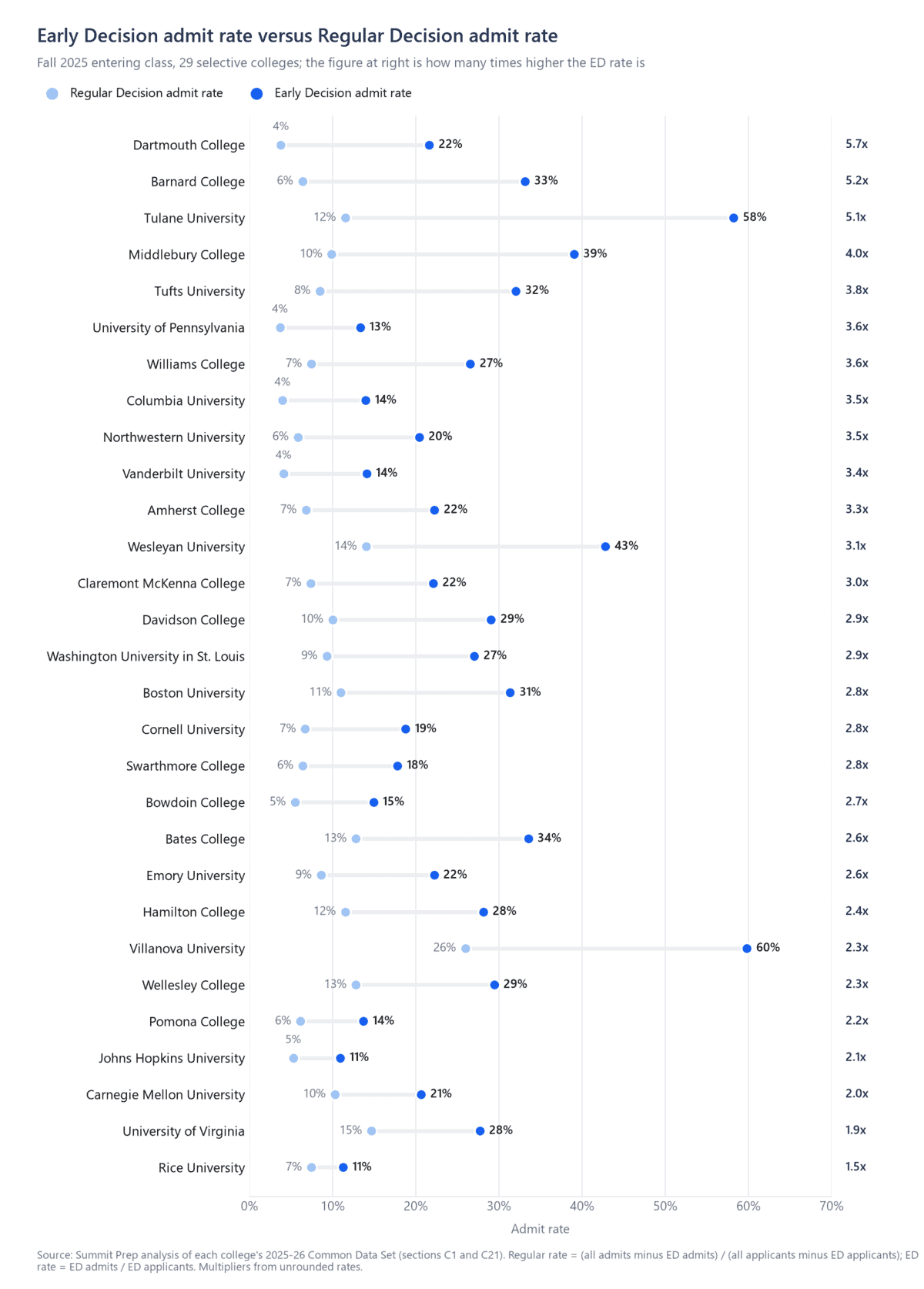
The largest edges in our fall 2025 data:
- Dartmouth admitted 22% of its ED pool against 4% of everyone else, nearly 6 times, which still means about 8 of 10 ED applicants were turned away.
- Barnard: 33% against 6%, 5 times.
- Tulane: 58% against 12%, 5 times.
- Middlebury: 39% against 10%, 4 times.
- Tufts: 32% against 8%, nearly 4 times.
The table carries the rest, including a cluster of Ivy League and similar colleges between 3 and 4 times.
Then there’s Northeastern, the largest gap in Murphy’s data. It hadn’t posted a 2025-26 Common Data Set as of October 2026, so we have to use its fall 2024 class: 43% of its ED pool admitted against 4% of everyone else, 11 times the rate. That’s pretty wild. And Murphy’s gloss says why it can: “With so much of the class filled already, the admissions office could reject 96% of the RD applicants.”
At the other end, ED gave essentially no edge, and at these five colleges it’s a way to finish early, not a way to get in:
- Connecticut College admitted 41% of its ED pool and 39% of everyone else.
- Rochester: 42% and 42%.
- Occidental: 43% and 45%, so the ED pool was admitted at a lower rate than the rest.
- Brandeis: 36% and 46%, also lower.
- Case Western: 25% and 36%, also lower.
A third count agrees on the pattern
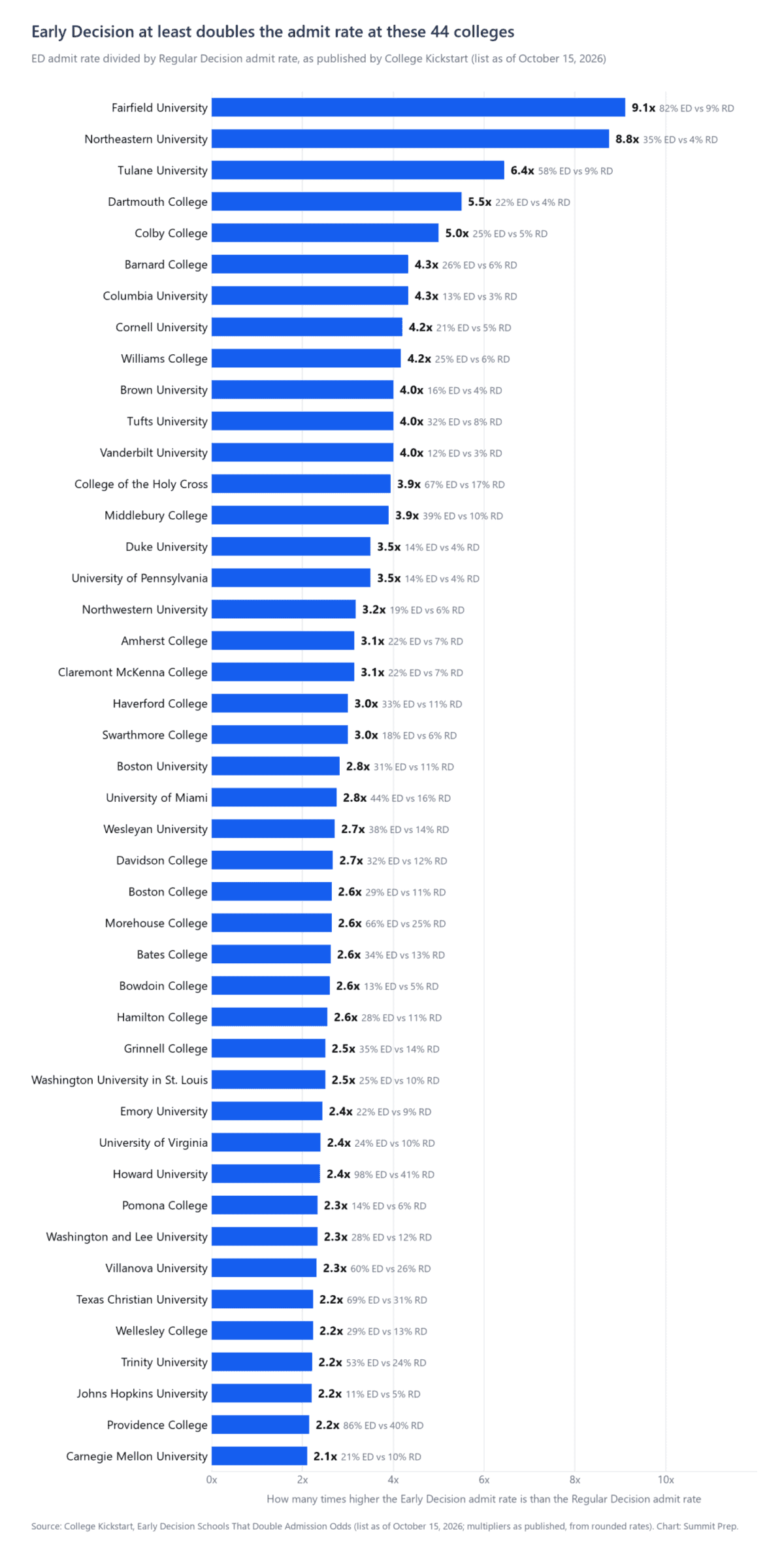
College Kickstart, a college-planning software company, keeps a list of colleges where the Early Decision admit rate is at least double the Regular Decision rate; as of October 15, 2026 it listed 44 colleges, 21 of them at 3 times or more. It’s built differently from ours (it publishes no method, its regular decision rates aren’t always computed the way ours are, and its rows mix the last three entering classes), so some multipliers differ while the pattern doesn’t.
Its own verdict: “These are differences too big to ignore.”
Why the raw multiplier overstates it
Granted, the raw gap is real. But the multiplier isn’t your multiplier. The gap a family sees is the hooked applicants in the pool, the stronger average preparation of ED applicants, the college’s decision to fill most of its class early and, smallest at the most selective colleges, the boost for committing.
Dartmouth’s own FAQ says the quiet part: “the published higher percentage of applicants accepted early is somewhat misleading because it includes recruited Division 1 athletes, whose credentials have been reviewed in advance. With recruited athletes removed from the Early Decision numbers, the statistical advantage isn’t as large.”
How large is the hooked share? In December 2019, Dartmouth reported that recruited athletes made up 25% of its ED admits and children of alumni 15%. Murphy adds the plainer point: ED applicants “tend to come from expensive private schools and wealthier ZIP codes,” with the scores, grades and activities “that reflect a life of parental investment in their success.”
How big is the real boost, like for like? The only careful estimate rests on 1990s data: Avery, Fairbanks and Zeckhauser analyzed the admission records of 14 highly selective colleges (the book is The Early Admissions Game, 2003) and found, as their 2001 working paper put it, that “early applicants are significantly more likely to be admitted than are regular applicants with similar qualifications.”
Harvard’s dean William Fitzsimmons summarized that advantage in 2003 as “approximately equal to the effect of an increase of 100 points in SAT® score.” Phillip Levine, a Wellesley economist writing for Brookings in January 2026, reads the later research as a 20% to 30% higher chance of admission for equally qualified ED applicants.
As of October 2026, we found no quality-adjusted estimate built on data from the 2020s, so the working rule is this: ED gives a real but smaller-than-advertised edge to an applicant who is already competitive, and almost nothing to one who isn’t.
How much of the class is already filled before Regular Decision
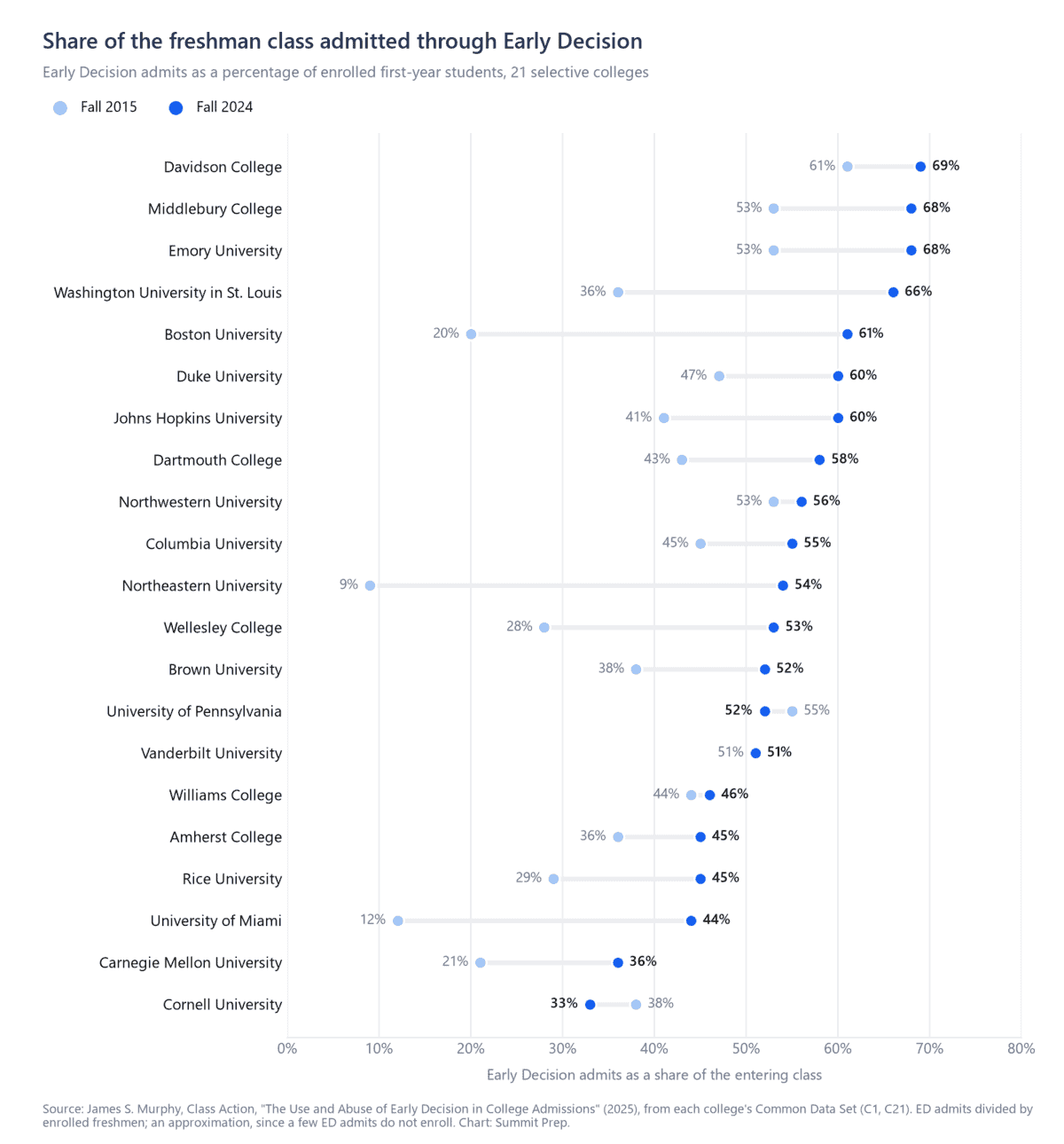
The number of colleges using ED has been flat for a decade, but the colleges that use it have leaned on it harder since 2015, by Murphy’s count.
- In 2015, Early Decision admits were equal to 9% of Northeastern’s freshman class. In 2024, 54%.
- Boston University went from 20% to 61% over the same nine years.
- ED admits equaled 40% or more of the entering class at 73 of the 193 colleges in fall 2024, nearly 4 in 10, up from 50 in 2015.
- Levine’s Brookings analysis of 66 of those heavy users found the average share enrolled through ED rose from 38% to 54%, from about 4 in 10 of a class to more than half.
Our fall 2025 data put it bluntly.
- At 34 of the 58 colleges, ED admits equaled half or more of the entering class.
- At 17 they equaled 60% or more, led by Emory and Middlebury (73% each), WashU and Barnard (68%), Davidson (67%), Hamilton (66%), and Tulane and Bates (65%).
- At Emory, nearly three out of four seats were spoken for before anyone read a Regular Decision application.
That’s enormous.
The colleges don’t dispute it. Johns Hopkins’ FAQ: “Historically, we admit the majority of our class through Early Decision rounds.” Wake Forest, with a straight face: “While we tend to enroll just over half of our incoming classes through Early Decision, we do not begin an admissions cycle intending to do so.” And of the 39 colleges on the published list above with a figure, 30 fill half or more of the class with ED admits.
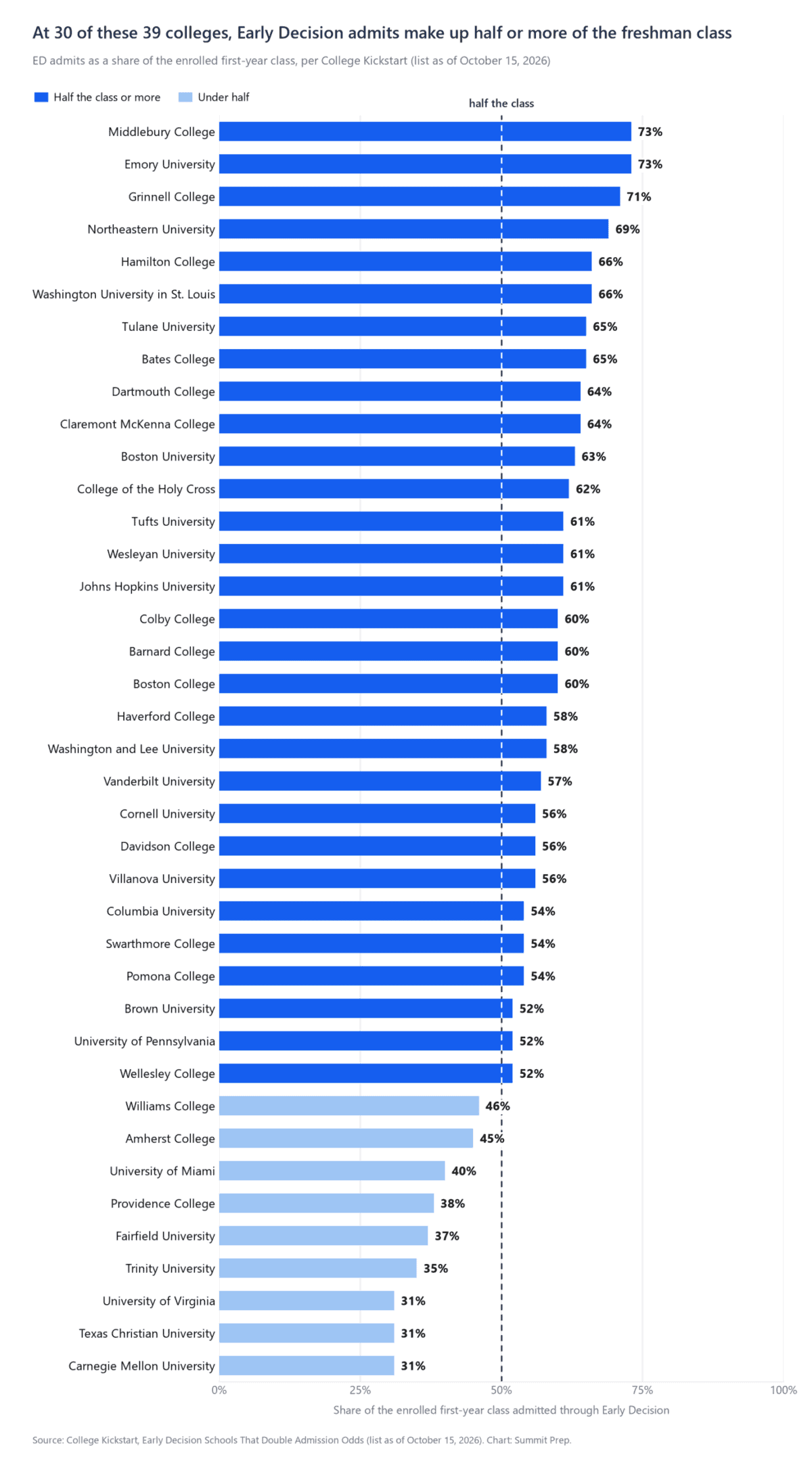
Which is why the January round is becoming Irregular Decision. When half or more of the seats are gone by mid-December, the regular-round admit rate at these colleges isn’t really the college’s selectivity, since it’s whatever is left over, and the biggest pool by far competes for it. Vanderbilt’s dean Doug Christiansen gave the arithmetic to the student newspaper in February 2026: “You’re admitting 50% of 1600 coming from a pool of 7,000.”
One caveat on the measure: the Common Data Set didn’t collect how many ED admits enrolled, so these shares divide ED admits by enrolled freshmen and run a little high. The Department of Education began collecting those counts in winter 2025-26, so, as of October 2026, exact figures were expected around the end of 2026.
What this means for your own odds
Take a student whose honest chance at a given college is 10% in the regular round. Levine’s reading of the research, a 20% to 30% higher chance for an equally qualified ED applicant, turns 10% into 12% or 13%.
The raw pool multiplier at a college like Penn, about three and a half times, turns 10% into 35%, but that figure includes the athletes, the legacies and the stronger applicants, so it’s a ceiling an unhooked applicant shouldn’t expect. Where you actually land is between the two, and closer to the first if you have no hook.
That’s still low.
Now take a student whose honest chance is 80%, a strong fit at a college that fills 60% of its class early. ED can absolutely push that student over the finish line, because the college is choosing between two qualified applicants and one of them has promised to come. The multiplier is the same, but the student isn’t, and the starting point is what decides whether it matters.
What is Early Decision? The agreement you sign
The National Association for College Admission Counseling (NACAC) defines it in one sentence in its Guide to Ethical Practice in College Admission (updated August 2026): “Students commit to a first-choice college at the time of application and, if admitted, agree to enroll and withdraw their other college applications.” The order matters. The commitment is made when you apply, not when the acceptance letter arrives.
What you sign is the Common App’s Early Decision Agreement, a one-page form that the student, a parent or guardian, and the school counselor all sign. Here is the key sentence: “If the student is accepted under an early decision plan, the student must promptly withdraw the applications submitted to other colleges and universities and make no additional applications to any other university in any country.”
A student applying for financial aid “need not withdraw other applications until the student has received notification about financial aid from the admitting early decision institution.” And the student signs this: “I also understand that with an early decision offer of admissions, this institution may share my name and my early commitment with other institutions.”
Keep in mind what the form doesn’t say. It never uses the words “contract,” “legal” or “penalty,” and the current form (the copy Johns Hopkins posted in August 2026) doesn’t carry the older NACAC sentence promising a release when the aid offer doesn’t make attendance possible. That release lives in each college’s own policy, so read your college’s ED page before you sign. The parent signs a line of their own (“I will ensure the student abides by the early decision commitment outlined above”), and so does the counselor, which means your high school’s name is on the promise too.
You may have only one ED application pending at a time (Boston University’s agreement: students “may have only one Early Decision application pending at any time”), and you may apply Early Action to other colleges at the same time, public universities included (the restrictive early action exceptions are in the table below). If you’re admitted ED, a nonrefundable deposit is due within weeks of the decision, typically $1,000 to $1,500 at the colleges that state an amount. Everyone else gets until May 1.
Early Decision vs Early Action vs Restrictive Early Action vs Regular Decision (ED vs EA)
| Plan | Binding? | How many colleges this way | Usual deadline (fall 2027 entering class) | Usual decision | Can you compare aid offers? | Who uses it |
|---|---|---|---|---|---|---|
| Early Decision I (ED I) | Yes | One | October 15 to November 15, 2026, most on November 1 or 2 | Mid-December | No, you see one offer from one college | Most selective private colleges, plus a few publics (UVA, William & Mary, Michigan, Florida, Florida State) |
| Early Decision II (ED II) | Yes | One, after an ED I denial or deferral elsewhere | January 1 to 15, 2027 | Mid-February | No | About four in five of the ED colleges in our data, and no Ivy League college |
| Early Action (EA) | No | As many as offer it | November 1 to 15, 2026 | Mid-December to February | Yes | MIT, Georgetown (whose EA bars a simultaneous ED application), most public universities, many private colleges |
| Restrictive or Single-Choice Early Action (REA, SCEA) | No | One private early application at Harvard, Yale, Princeton, Stanford and Caltech (Notre Dame bars only binding ED); public EA still allowed | November 1, 2026 | Mid-December | Yes | Harvard, Yale, Princeton, Stanford, Notre Dame, Caltech |
| Regular Decision (RD) | No | As many as you like | Early January 2027 | Late March to early April | Yes | Everyone |
| QuestBridge National College Match | Yes, except at MIT | Up to 15 ranked colleges | October 1 each fall (October 1, 2026 for the fall 2027 class) | December 1 (Match Day) | No, but a match carries a full four-year scholarship | Students from households under about $65,000 with minimal assets, at 55 partner colleges |
Should a student apply Early Decision?
The rule when we first wrote this guide in 2023 was short: if getting into college (not affording it) is the primary objective, then the answer is probably yes; if affording college is the primary objective, then probably not. That rule still holds. But “probably” turns on four questions, and a no on any one of them is a no on Early Decision.
1. Would you choose this college over every other?
The test isn’t whether you’d be happy there, it’s whether you would pick it in April over every college that might admit you, with comparable aid. That’s the test the colleges set themselves (Rice: ED “is a binding decision plan designed for students who have selected Rice as their first choice”). But the admissions author Jeff Selingo wrote in his November 2025 newsletter that “ED has turned into a strategy for getting into a selective college and less about committing early to a campus you love.” He’s right, and a strategy is a poor reason to spend four years somewhere.
So if the answer is “it’s one of three,” then don’t sign. And visit first. As we wrote in our post on choosing colleges, why would you do binding Early Decision to a school without visiting? If you can’t visit before the deadline, that’s a reason to apply Early Action.
2. Can your family pay what the net price calculator shows?
Every college that takes federal aid is required by law to post a net price calculator, which estimates what families like yours paid after grants in the prior year. Run it before you sign, with complete numbers (both households’ finances if the college wants the CSS Profile from a noncustodial parent, which some do), save the result, and ask one question: could we pay roughly this for four years without any merit scholarship? Wake Forest’s own FAQ gives the same advice: if the calculator shows an award “that is comfortable for the applicant and their family, they should feel confident about applying Early Decision.”
But the calculator estimates need-based aid only (Northeastern says flatly that “Early estimates for merit scholarships are not possible”), and it uses the prior year’s data. Then file the FAFSA and CSS Profile by the college’s ED aid deadline (most ED colleges set a date in November), because, as Cornell’s FAQ says of the financial release, “This applies only to students who have applied for financial aid.” So a family that skips the aid forms has no way out. And if the number only works with merit aid, then don’t apply ED. Boston College tells families who depend on merit aid not to apply Early Decision, Emory tells them to apply Regular Decision instead, and they would know.
3. Are you in the college’s admitted range?
Section C9 of a college’s Common Data Set lists the middle 50% of its enrolled students’ test scores, and your counselor can tell you where your grades and coursework sit. ED multiplies your chances. It doesn’t replace them. For the fall 2024 entering class, according to Murphy’s report, Duke admitted 17% of its ED pool and 4% of everyone else, about 4 times the rate, and 17% still means more than 8 out of 10 ED applicants were turned away. A student whose scores sit below Duke’s 25th percentile doesn’t have the pool’s 17%, because that 17% includes the recruited athletes and the applicants at the top of the range.
For that student, ED at Duke turns a very long shot into a long shot. For a student squarely in Duke’s range, ED is the tiebreaker Duke itself says it gives (“Applying early decision has an advantage in the admissions process,” per its FAQ).
So if you’re well below the range, then use ED where you are in range, or save it. And if the college’s multiplier is near 1 (Rochester, Connecticut College, Occidental, Brandeis and Case Western in our fall 2025 data), then ED buys you certainty and an early answer, not better odds. Commit there for fit, not for the boost.
4. Will your best test score exist by the deadline?
For the fall 2027 entering class, no college in our directory of last test dates rules out the October 3, 2026 SAT for ED I, and the October 17 ACT® works at nearly every one. The exceptions come earlier, not later: Rice’s ED I takes the September ACT, Richmond’s ED page names the September ACT too (October ACT scores may be self-reported), and Florida and Florida State, whose ED deadline is October 15, want a score on file by October 22, which leaves no margin for the October ACT. After that, it depends on the college.
- The November 7 SAT works at Penn, Duke, Dartmouth, Columbia, Tufts, the University of Chicago, Boston University, Harvey Mudd and Vassar.
- Brown, Rice, Tulane, and Washington University stop at October.
- Vanderbilt and Carnegie Mellon prefer scores by October or November 1 (“December testing is too late for Early Decision consideration,” says CMU).
- The December 5 SAT and December 12 ACT mean ED II or Regular Decision.
If your score is still climbing, then the question is whether a higher score in December beats the ED boost in November, and the answer depends on the college. At Penn, ED applicants to the Class of 2025 who submitted scores were admitted at 18%, nearly double the rate of those who didn’t, as we reported when Penn released its Class of 2025 Early Decision data, so a score that moves from below a college’s range to inside it can, as our post on retaking the SAT and ACT says, “more than offset the boost they would have gotten from applying early.”
At a college where the ED pool gets in at 4 or 5 times the regular rate, the trade is closer. Either way, apply Early Action somewhere in November while you retest, and submit a score with an ED application if it sits at or above the college’s middle 50%, because not submitting is essentially submitting an ambiguously low score.
Should you apply Early Decision? Six questions, in order
- 1. Is there one college you would choose over every other, no matter what else came in? No: skip Early Decision. Apply Early Action wherever you can and Regular Decision everywhere else. Yes: go to question 2.
- 2. Run that college’s net price calculator. Can your family pay the estimate for four years without a merit scholarship? No: do not apply ED. You would be signing away the one chance to compare offers, and the aid release is the college’s call, not yours. Yes: go to question 3.
- 3. Are your grades and scores inside the college’s middle 50%, or close to it? No: ED multiplies a small number, and the ED pool’s higher admit rate includes recruited athletes and legacies. Consider spending the ED card on a first choice where you are in range. Yes: go to question 4.
- 4. Does ED actually help at this college? Check its line in our table (or section C21 of its Common Data Set). Edge near 1x: ED buys certainty, not odds. Apply ED only if the early answer itself is worth the lost leverage; otherwise use Regular Decision. Edge of about 1.2x to 1.9x: a modest edge. Commit for fit first, not for the odds. Edge of 2x or more: go to question 5.
- 5. Are you also applying Restrictive Early Action to Harvard, Yale, Princeton, Stanford, Notre Dame or Caltech, or Early Action to Georgetown? No: go to question 6. Yes: ED I is off the table at the same time. If the restrictive college defers or denies you in mid-December, ED II elsewhere is allowed.
- 6. Will your best SAT or ACT score exist by the deadline? No (you need the December test): use ED II, with its January deadline, or Regular Decision. Apply Early Action somewhere in November anyway. Yes: apply ED I, apply Early Action to at least one other college, and keep the Regular Decision list ready in case the answer in December is no.
Before signing: file the CSS Profile and FAFSA by the college’s ED aid deadline, note any merit or honors deadlines that fall before the ED decision, and confirm the deposit date. The student, a parent and the school counselor all sign the Early Decision Agreement.
Who should sign, and which college to use it on
- If the answer to all four questions is yes, then apply Early Decision, and apply it to that college.
- If a college is your clear first choice but the price only works with merit aid, then apply Early Action or Regular Decision there and keep the merit deadlines (BU, Vanderbilt and Rochester, for instance, set December 1 scholarship dates). If you plan to apply test-optional, then check each scholarship’s own score rule, because some merit scholarships at test-optional colleges still require an SAT or ACT score.
- If the price works but the college is a long reach, then use ED where you are in range and apply Regular Decision to the reach.
- If you’re still retesting, then Early Action in November and ED II or Regular Decision after the retest.
- If a coach has asked you to apply ED, then the family should still run the aid test.
Which college, then? The worry we raised in 2023 still applies: if a student’s top choice is a significant reach, do they want to “waste” Early Decision there, or spend it on a phenomenal college that is a target for them? Don’t waste it on a long shot, and don’t lock yourself into a college below your level for a sure thing. Being strategic about this choice requires a realistic read of a student’s chances at a given college, the kind of read a good college counselor can give.
Apply Early Action everywhere else
Almost every student should apply Early Action to at least one college, whatever they decide about ED, because Early Action gets you a decision in December or January with no commitment. At some colleges the EA pool is admitted at no higher a rate than everyone else (NACAC’s fall 2018 survey put the average at 73% against 64% overall), so treat EA as an early answer rather than a boost. It also protects you against the December test: if you wait to apply anywhere until a December score comes in and the score disappoints, then you’ll have the same score you had in October and will have lost the advantage of applying early. Supplemental essays are due at the early deadline either way, which is why our application-essay timeline starts in the summer.
Pros and cons of Early Decision
The pros:
- A real boost to your admission chances at most selective colleges, though smaller than the raw numbers suggest, especially if the college would already consider you a good fit.
- An answer in December.
- If admitted, no more applications to write.
The cons:
- You lose the ability to compare and negotiate financial aid offers, which for a family on aid can be a terrible bargain.
- You lose the option to change your mind in April.
- The deposit is due within weeks and is nonrefundable.
- You spend the option on one college, which has to be the right one.
Mistakes to avoid
- Applying ED to a college you haven’t visited or can’t afford at the calculator’s price.
- Assuming you can back out. The only exit is the college’s own judgment about aid.
- Pairing ED with restrictive early action, or holding two ED applications at once. Both can get every offer rescinded.
- Missing merit and honors deadlines, which fall on or before the ED II deadline and in USC’s case on the ED I date (USC November 1, Emory Scholars November 15, BU, Vanderbilt and Rochester December 1).
- Treating a “preliminary” aid award as final. Vanderbilt’s arrives in mid-December, its deposit is due December 31, and final packages come in late March.
- Spending ED on a college whose multiplier is near 1 for the odds alone.
Why colleges love Early Decision
Colleges are businesses. What is the mandate of a college admissions office? At most schools (all except the few whose endowments make money a secondary concern), college admissions is about keeping the lights on. That’s the first priority. Second is admitting students who will maintain or raise the prestige of the school. The point of Early Decision, for a college, is that it serves both, and Murphy’s report gives four reasons that match what the deans say in public.
Start with yield, the percentage of admitted students who actually enroll. If a college admits 100 students and only 20 enroll, then it has a 20% yield rate, and it has just told the world that for 8 out of 10 of its admits it was a back-up.
But yield has been falling at American colleges every year since 2001, because students apply to more colleges every year (Common App applicants averaged under 5 applications each in 2013-14 and 7 in 2025-26), which makes every acceptance letter less likely to become a student and the whole class harder to predict. NACAC puts the average yield at four-year nonprofit colleges at about 30% in fall 2022.
ED is the cure, because nearly every ED admit enrolls: NACAC’s fall 2018 survey put the average ED yield at 90%, against 25% for all admits at the same colleges. Northwestern’s then-dean Christopher Watson said it best, in 2013: “Obviously your chances are going to be a little better if we’re your first choice and that’s a good thing for the school.”
At least he was honest.
Revenue is the part colleges talk about least, and Murphy spells it out: “Early decision does not just lock in students; it locks in the tuition revenue that comes with them, particularly since students who apply this way tend to come from wealthy families.” Merit aid is a discount offered to make a paying student more likely to enroll, and a student who has already promised to enroll needs no discount. Most colleges compete on price with merit aid, and ED lets a college fill part of its class without competing at all.
Then there’s shaping the class, which was the heart of this guide when we first wrote it in 2023. With Early Action and Regular Decision, colleges send out acceptance letters but can’t control who accepts them back, so a college could admit a large number of full-pay students and watch none of them enroll.
Early Decision gives a college real control over the foundation of its class: enough full-pay students, the recruited athletes a coach needs, the students from the feeder schools and pipeline programs it values. Colleges also want students who want them. But the size of the preference, 2 to 6 times the regular rate at the most selective colleges, isn’t about enthusiasm but about certainty, and certainty is worth money.
And there’s the admit rate. Since ED fills seats early, a college can admit fewer students in the regular round, which lowers its overall admit rate, and a lower admit rate attracts applicants who assume that lower means better. Tulane’s then-director of admission Jeff Schiffman told a NACAC conference panel in 2019, as Inside Higher Ed reported, “I cringe every time Tulane shares how excited we are about how low our admit rate is, but PR offices love this stuff.”
Tulane is the whole mechanism in one college: it launched ED in 2016, by 2017 26% of its class came through ED, and five years later 68% did. Jim Jump, a past president of NACAC, called Tulane in 2025 “the poster child for how colleges and universities use early decision to manage both enrollment and prestige.”
Colleges keep adding ED, and USC is the example: its then-director of admission Kirk Brennan told that same 2019 NACAC panel, “The sense of scarcity is created, manufactured, by early-decision programs,” and in February 2026 USC’s provost announced binding Early Decision for fall 2027 applicants, “in response to growing demand from students who are confident that USC is their top choice college.” Michigan added binding ED for the fall 2026 entering class, Florida and Florida State for fall 2027, and as of October 2026 no college we could find had dropped it in those two cycles.
Even the famous reversal ran the other way: Harvard announced in September 2006 that it would drop early admission, and by 2011 it had an early program again.
Is that fair? We don’t think so. But, again, college is a business. And as long as Early Decision is available, we don’t blame anyone for using the best option available to them.
Is Early Decision binding? Can you back out?
In practice, yes, it’s binding, and no, you shouldn’t plan to back out. Whether a court would ever enforce the agreement is a question that, as of October 2026, no court has answered. No ED agreement we read names a legal remedy, and we found no record of a college suing a student over Early Decision.
Jim Jump wrote in November 2025 that “Early decision is in no way legally binding, but colleges take the early-decision commitment seriously,” and the plaintiffs in a pending antitrust suit argue the same (allegations, not findings). Emory’s FAQ, for its part, calls ED “a contractual agreement.” So the answer to “is it legally binding?” is that nobody has tested it, and what matters to a family is what colleges actually do.
Colleges can rescind, and Dartmouth’s FAQ warns that if you’re admitted to more than one binding or restricted program, “the schools which admitted you may choose to rescind their offers of admission.” They can share your name, which is the clause you signed. They keep the deposit. And since the fall of 2025 at least one of them has punished a high school.
In the 2024-25 cycle, a senior at Colorado Academy, a private school in Denver, was admitted to Tulane through Early Decision, enrolled, and then withdrew, not for financial reasons, according to Tulane. In the fall of 2025 Tulane barred students from four high schools, Colorado Academy among them, from applying ED for one year, as the New York Times reported on October 26, 2025.
Tulane’s spokesman told the student newspaper the pause “is intended to give schools time to reinforce the importance of a promise signed by students, families and counselors,” and added that “Over 50 students were released from early decision for financial reasons in the last application cycle with no repercussions” (the 2024-25 cycle). Jump called it collective punishment, and as of October 2026 no other college we could find had copied it.
Whatever you think of the sanction, the lesson for a family is in that word “counselors”: your school counselor signed the agreement too, and your high school’s future applicants can pay for your promise.
So, can you back out? Through the front door, yes, on one condition. NACAC’s guide says colleges should release an ED applicant who is denied, deferred to Regular Decision, offered a different program or major, or “Not offered a financial aid award that makes attendance possible.” The last is the only exit you control, and the college holds it.
Columbia: “Only students who, after consultation with Financial Aid and Educational Financing, cite financial reasons for not attending will be released from the Early Decision agreement.” Cornell adds a condition that’s easy to miss: “This applies only to students who have applied for financial aid.” Assume that rule everywhere, write to the aid office before the deposit date, state the gap in numbers, and keep the reply.
Through the back door, you can decline and walk away, but your deposit is gone, your other acceptances may be withdrawn once the college shares its list, and, if Tulane’s example spreads, your younger classmates pay for it.
Don’t apply ED unless you mean it.
On August 8, 2025, students and graduates sued 32 selective colleges (Brown, Columbia, Cornell, Dartmouth, Duke, Penn and Vanderbilt among them) in federal court in Massachusetts, arguing that ED “is enforced by mutual agreement between would-be competitors not to compete for students offered admission through Early Decision at other schools.” On August 7, 2026, Judge Angel Kelley denied the colleges’ motion to dismiss, and the case moved into discovery. As of October 2026 it’s pending, nothing on the merits has been decided, and no family applying for fall 2027 should plan around it.
Early Decision and financial aid
What Early Decision usually costs you isn’t aid itself, it’s the ability to compare, because you see one offer instead of several. Penn says it on its own page: Regular Decision is for applicants who “want the ability to compare financial aid packages across all schools to which you are admitted.” Is that comparison worth money? Yes. In Sallie Mae’s How America Pays for College 2026, 33% of families with an aid offer from the college the student attends appealed it or asked for more, and 70% of those who asked received more aid.
Our post on negotiating college financial aid describes adjustments of $1,000 to $10,000 a year, “especially if you can show a competing offer,” and that’s the lever an ED admit no longer holds. Appeals on need still work (Dartmouth’s FAQ for ED admits who can’t afford it begins “Tell us!”), but an appeal without a competing offer is a request, not a negotiation.
Need-based aid is the smaller worry. Every college that addresses it says need-based aid is calculated the same way in either round (Johns Hopkins: “Your admissions plan does not affect your financial aid offer”), and the colleges that meet full demonstrated need (BU for ED applicants, Duke and Wake Forest among them) make the calculator’s estimate a close guide to the real offer.
But Murphy’s caution applies. Some ED colleges promise full need, and, as he wrote in a 2022 brief for Education Reform Now, “the vast majority do not,” so at the rest the gap between estimate and offer is unknown until December. Some ED colleges are need-blind and some are need-aware, and the college’s own aid page says which.
The release has traps built in. Vanderbilt releases “preliminary” aid offers with its mid-December decisions and finalizes them in late March, while its ED deposit is due December 31, and Lehigh gives families “two weeks to make a decision” after a preliminary offer based on the prior year’s costs, so a family can be asked for a nonrefundable deposit while holding an estimate. And because the release is tied to need, no college we read releases a student because a merit scholarship failed to arrive.
Merit aid is where the plans diverge. A Tulane admissions counselor, Owen Knight, wrote on the office’s blog on August 30, 2022 that “Need-based Aid is offered the same regardless of round, but merit aid varies more with ED,” and that for ED students “that pool of money is smaller.” Vanderbilt says there is “no advantage or disadvantage” to ED for scholarships, then notes that ED admits commit “without knowing if you will be offered a merit scholarship,” because recipients aren’t told until late March. Emory says its scholar awards are “not finalized until early April,” so students who need merit aid “are advised to apply under Regular Decision.”
No college we read says ED applicants get more merit aid. And since most colleges compete on price (the most selective ones don’t) and college is a massive investment either way, the bargaining power matters. In short, Early Decision trades bargaining power on price for a better chance of getting in.
Who applies Early Decision
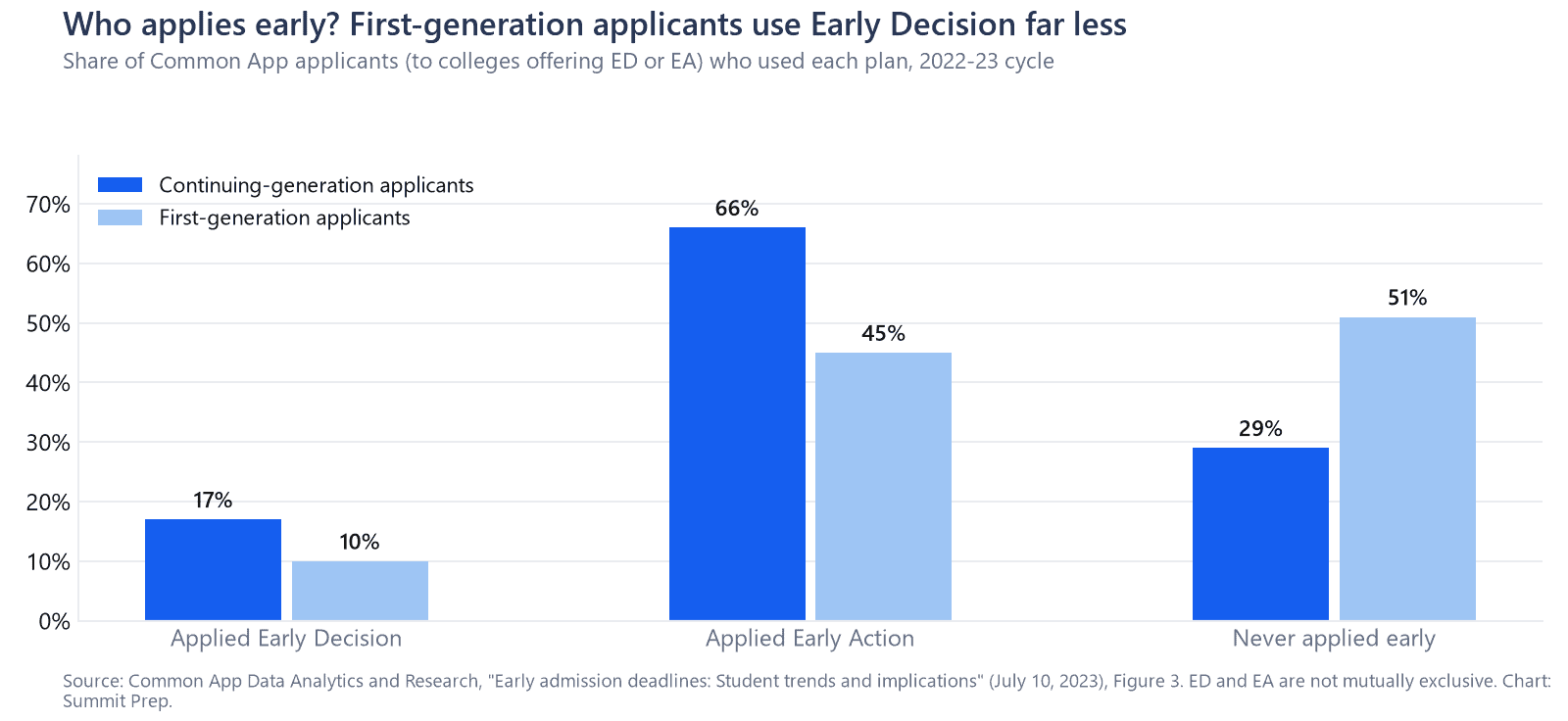
ED skews toward the students who can afford to sign before the aid offer arrives and who know the option exists. Common App’s July 2023 analysis of the 2022-23 cycle found two gaps.
- Continuing-generation applicants applied ED at 17%, against 10% for first-generation applicants.
- 52% of fee-waiver-eligible applicants never applied early at all, against 29% of everyone else.
But the number that stopped us is this one. Among applicants with a GPA of 3.8 or above, 42% of those in ZIP codes where at least 80% of adults hold a bachelor’s degree applied ED, against 8% in ZIP codes where fewer than 20% do. Yes, you’re reading that correctly: with grades in the same top band, more than 5 times the use of ED.
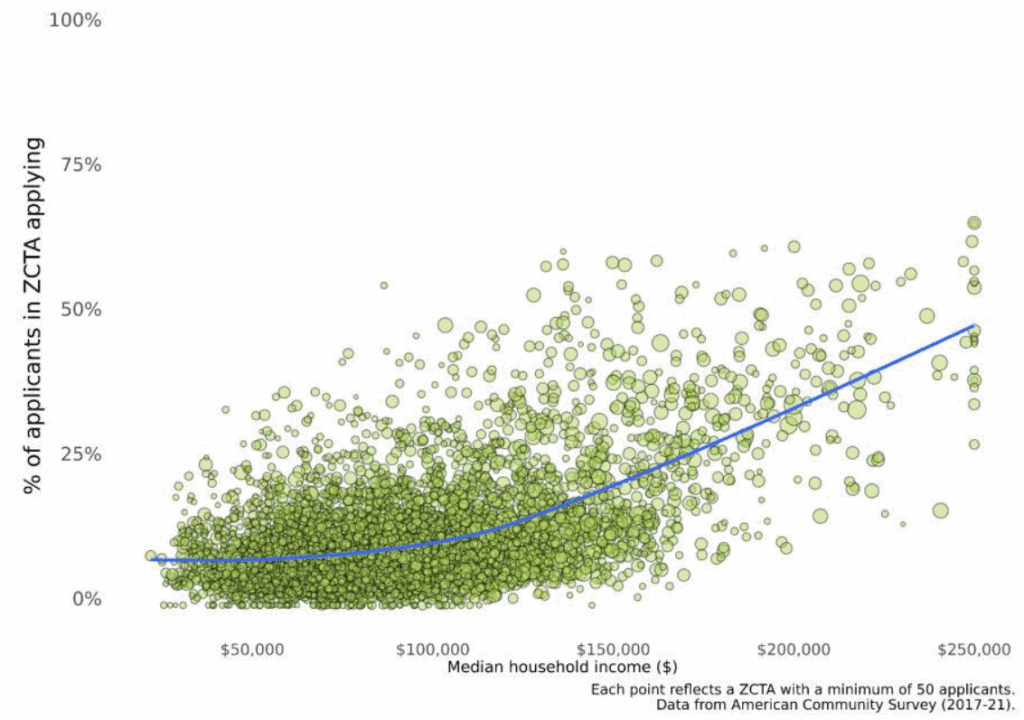
Common App’s conclusion: “community factors, including financial resources and informational access, more strongly predict ED applying than academic performance.” The same report’s chart of ED applying against ZIP-code income, which has sat in this post since 2023, shows the same slope, and the lesson holds: the gap is partly fit (a family that can pay has less to lose by committing) and partly information. Murphy puts the second part bluntly: “Hiring a private admissions consultant is one of the strongest predictors that a student will apply ED.”
Does ED change who ends up in the class, as opposed to who gets in early? The experts disagree: Murphy, writing for an advocacy organization, argues that it “puts students from low- and moderate income households at a disadvantage,” while Levine, writing for Brookings, studied 66 heavy ED users over nine years and found no association between greater use of ED and the share of students receiving Pell Grants. So ED clearly changes who gets in early, and whether it changes who ends up in the class is disputed.
Is ED only for the wealthy, then? No, and the information gap cuts both ways. A student who needs aid can still apply ED to a college that meets full need, after running the calculator with real numbers, filing the aid forms on time and saving the college’s release sentence (Murphy, on the fear of being locked into an unaffordable college: “That is not the case”).
And a student from a household earning under about $65,000 with minimal assets has a binding early route built for them: the QuestBridge National College Match, which lets a finalist rank up to 15 of its 55 partner colleges (most of the colleges in our table among them), with a match that is binding except at MIT and comes with a full four-year scholarship. The Match application is due around October 1 (October 1, 2026 for the fall 2027 class) and Match Day is December 1, ahead of the ED I decisions.
Early Decision II (ED II, or ED 2): the second binding round
ED II is the same promise with a January deadline. For the fall 2027 entering class, ED II deadlines run January 1 to 15, 2027 (the timeline below has the dates), with decisions in mid-February and deposits due within weeks. Tulane: “as with Early Decision I, Early Decision II is a binding agreement.” Of the 69 colleges with ED counts in our data, 56 list a second round. The ones that don’t are the Ivy League colleges with ED (Brown, Columbia, Cornell, Dartmouth and Penn), plus Duke, Northwestern, Amherst, Williams, Barnard, Carnegie Mellon and UVA (Case Western’s filing leaves the second-round fields blank), and USC’s program, announced in February 2026, is a single round too.
Who is ED II for? Murphy’s description is exact: it “is designed, in part, to catch students rejected by another institution during the initial round of ED.” It also serves a student who wasn’t ready in November because a score or an essay wasn’t, and the rules make room for both.
- Harvard, Stanford, Caltech and Notre Dame all allow a student they deny or defer in mid-December to apply ED II elsewhere (Harvard’s FAQ: you are “free to apply under any plan, including binding ones like Early Decision II”).
- Many colleges let you convert a Regular Decision application to ED II by signing the agreement after the fact (Johns Hopkins allows it until January 16).
- The December 5 SAT and December 12 ACT count for ED II at Rice, Tulane, Boston University, Tufts, and the University of Chicago, among others, and Vanderbilt lists them as its preferred last test dates.
Does ED II help as much as ED I? Nobody outside the colleges knows, because the Common Data Set pools both rounds into one count and no college we read publishes the split. The one college we found that has published one, Emory, admitted 33% of its ED I applicants and 13% of its ED II applicants for its fall 2020 class (Atlanta campus), as its student newspaper reported. Merit and honors deadlines often sit at or before the ED I date, so an ED II applicant has usually missed them, and Johns Hopkins never defers ED II applicants: the answer is admit or deny.
A side note on Wake Forest, whose ED I is “a rolling process” that reads applications from August 1 and sent its first decisions of the 2026-27 cycle on September 30, 2026, so a Wake denial can arrive before November 1 and free a student to apply ED I elsewhere, then ED II somewhere else, which is why Selingo’s newsletter calls it “EDZero.” Three binding rounds for one student isn’t what a first-choice commitment was meant to be, but it’s where the incentives lead.
So if you were denied or deferred in ED I and a true second first choice passes the same four tests, then apply ED II there. If your ED I college was a reach and a target college you’d be glad to attend offers ED II, then that’s a sensible use of it. If you would be applying ED II only because the option exists, then don’t, because it’s a new binding promise with the same deposit and the same consequences.
Early Decision deadlines and when decisions come out
The pattern repeats every year, and only the dates shift. For the fall 2027 entering class, ED I deadlines run October 15 to November 15, 2026, with most on November 1 or 2. We checked each college’s page in October 2026, and the timeline below carries the dates.
The early application calendar, fall 2027 entering class
- October 3 and October 17, 2026 Last SAT (October 3) and ACT (October 17) to plan on for Early Decision I Some colleges (Penn, Duke and Dartmouth among them) take the November 7 SAT for ED I, and a few stop earlier; check the college’s testing page. December tests only work for ED II or Regular Decision.
- November 1 to 15, 2026 Early Decision I deadlines, and most Early Action and Restrictive Early Action deadlines November 1 at most colleges (Columbia, Penn, Vanderbilt, Tulane, USC); November 2 at Duke and the University of Chicago; November 15 at Wake Forest and Carleton. The signed Early Decision Agreement and the aid forms (CSS Profile, FAFSA) are usually due with the application.
- Mid-December 2026 ED I decisions: admitted, deferred or denied Admitted means withdraw every other application and pay the deposit by the college’s date (Tulane January 15; Wake Forest within two weeks). Deferred means the binding promise is released at most colleges and you may apply ED II elsewhere. Restrictive Early Action decisions arrive the same week.
- January 1 to 15, 2027 Early Decision II deadlines, alongside most Regular Decision deadlines January 1 at Vanderbilt and Wake Forest; January 4 at the University of Chicago; January 5 at Wellesley and Boston University; January 15 at Tulane and Carleton. ED II is just as binding as ED I. No Ivy League college offers it.
- Mid-February 2027 ED II decisions Deposits typically due within weeks (Vanderbilt March 1).
- Late March to early April 2027 Regular Decision results By then more than half of the class is already full at many of the colleges in our table.
- May 1, 2027 National reply date for Early Action and Regular Decision admits Early Decision admits committed back in December or February and never see this date.
Deadlines are each college’s published dates for the 2026-27 cycle. Dates checked October 2026; confirm each date on the college’s own page.
By the ED I date you need more than the application: the supplemental essays (which belong in the summer and early fall), the CSS Profile and FAFSA by the college’s ED aid deadline, and your test scores. Plan on the October 3 SAT (scores October 16) or the October 17 ACT (scores October 22 online, October 27 on paper) for ED I. Some colleges take a later SAT (Penn, Duke, Dartmouth, Tufts and the University of Chicago, among others, accept the November 7 SAT for ED I), and Rice stops earlier, at the September ACT, so check the last SAT and ACT dates each college accepts before you register.
October ACT scores start releasing before November 1 (online scores first), but a college gets its copy after that, and not every college reads a score that arrives after its deadline, so do not count on a grace period: check each college’s own rule on late scores. As our SAT and ACT testing timeline says, a student who starts late can test through October of senior year and still submit to the early round, but the target is to finish by the end of junior year, for exactly this reason.
Which colleges offer Early Decision, and which do not
The College Board puts it at “Approximately 450 colleges” with early decision or early action plans, some with both. Early Decision specifically is a private-college tool: of the 193 colleges that enrolled anyone through ED in fall 2024, Murphy counts only 13 public universities (UVA, William & Mary and Miami University of Ohio among them), and Michigan, Florida and Florida State have joined since.
The most famous names without it are Harvard, Yale, Princeton, Stanford, Notre Dame and Caltech, which run restrictive or single-choice early action, and MIT and Georgetown, which run non-binding Early Action (Georgetown’s still bars a simultaneous ED application). As for why not more, Murphy’s answer is that “most colleges and universities don’t have a brand strong enough to draw sufficient applications to make the investment in early decision worthwhile,” which is a polite way of saying ED only works when the college is the one being chosen.
Deferred or denied Early Decision? What to do in December
A deferral lifts the commitment. Cornell: “Students whose applications are postponed to regular decision are released from the early decision binding commitment.” The Common Data Set defines a deferred ED applicant as one forwarded to the regular pool “without prejudice.” Your moves are few and specific.
- Send mid-year grades, because nearly every college asks for them.
- Follow the college’s own instructions (NYU requires a deferral response form and asks for no extra recommendation letters).
- Where the college invites updates, write a short letter of continued interest, with gratitude and a real development or two, in the spirit of the one our letter of continued interest post describes for waitlists.
Then look at ED II elsewhere if a true second first choice exists, and keep the Regular Decision list strong. Be realistic about the odds: Dartmouth says “5 to 10 percent of candidates deferred in Early Decision are typically admitted,” and about 10% of Vanderbilt’s fall 2026 class came from deferrals. Our guide to what to do if you are deferred walks through each step.
A denial is final at that college for the year. Cornell, Brown, NYU, Tufts and Johns Hopkins all say a student denied in ED may not reapply Regular Decision in the same cycle, and Emory explains why it denies rather than defers: “If we know a student does not have a chance for admission, we deny them at the ED stage.” That’s a hard truth. But keep in mind that a denial from a college that admits 4% of its regular pool was always the likely outcome (even Penn’s ED pool was turned away nearly 9 times in 10), and you’re free to apply ED II to a different college and Regular Decision everywhere else.
Treat mid-December as the start of the regular round, not the end of the early one, and you’ll be the student who ends up with good choices in April.
Video: Early Decision and Early Action explained

In this interview for the National Test Prep Association, published September 20, 2022, our co-founder David Blobaum explains why students should strongly consider applying Early Decision to their top-choice college and Early Action to the rest. The video is from the 2022-23 cycle, so the dates above are the ones to use.
The bottom line
The decision you make by the ED I deadline is less about the odds than about the promise. If a college is truly the student’s first choice, the family can pay what its net price calculator shows, the student sits within the college’s range, and the best test score is in hand by the deadline, then apply Early Decision, because at most selective colleges the early round gives a student in range the better odds, and at many of them it fills half the class or more. If not, then don’t. Apply Early Action, keep the Regular Decision list strong, and let the aid offers compete in April.
Either way, work hard on the applications, because ED only decides which pool yours is read in. The application still has to earn the admission. Questions? We love answering questions. Feel free to reach out anytime, and our college counseling team is glad to give a second opinion on the list.
Frequently asked questions about Early Decision
Is Early Decision worth it?
Yes, if one college is your clear first choice, your family can pay its net price calculator estimate, and your grades and scores sit in its range, because at many selective colleges the ED pool is admitted at 2 to 6 times the regular rate. No, if affording college depends on comparing offers or on merit aid you won’t see until spring, or if the college is a long reach, because ED multiplies a small number and takes your bargaining power with it.
Is Early Decision legally binding?
Nobody can say for certain, because as of October 2026 no court has ruled on an ED agreement. No agreement we read names a legal remedy, and we found no record of a college suing a student over Early Decision. NACAC’s past president Jim Jump calls ED “in no way legally binding,” while Emory’s FAQ calls it “a contractual agreement.” What colleges actually do is share your name, rescind, keep your deposit and, in Tulane’s case, bar your high school for a year. Treat it as binding.
Can I back out of Early Decision if I can’t afford it?
Yes, if the college’s financial aid office agrees that its offer doesn’t make attendance possible. The college decides, using its own need formula rather than your family’s budget, and at Cornell the exit exists only for students who applied for aid, so file the aid forms. Tulane released more than 50 ED admits for financial reasons in the 2024-25 cycle. Write to the aid office before the deposit deadline, state the gap in numbers, and keep the reply.
What happens if I back out of Early Decision?
Your deposit is gone, the college can share your name with other colleges, and your other acceptances can be rescinded, because the agreement you signed allows all three. In the fall of 2025 Tulane went further and barred students from four high schools from applying ED for a year after one student backed out. We found no record of a college suing a student. The agreement commits you to enroll, not to stay four years, and no ED agreement we read addresses transferring later. Treat it as binding.
Can I apply Early Decision to two colleges?
No. You may have only one ED application pending at a time, and the agreement you signed lets the first college share your name with others, so if both admit you, both can rescind. What you can do is apply ED to one college and non-binding Early Action anywhere else, public universities included (the exceptions are restrictive early action at Harvard, Yale, Princeton, Stanford, Notre Dame and Caltech, and Georgetown’s Early Action), and, if your ED I college denies or defers you, ED II to a different college in January.
Is Early Decision II binding?
Yes, on the same terms as ED I. Tulane’s instructions say “as with Early Decision I, Early Decision II is a binding agreement,” and the same deposit and the same consequences apply. ED II deadlines run January 1 to 15 at most colleges that offer it, with decisions in mid-February. About four in five of the ED colleges in our data offer a second round; the Ivy League colleges with ED, Duke, Northwestern, Amherst, Williams, Barnard, Carnegie Mellon and UVA do not.
Does Early Decision II increase my chances?
Presumably, but by how much is unknown, because colleges don’t report ED I and ED II separately in the Common Data Set, so every published ED rate pools both rounds. The one college we found that has published a split, Emory, admitted 33% in ED I and 13% in ED II for its fall 2020 class. ED II is still binding and still fills seats before Regular Decision is read, so it carries the commitment’s weight, but it usually comes after the merit and honors scholarship deadlines.
What percent of the class is admitted through Early Decision?
Half or more at many selective colleges. In our analysis of 58 selective colleges’ fall 2025 figures, taken from their 2025-26 Common Data Sets, ED admits equaled half or more of the entering class at 34 of them and 60% or more at 17, with Emory and Middlebury at 73%. Across Murphy’s 193 colleges the median was 30%, and at 73 colleges ED admits equaled 40% or more of the class. The figure is an approximation, because a few ED admits don’t enroll.
Is a 60% Early Decision acceptance rate the college’s acceptance rate?
No. A figure like Tulane’s 58% is the admit rate of the ED pool alone, the students who signed a binding agreement. Tulane admitted 12% of everyone else for the fall 2025 entering class, and 14% of all applicants. Published tables often mix the two, so check the column header. Our table’s “ED admit rate” is the ED pool’s rate, and it’s a very different number from the one a typical applicant faces.
Can I be denied in Early Decision, or only deferred?
Denied, yes. ED outcomes are admit, defer or deny, and some colleges deny most of their ED pool: Williams denied 599 of its 1,023 ED applicants for the fall 2026 entering class and deferred 157. Emory denies at the ED stage when it knows a student has no chance. A denial ends your application at that college for the year (Cornell, Brown, NYU, Tufts and Johns Hopkins all bar a Regular Decision reapplication in the same cycle), but you’re free to apply ED II and Regular Decision everywhere else.
What happens if I am deferred Early Decision?
The commitment lifts, and your application moves into the Regular Decision pool “without prejudice,” as the Common Data Set puts it. Send mid-year grades, follow the college’s own instructions (NYU requires a deferral response form), and write a short letter of continued interest where the college invites updates. Odds are modest: Dartmouth admits “5 to 10 percent” of its deferred ED candidates. You’re free to apply ED II elsewhere.
Do Early Decision students get less financial aid?
Not need-based aid, at the colleges that address it. Johns Hopkins, Columbia, Duke and Vanderbilt all say the aid formula is the same by round. Merit aid is where ED costs you: Emory tells merit-dependent families to apply Regular Decision and Boston College tells them not to apply ED, Vanderbilt admits ED students before its merit decisions are made, and a Tulane counselor wrote in 2022 that the merit pool for ED is smaller. And no ED admit can compare offers across colleges.